<p><!-- BEGIN THEIA POST SLIDER --></p>
<p> <br />
</p>
<div>
<p>ROME — Perched majestically atop a rocky hill 80 miles south of Rome, the first house of the Benedictine order will this year celebrate the 60th anniversary of the proclamation of St. Benedict as the main patron saint of Europe.</p>
<p>Feb. 15 also marks the 80th anniversary of the devastation caused when German forces bombed the abbey during the Second World War’s Battle of Monte Cassino.</p>
<p>“We know that Benedict came to Monte Cassino from Subiaco,” Dom Antonio Luca Fallica, the abbot of the Abbey of Monte Cassino in Italy, told the Register, “where he had begun his monastic life first in an eremitic [hermitical] form, and then in a cenobitic [communal] form.”</p>
<p> <!-- EMBED START Image {id: "editor_0"} --> </p>
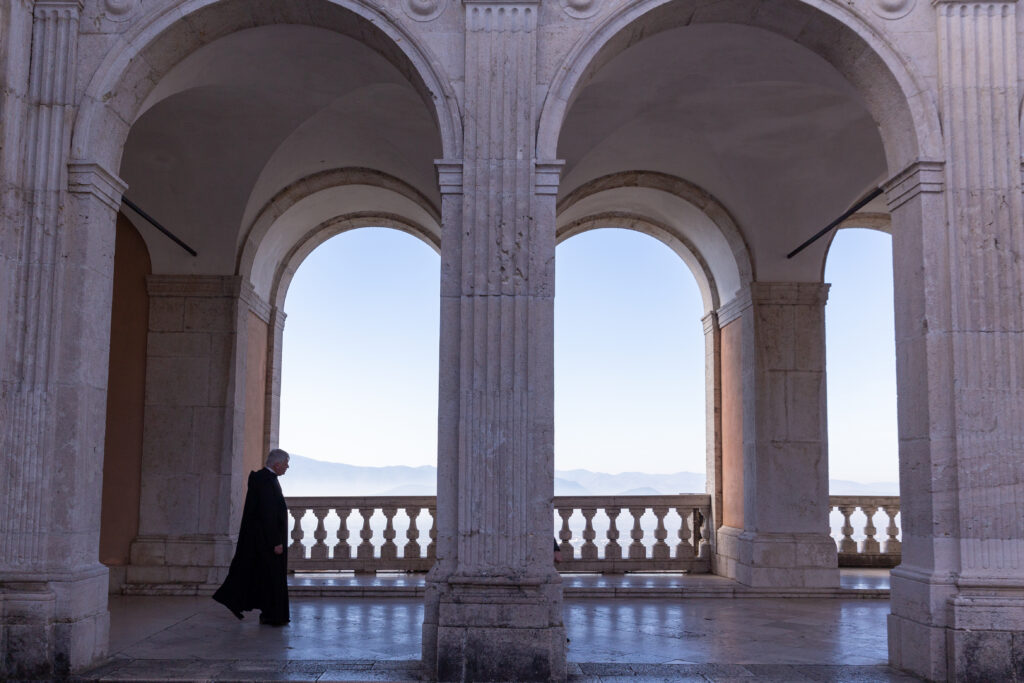
<figure><img src="https://publisher-ncreg.s3.us-east-2.amazonaws.com/pb-ncregister/swp/hv9hms/media/20240214200220_6d4d74df35afa0241dd277915cd12dac15da8785c2b17293c301336b25495a29.jpg" data-media-id="editor_0" data-image-id="20240214200220_6d4d74df35afa0241dd277915cd12dac15da8785c2b17293c301336b25495a29" data-rendition-name="original" width="4695" height="3130" loading="lazy" alt="Monte Cassino abbot"/><figcaption>Dom Antonio Luca Fallica, abbot of Monte Cassino, walks through the courtyard.<span>(Photo: Bénédicte Cedergren)</span></figcaption></figure>
<p> <!-- EMBED END Image {id: "editor_0"} --> </p>
<p>Because of the jealousy of a local priest, the abbot explained, St. Benedict decided to leave Subiaco — where he had already founded 12 communities — with a group of disciples, arriving at Monte Cassino around the year 529. </p>
<p>Following the destruction of the Roman acropolis and pagan temples dedicated to Apollo he found on the mount, St. Benedict undertook the construction of various oratories. “The first oratory, which became the community’s place of prayer, he dedicated to St. Martin,” Dom Antonio noted, “and on the highest point of the mountain, where now stands the great cathedral-basilica, he built an oratory dedicated to St. John the Baptist.”</p>
<p>It was here, in this very first monastery of the order, that the saint wrote down his renowned <a href="https://osb.org/our-roots/the-rule/">rule</a>, shaping a monastic life centered around prayer, work, studies and hospitality. While it was at first only observed at the Abbey of Monte Cassino, the rule quickly spread across Europe.</p>
<p>“Thanks to the work of Charles the Great during the Carolingian epoch, the Benedictine rule started to diffuse and eventually became the unique rule for occidental monasticism,” Dom Antonio explained. “From that moment on, the Benedictine monasticism born here at Monte Cassino became important not only because it unified the monastic experience during the reign of Charles the Great, but because it also did so during the following epochs.” </p>
<p><b> </b></p>
<h3><b>Preserving a Cultural Heritage</b></h3>
<p>“The ecclesial and political influence of the abbey peaked in the 11th century,” Dom Antonio explained, “under the time of the great Abbot Desiderius, who later became Pope Victor III.” Not only did Desiderius rebuild the abbey that had been destroyed by the Saracens two centuries earlier, and reestablish monastic discipline that had eroded over time, but he also saw to it that the monastery library became one of the most extensive in Europe, by having the monks collect and translate manuscripts from all cultures, nations and times into Latin.</p>
<p> <!-- EMBED START Image {id: "editor_2"} --> </p>
<figure><img src="https://publisher-ncreg.s3.us-east-2.amazonaws.com/pb-ncregister/swp/hv9hms/media/20240215060248_d13d3ecd72266a32512c80ba04cd7695c7a477bd6f124355d757954500db3710.jpg" data-media-id="editor_2" data-image-id="20240215060248_d13d3ecd72266a32512c80ba04cd7695c7a477bd6f124355d757954500db3710" data-rendition-name="original" width="2733" height="2480" loading="lazy" alt="The Abbey of Monte Cassino after the Battle of Monte Cassino in 1944"/><figcaption>The Abbey of Monte Cassino after the Battle of Monte Cassino in 1944<span>(Photo: Wikimedia Commons )</span></figcaption></figure>
<p> <!-- EMBED END Image {id: "editor_2"} --> </p>
<p>However, the preservation of the many literary and cultural treasures of the abbey proved to be no easy feat. Throughout the centuries, the abbey suffered several serious destructions, including from attacks by the Lombards in 570, by the Saracens in 883 and by an earthquake in 1349. The most notable destruction however, happened on Feb. 15, 1944, when the monastery was bombed by the Allies during the <a href="https://www.britannica.com/topic/Battle-of-Monte-Cassino">Battle of Monte Cassino</a> during the Second World War.</p>
<p> <!-- EMBED START Image {id: "editor_4"} --> </p>
<figure><img src="https://publisher-ncreg.s3.us-east-2.amazonaws.com/pb-ncregister/swp/hv9hms/media/20240214200232_2a1179bb2fd5af5cea129e0410432d96cbc96a14eb0a9f2331186e1d8194ca8e.jpg" data-media-id="editor_4" data-image-id="20240214200232_2a1179bb2fd5af5cea129e0410432d96cbc96a14eb0a9f2331186e1d8194ca8e" data-rendition-name="original" width="1200" height="810" loading="lazy" alt="Monte Cassino abbey 1944"/><figcaption>Polish soldiers inside the ruined Monte Cassino abbey monastery in 1944<span>(Photo: Public domain)</span></figcaption></figure>
<p> <!-- EMBED END Image {id: "editor_4"} --> </p>
<p>“The area where the monks lived, which was the oldest part of the monastery where the cell of St. Benedict was located, was saved from the destruction,” the abbot of Monte Cassino underlined, “and so neither the monks nor the civilians who took refuge there died.”</p>
<p>“Also the burial place of <a href="https://ewtn.co.uk/article-st-scholastica/">St. Benedict and St. Scholastica</a> was somehow miraculously saved,” he added, “because a grenade that fell there did not explode.”</p>
<p> <!-- EMBED START Image {id: "editor_6"} --> </p>
<figure><img src="https://publisher-ncreg.s3.us-east-2.amazonaws.com/pb-ncregister/swp/hv9hms/media/20240214200220_47e43fe3563ff151af2e55f2f65ebe9a2dc55194ea7cd87fe3df61cc47e4af7a.jpg" data-media-id="editor_6" data-image-id="20240214200220_47e43fe3563ff151af2e55f2f65ebe9a2dc55194ea7cd87fe3df61cc47e4af7a" data-rendition-name="original" width="5386" height="3591" loading="lazy" alt="Tomb of Sts. Benedict and Scholastica"/><figcaption>Tomb of Sts. Benedict and Scholastica behind the main altar of the cathedral-basilica<span>(Photo: Bénédicte Cedergren)</span></figcaption></figure>
<p> <!-- EMBED END Image {id: "editor_6"} --> </p>
<p>Although no monks or civilians hiding in the monastery’s older part died, Dom Antonio recalled that hundreds of civilians died in the Battle of Monte Cassino. In addition to the loss of life, the almost complete destruction of the abbey caused a “great emotional impact” because of its significant symbolic value — not only for the monastery itself, but for the entire Benedictine Order and the Church far beyond the borders of Italy.</p>
<p>“Also, the destruction of the abbey entailed a destruction of a cultural heritage,” the abbot noted. “Many artworks, such as the original frescoes in the church, were inevitably lost.”</p>
<p>Luckily, “the literary material kept in the archives, the manuscripts, the library and some of the artistic treasures of the abbey were saved, thanks to the work and efforts of German priests,” who transferred the priceless artifacts to Rome as the war approached the abbey.</p>
<p>In addition, the most precious objects from Italy’s National Museum and the San Martino Museum in Naples, from the convent of Montevergine, and from the Keats-Shelley house in Rome, which had all been sent early in the war to the Benedictine abbey for safety by Italian authorities, were transferred to the Roman capital together with the abbey’s own literary treasures.</p>
<p><b> </b></p>
<h3><b>St. Benedict as ‘Promoter of Unity’</b></h3>
<p>“The monastery was rebuilt faithfully to its original design” after the war, Dom Antonio pointed out. During this reconstruction period, the abbey library was temporarily sheltered at the now-dissolved Pontifical Abbey of St. Jerome-in-the-City in Rome.</p>
<p>“In October 1964, Pope St. Paul VI came to reconsecrate the cathedral-basilica,” the abbot recalled, “and on this occasion, with the bull <a href="https://www.vatican.va/content/paul-vi/la/apost_letters/documents/hf_p-vi_apl_19641024_pacis-nuntius.html"><i>Pacis Nuntius</i></a>, he proclaimed St. Benedict the main patron saint of Europe.”</p>
<p> <!-- EMBED START Image {id: "editor_8"} --> </p>
<figure><img src="https://publisher-ncreg.s3.us-east-2.amazonaws.com/pb-ncregister/swp/hv9hms/media/20240214200224_cd9b2cc656dcd4d90a5f33e57212ce8d2d908547f36bda36a9c2599055198458.jpg" data-media-id="editor_8" data-image-id="20240214200224_cd9b2cc656dcd4d90a5f33e57212ce8d2d908547f36bda36a9c2599055198458" data-rendition-name="original" width="5472" height="3648" loading="lazy" alt="Cathedral Basilica of the Abbey of Monte Cassino"/><figcaption>Interior of the cathedral-basilica at the abbey<span>(Photo: Bénédicte Cedergren)</span></figcaption></figure>
<p> <!-- EMBED END Image {id: "editor_8"} --> </p>
<p>Describing the saint as <i>unitatis effector</i> — a “promoter of unity” — Pope Paul VI asserted that “not without reason, then, did Pope Pius XII call St. Benedict the ‘Father of Europe,’” for he inspired the peoples of this continent with the love of order which is the foundation of true society.”</p>
<p>“St. Benedict is important because he was truly a point of connection between Eastern monasticism and what was to become Western monasticism,” the abbot said. </p>
<p> <!-- EMBED START Image {id: "editor_9"} --> </p>
<figure><img src="https://publisher-ncreg.s3.us-east-2.amazonaws.com/pb-ncregister/swp/hv9hms/media/20240214200220_4307315596b0bce6a2761d3ff715b8a0ee2ec85204b4e86ffeebc084679737e1.jpg" data-media-id="editor_9" data-image-id="20240214200220_4307315596b0bce6a2761d3ff715b8a0ee2ec85204b4e86ffeebc084679737e1" data-rendition-name="original" width="1920" height="1280" loading="lazy" alt="Fresco depicting St. Benedict"/><figcaption>Fresco depicting St. Benedict<span>(Photo: Bénédicte Cedergren)</span></figcaption></figure>
<p> <!-- EMBED END Image {id: "editor_9"} --> </p>
<p>Noting that St. Benedict — who lived before <a href="https://www.ewtn.com/catholicism/library/great-schism-that-divided-east-and-west-10794">the Great Schism</a> — makes reference to both Western and Eastern Church Fathers in his rule, such as St. Basil, the father of communal monasticism in Eastern Christianity, the abbot emphasized Benedict’s ecumenical role today.</p>
<p>In fact, Dom Antonio said, St. Benedict’s model for the monastic life could be considered as “a dialogue and encounter not only between Western and Eastern monasticsm but between the Latin and Eastern Church.”</p>
<p> </p>
<h3><b>‘Cut Down, It Grows Anew’</b></h3>
<p>Another legacy of the saint is his emphasis on living an integrated life.</p>
<p>“St. Benedict is known for the famous motto <i>Ora et Labora</i> [‘Pray and Work’], the abbot reiterated, “but beyond the verbs, I believe that it is the <i>et</i> that connects them that is the most important.” </p>
<p>Explaining that “St. Benedict testifies to the importance of a unified, harmonic life,” Dom Antonio added that “it isn’t for no reason that the Benedictine motto is <i>pax</i> (peace) and that Benedict was described as a ‘messenger of peace<i>’</i> in the bull <i>Pacis Nuntius</i>.” </p>
<p>The abbot of Monte Cassino also pointed out that “St. Benedict also suggested that we can all be signs or instruments of peace, provided that we are first able to find an inner peace or harmony within ourselves.” </p>
<p>Looking back at the multiple destructions that the abbey has suffered throughout the centuries, in particular during the Second World War, the abbot emphasized that “out of all these destructions, monasticism has always been reborn at Monte Cassino.” </p>
<p>Indeed, despite the challenges faced by the abbey in its history, Benedictine monasticism has seemingly always persevered. After the reconstruction of the Abbey of Monte Cassino and the papal reconsecration of its cathedral, Dom Antonio shared, “life resumed” at the abbey: Today, it is the humble home of eight Benedictine monks who continue to live a quiet life of prayer, work and study, faithfully observing the rule written by St. Benedict in the abbey 1,500 years earlier.</p>
<p> <!-- EMBED START Image {id: "editor_11"} --> </p>
<figure><img src="https://publisher-ncreg.s3.us-east-2.amazonaws.com/pb-ncregister/swp/hv9hms/media/20240214200224_2de057800b1f62b7aeb3cac91b861be0295337e03f998e4bd5f7bad25c2c4949.jpg" data-media-id="editor_11" data-image-id="20240214200224_2de057800b1f62b7aeb3cac91b861be0295337e03f998e4bd5f7bad25c2c4949" data-rendition-name="original" width="5386" height="3591" loading="lazy" alt="Abbey of Monte Cassino"/><figcaption>Abbey of Monte Cassino<span>(Photo: Bénédicte Cedergren)</span></figcaption></figure>
<p> <!-- EMBED END Image {id: "editor_11"} --> </p>
<p>“After all,” the 193rd successor of St. Benedict added, “the motto of the Abbey of Monte Cassino is <i>Succisa Virescit</i>, meaning, ‘cut down, it grows anew.”’</p>
<p>While commemorating the 80th anniversary of its destruction during the Second World War on Feb. 15, the Benedictine abbey also joyfully anticipates the celebration of the 60th anniversary of the proclamation of its founder as the principal patron saint of Europe.</p>
<p>“We would like to celebrate this 60th anniversary well, since it truly indicates a rebirth,” the abbot stressed. “We will get to look back at the destruction, but also at the new life that has emerged from it.”</p>
</p></div>
<p><br />
<br /><a href="https://www.ncregister.com/features/benedictine-abbey-of-monte-cassino-in-italy">Source link </a></p>
<p><!-- END THEIA POST SLIDER --></p>

The Legacy of the First Benedictine Monastery| National Catholic Register