<p><!-- BEGIN THEIA POST SLIDER --></p>
<p> <br />
</p>
<div>
<p>COMMENTARY: Sixty years later, the Church continues to give thanks for the fruits of ‘Nostra Aetate’ while cultivating a fervent hope in its future promise.</p>
</p></div>
<div>
<p>On an unseasonably warm New Year’s Day in Bergzabern, Germany, a bright young philosopher of Jewish heritage rejects atheism and professes her faith in Christ at St. Martin’s Church. She receives the waters of baptism and — in her words — “returns to God” and “becomes Jewish again.”</p>
<p>The year is 1922, and her name is Edith Stein. She is now known as St. Teresa Benedicta of the Cross. </p>
<p>On Dec. 8, 1939, a Franciscan friar is released after three months of being shuffled from one Nazi prison to another. He returns to his monastery in Niepokalanów, Poland, to find it bombed and in shambles. So he converts it into a shelter for war refugees, including 2,000 Jews fleeing Nazi persecution. Within two years, the friar is thrown back into detention and ends up confined to an underground starvation bunker, voluntarily taking the place of a husband and father who had begged the SS to spare his life.</p>
<p>The year is 1941. His name is Raymond, and he is better known as St. Maximilian Maria Kolbe.</p>
<p>In a torrential downpour on the Sabbath, Gestapo forces burst into the Jewish Quarter of Rome and round up more than 1,000 Jews for deportation to Auschwitz. The Vicar of Christ immediately orders every religious house in the city to open its doors and provide sanctuary to Jews fleeing deportation. The meticulously coordinated effort contributes to the rescue of more than 4,000 Jews, some of whom used the Pope’s own bed to give birth while in hiding.</p>
<p>His name is Eugenio Pacelli, better known as Venerable Pius XII. </p>
<p>Dramatic as these stories are, they barely scratch the surface of the deeply interconnected history of Catholics and Jews in the 20th century — a history leading to a concerted effort to understand one another religiously, culturally and theologically.</p>
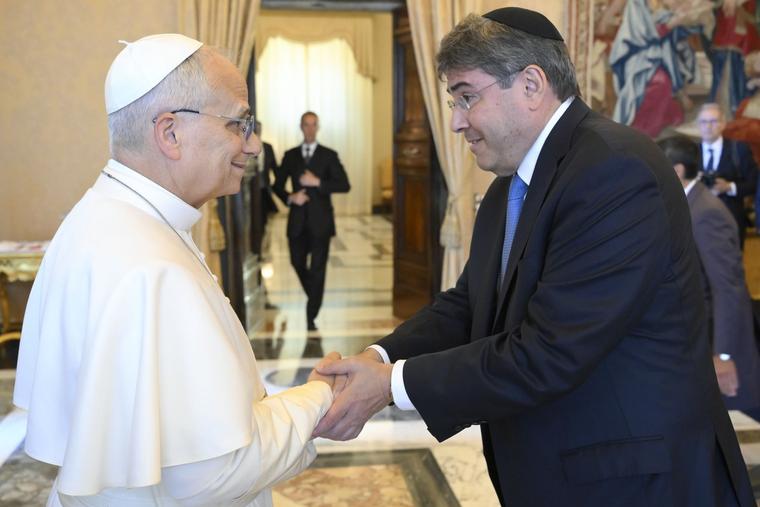
<p>That effort took a decisive turn in a meeting between Pope John XXIII and Jewish historian Jules Isaac on June 13, 1960. The two spoke for only half an hour, but that was enough time for the aging French academic to tell the Pope about the horrible deaths of his wife, daughter and son-in-law in Auschwitz. That unfathomable loss drove Isaac to search out the roots of antisemitism in Europe, tracing some of them back to certain strains of Christian theology that portrayed the Jews as perfidious murderers personally responsible for the death of Jesus Christ.</p>
<p>Such theology had a direct impact on the city where I now live. The Royal Charter establishing the colony of Georgia granted religious freedom to all settlers except Catholics. The charter opened the door to 41 Jews aboard the <i>William and Sarah </i>who had fled the Portuguese Inquisition and arrived in Savannah in 1733. The religious freedom afforded them meant that they no longer had to live as “crypto-Jews,” pretending to be Catholic by day and worshiping as Jews by night. After the American Revolution opened religious freedom to all citizens, Catholics settled in Savannah as well, leading to a long history of peaceful coexistence and civic collaboration between Catholics and Jews in the city.</p>
<p>After his pivotal conversation with Jules Isaac, John XXIII — <i>il papa buono </i>(the “good pope”), who himself had protected Jews from deportation during his tenure as papal representative in Turkey — took immediate action and directed Cardinal Augustin Bea to draft a text oriented toward healing the painful division between Catholics and Jews. On the conciliar floor, that text became the kernel of the Declaration on the Relation of the Church to Non-Christian Religions, commonly known as <a href="https://www.vatican.va/archive/hist_councils/ii_vatican_council/documents/vat-ii_decl_19651028_nostra-aetate_en.html"><i>Nostra Aetate</i></a><i> </i>(1965).</p>
<p>“The Church,” we read in the declaration, “cannot forget that she received the revelation of the Old Testament through the people with whom God in His inexpressible mercy concluded the Ancient Covenant. Nor can she forget that she draws sustenance from the root of that well-cultivated olive tree onto which have been grafted the wild shoots, the Gentiles. Indeed, the Church believes that by His cross Christ, Our Peace, reconciled Jews and Gentiles, making both one in Himself” (4).</p>
<p>Every time I walk past the synagogue of Congregation Mickve Israel on my way to Mass at the Cathedral Basilica of St. John the Baptist in downtown Savannah, the intertwined history of Jews and Catholics floods my mind. I can’t help but recall the teaching of <i>Nostra Aetate </i>that “the Jews should not be presented as rejected or accursed by God, as if this followed from the Holy Scriptures” — rather, the Church is “mindful of the patrimony she shares with the Jews” and, moved “by the Gospel’s spiritual love, decries hatred, persecutions, displays of anti-Semitism, directed against Jews at any time and by anyone” (4). </p>
<p>And yet the work is not over, which makes the recent <a href="https://www.vatican.va/roman_curia/congregations/cfaith/documents/rc_ddf_doc_20260916_nota-cammino-speranza_en.html">joint note</a> of three Roman dicasteries titled “A Journey of Hope: Sixty Years of Interreligious Dialogue and Fraternity in the Light of the Conciliar Declaration <i>Nostra Aetate</i>” all the more opportune. </p>
<p>“Jewish-Christian dialogue,” we read, “cannot be regarded as a secondary activity for Christians, aimed only at gaining a better understanding of Judaism, fostering diplomatic relations, or even simply cultivating friendship with the Jewish people. Rather, it is a matter of becoming fully aware of one’s own original identity. God’s covenant with the Jewish people is irrevocable, and this continually challenges the Church. … The more Christians come to know and love the Jewish roots of their own tradition, the better they understand themselves in the practice of faith, and the stronger their religious identity becomes.”</p>
<p>The note could not be clearer: this does not mean there are two parallel paths to salvation, nor that the fullness of truth is not found in Christ. “The Church,” the document insists, “teaches that Christ is the one and only Redeemer” (13). </p>
<p>Some things issued by the Roman Curia deserve a closer reading than others. “A Journey of Hope” deserves not only a close reading but an even closer rereading. It represents an ambitious endeavor to synthesize whence we have come and whither we are going in Christian-Jewish dialogue. It is a golden opportunity to take stock of a contentious history while giving thanks for the fruits of this dialogue and cultivating a fervent hope in its future promise.</p>
</p></div>
<p><br />
<br /><a href="https://www.ncregister.com/commentaries/gallagher-nostra-aetate">Source link </a></p>
<p><!-- END THEIA POST SLIDER --></p>

The Long Life of Vatican II’s Shortest Document| National Catholic Register