


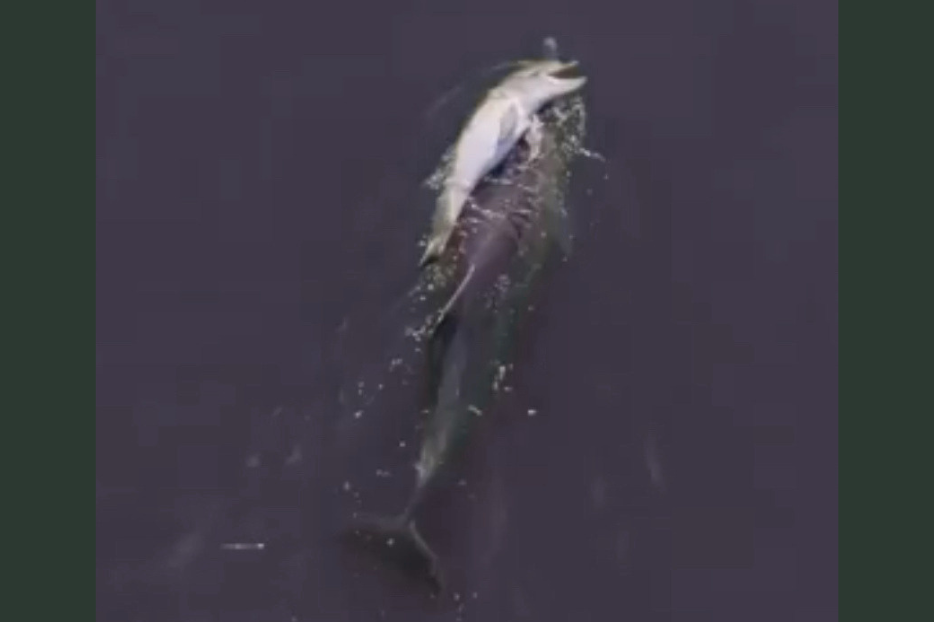
Fraggle’s refusal to abandon her calf hits an intimate, familiar nerve.
A poignant video circulating online has captured a deeply moving display of grief in the wild, showing a mother dolphin in Western Australia refusing to let go of her deceased two-week-old calf.
The footage, captured by drone by the conservation organization Geographe Marine Research, shows the mother dolphin — known to local researchers as Fraggle — swimming through the Leschenault Estuary near Bunbury.
Fraggle was recorded balance-carrying her calf across her back and near her rostrum or beak, keeping her baby lifted near the surface as she moved through the water.
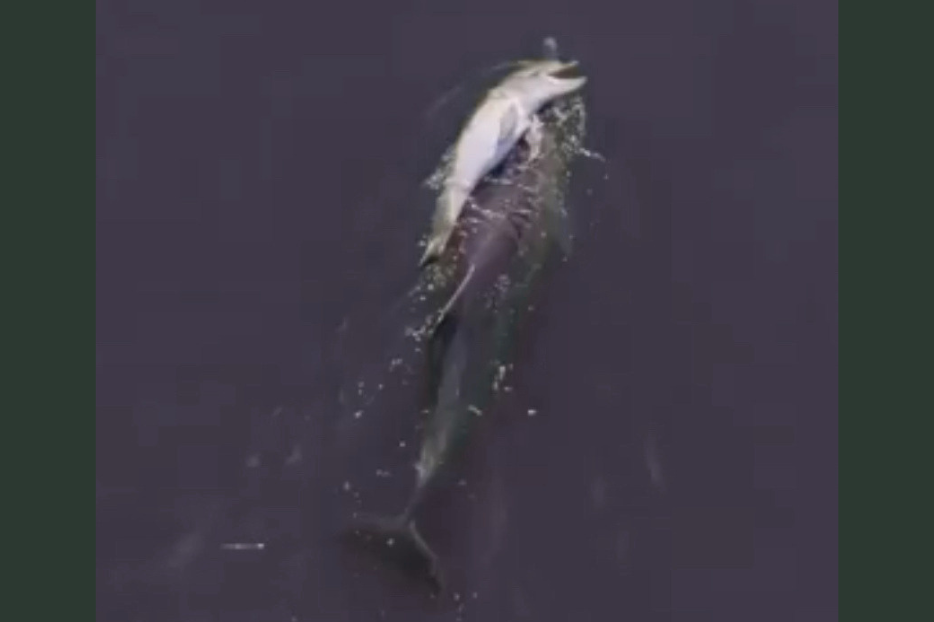
Adding to the emotional weight of the scene, researchers revealed that this marks Fraggle’s fifth consecutive calf loss.
A Winter Loss
Researchers monitoring the local pod had been keeping a close eye on the calf since its birth two weeks prior. Baby dolphins born during the Southern Hemisphere’s winter face severely reduced survival rates due to harsh water temperatures and cold air, which can lead to respiratory illnesses like pneumonia.
Researchers were “[w]itnessing a high respiratory rate in the calf recently,” and “sadly we knew this day was coming,” explained an Instagram post from the organization. Despite hopes that the newborn would defy the odds, the young calf ultimately succumbed to illness.
In a show of complex social support, other members of Fraggle’s pod were seen swimming closely alongside her throughout the ordeal, keeping pace as if offering quiet solidarity.
Understanding ‘Post-Mortem Attentive Behavior’
While painful to watch, marine scientists explain that Fraggle’s refusal to leave her calf is a recognized response documented in marine mammals, formally referred to in marine biology as “post-mortem attentive behavior.”
Dolphins share remarkably strong mother-calf bonds and possess highly developed emotional centers in their brains. When a calf dies, mothers often carry, nudge or push the body toward the surface for days, a behavior scientists interpret as a ritual of grief or an instinctual attempt to help an unresponsive offspring breathe.
However, carrying a body is physically grueling for the mother, disrupting her own hydrodynamic shape and preventing her from hunting for food.
“Dolphins will carry their deceased calves during a period of mourning which can last for many days,” Geographe Marine Research stated. “[A]t some stage she must let go and feed to survive [—] that day is near.”
A Universal Expression of Grief
The viral video has touched millions of viewers worldwide, sparking a wave of sympathy online and serving as a stark reminder of the deep emotional capacity found in the natural world.
To human observers, Fraggle’s refusal to abandon her calf hits an intimate, familiar nerve: It reflects the profound bond mothers have with their babies and the universal instinct to hold on to those we love at all costs.
Scientists note that because dolphins possess complex brain structures associated with self-awareness and social bonding, their mourning rituals share a striking emotional lineage with human grief. For mothers who have lost children, those wounds leave deep scars that may never fully heal. And for women who have suffered the loss of a baby through miscarriage, there is no child left to hold or carry — only the heavy waves of despair.
Fraggle’s story highlights not only the delicate nature of estuary marine life, but a far more universal truth: The instinct to love, mourn and protect a child is a bond that connects all of God’s creation.