


Zacchaeus, Childhood Wonder and the Tree That Leads Us to the Cross
In St. Luke’s Gospel, Zacchaeus climbs a tree in order to see Christ above the crowd (Luke 19:1-10). It is an unexpected image: a wealthy official perched among the branches like a curious boy. Yet from that unlikely vantage point, Zacchaeus not only sees the Lord — he is seen in return.
The passage notes that the tree was a sycamore, a common roadside tree. The detail is fitting: conversion often begins not in grand gestures but in the humble willingness to rise above the crowd in order to see Christ.
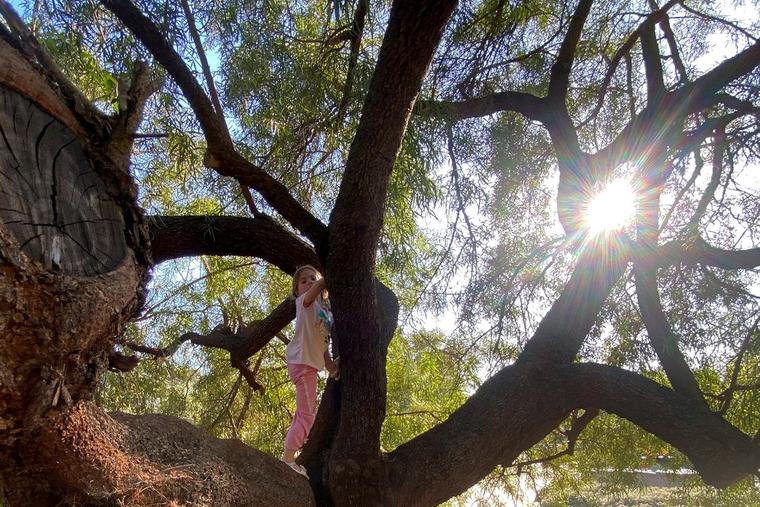
The nearly forgotten art of climbing a tree — once a common experience of childhood — offers a quiet lesson about wonder, humility and the clearer vision we are called to seek.
For generations, climbing trees belonged to the ordinary grammar of childhood. A child looked upward, studied the trunk and branches, and began to climb. At first the movement was tentative — testing bark, shifting weight, discovering which limbs could bear the body’s balance. Gradually the child learned the language of the tree.
But this seems to be a lost experience in modern childhood. Concern for safety, combined with the pull of digital entertainment, has replaced much of the unstructured outdoor exploration that once defined childhood afternoons. Yet educators increasingly recognize what earlier generations assumed: children benefit from exploration, physical engagement with the world, and even a measure of manageable risk.
Climbing a tree demands exactly this kind of engagement. Unlike playground structures designed for predictability, every tree presents a unique architecture. Branches fork irregularly. Each movement requires judgment. Where should my next step go? Will that limb support me?
These questions are not theoretical. They are answered through experience — a particularly human experience.
Romano Guardini reflected on this dimension of human experience in his classic work, The Spirit of the Liturgy. Human beings, he observed, often encounter reality through play before understanding it intellectually.
Reflecting on his own childhood decades later, a certain Guardini disciple, Joseph Ratzinger, recalled in Milestones: Memoirs, 1927–1977 how encounters with the natural world awaken a sense of wonder that precedes analysis. The world first appears not as something we construct but as a gift that invites contemplation.
Such experiences linger in memory because a tree is more than an object in the landscape. For a child it becomes a place of discovery — a first glimpse of the world from above the ordinary horizon.
In the Gospel account, Zacchaeus climbs a tree for a different reason: not to explore the world, but simply to see Christ. And note that in that same chapter of Luke is Jesus’ entry into Jerusalem. We are here moving toward the heart of the Christian faith, where yet another tree stands in wait — the Cross.
Scripture is bookended by tree imagery: from the Tree of Life in Genesis (2:9) to the tree whose leaves bring healing to the nations in Revelation (22:2). Between these two images, of course, stands the tree of Calvary.
Early Christian writers frequently referred to the Cross itself as a tree, sometimes calling it the lignum vitae, the “Tree of Life.” The Fathers spoke of salvation coming through the wood of the Cross, just as the fall had once come through the wood of a tree in Eden. They described the Cross as the new Tree of Life planted in the earth at Calvary, whose fruit restores what was lost through the tree in Eden.
The Church’s liturgy also preserves this ancient imagery, as in the hymn Crux fidelis, traditionally attributed to St. Venantius Fortunatus, praising the Cross as “the one noble tree among all others.”
St. Bonaventure reflected deeply on this symbolism in his devotional work The Tree of Life. There he describes the life of Christ as branches extending from the Cross — a living tree rooted in sacrifice and bearing fruit for the life of the world.
Seen in this light, the child climbing a tree encounters an echo of a deeper truth. Trees lift us upward while remaining rooted in the earth. Halfway up the trunk, gripping a branch and looking out through the leaves, a child experiences something modern life often obscures: wonder before the created world.
Such imagery evokes the insight of G. K. Chesterton: “The world will never starve for want of wonders; but only for want of wonder.”
A child in a tree requires little entertainment. The movement of leaves, the play of sunlight and the quiet height above the ground are enough. The world suddenly appears larger than before. And a child’s love of wonder is something we might cherish and even try to recapture when our world demands routine.
And so the story of Zacchaeus offers a quiet invitation. Our lives are crowded with noise, urgency and distraction. That was the atmosphere Zacchaeus found himself in. So he climbed a tree.
While we look to the Cross — that other tree on which our salvation was won — the Church invites us to seek the same clarity of vision Zacchaeus sought.
Sometimes the path to conversion begins simply with the desire to see.