<p><!-- BEGIN THEIA POST SLIDER --></p>
<p> <br />
</p>
<div>
<p><span style="font-weight: 400;">Life-threatening health emergencies can happen at any moment. While you should always call 911 and summon professional medical attention for a victim, oftentimes time is of the essence, and paramedics are minutes (or much longer) away. If the person is going to live, they can’t wait for a medic to get to them. They need help now. </span></p>
<p><span style="font-weight: 400;">That’s where you — a family member, friend, or random bystander-on-the-scene — come in. If someone close to you was stricken with a life-threatening emergency, would you be prepared to be the </span><i><span style="font-weight: 400;">first </span></i><span style="font-weight: 400;">first responder?</span></p>
<p><span style="font-weight: 400;">I talked to ICU nurse (and <a href="https://strenuouslife.co/">Strenuous Life</a> member) Jared Shears about the basic lifesaving skills every man should know. While all of these can be performed by laypeople, Jared highly recommends taking an in-person first aid course so you can actually do some hands-on practice. Check with your local Red Cross for times and locations for these classes. </span></p>
<h3><b>How to Perform CPR</b></h3>
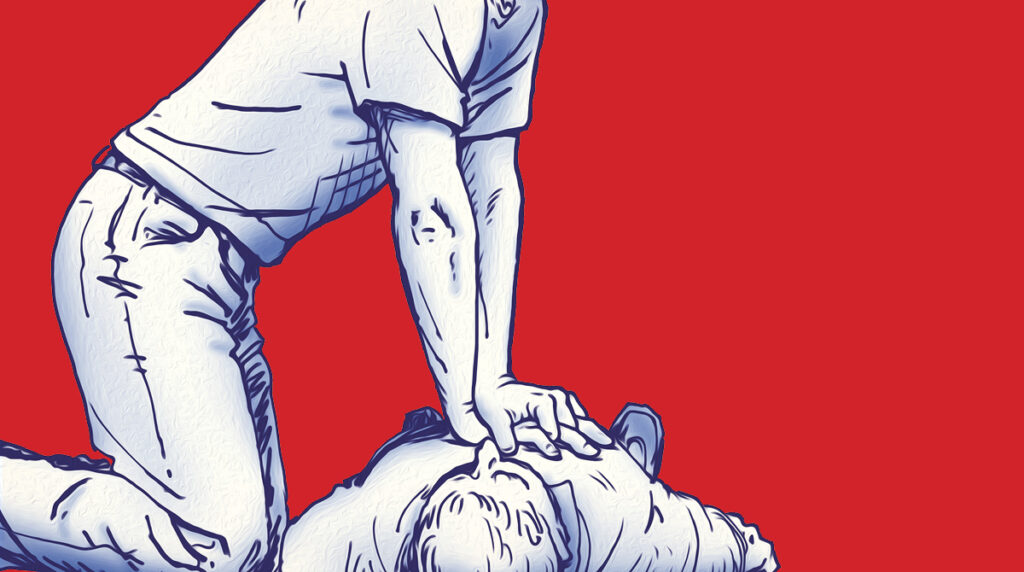
<p><span style="font-weight: 400;">If someone is unresponsive, doesn’t have a pulse, and isn’t breathing, they’ve likely gone into cardiac arrest. To prolong their life until an AED (see below) or advanced medical care is available, you’ll need to perform hands-only CPR (the American Heart Association recommends that untrained bystanders who see someone collapse do only the chest compression part of CPR, sans the mouth-to-mouth part).</span></p>
<p><span style="font-weight: 400;">In </span><a href="https://www.artofmanliness.com/articles/heart-attack-symptoms-what-to-do-cpr-aed/"><span style="font-weight: 400;">our in-depth article on how to recognize and treat a heart attack</span></a><span style="font-weight: 400;">, paramedic Charles Patterson strongly recommends that everyone take in-person CPR training: </span></p>
<blockquote>
<p><span style="font-weight: 400;">Having hands-on training to help you understand the mechanics of CPR and feeling the appropriate rate and depth of compressions is extremely beneficial and cannot be matched by simply watching a video or reading instructions online. Being able to go through the steps of CPR on a dummy will help you build confidence and remain calm in the event of an emergency.</span></p>
</blockquote>
<h3>How to Use an AED</h3>
<p><span style="font-weight: 400;">In a cardiac arrest emergency, hands-only CPR is performed to prolong life until a shock from an AED is given or an EMT arrives. As soon as an AED is available, use it.</span></p>
<p><span style="font-weight: 400;">AED stands for Automated External Defibrillator, and it gives the heart a shock to get it going again. </span></p>
<p><span style="font-weight: 400;">AEDs are located in most public places like stores, offices, and gyms. While most AEDs provide automated voice instructions when you turn them on, as with CPR, Charles recommends getting in-person training from the Red Cross or the American Heart Association so you can go through the steps manually and know what it feels like to use this device.</span></p>
<h3>How to Perform the Heimlich Maneuver</h3>
<p><span style="font-weight: 400;">Choking is the fourth leading cause of death by unintentional injury. Thankfully, with a bit of know-how, choking deaths can be prevented. Enter the Heimlich maneuver. </span></p>
<p><span style="font-weight: 400;">Before you perform the Heimlich maneuver, the Red Cross recommends first leaning the person over your arm (put one of your arms under one of theirs and across their chest) and giving them five hard blows on the back with your other arm. Often the item becomes dislodged with just these back slaps. But if that doesn’t work, then initiate the abdominal thrusts dictated by the Heimlich maneuver. </span></p>
<p><span style="font-weight: 400;">Be sure to go through our in-depth guide on </span><a href="https://www.artofmanliness.com/articles/how-to-perform-the-heimlich-maneuver-in-6-different-situations/"><span style="font-weight: 400;">how to perform the Heimlich maneuver in different circumstances</span></a><span style="font-weight: 400;">, including on pregnant women, obese people, babies, and even dogs. </span></p>
<h3>How to Use a Tourniquet</h3>
<p><span style="font-weight: 400;">A tourniquet is used to stop severe bleeding and prevent deaths caused by severe blood loss. For many decades, the tourniquet was seen as a measure of last resort because it was believed that completely stopping the blood flow to a limb would result in tissue or nerve damage. But studies out of the wars in Iraq and Afghanistan proved that the application of a tourniquet could save lives while having an extremely minimal chance of leading to nerve damage or limb amputation. As a result, many civilian EMTs and doctors recommend that tourniquets be applied more routinely in severe blood loss situations to prevent deaths. But it’s essential that you know how to use one properly.</span></p>
<p><span style="font-weight: 400;">For an in-depth guide on </span><a href="https://www.artofmanliness.com/articles/how-to-save-lives-like-an-army-medic-using-a-tourniquet-to-control-major-bleeding/"><span style="font-weight: 400;">how to use a tourniquet</span></a><span style="font-weight: 400;">, check out our article written by Iraq war veteran and Army medic Bruce A. West.</span></p>
<h3>How to Save Someone From Drowning</h3>
<p><span style="font-weight: 400;">The first step to saving someone from drowning is recognizing </span><a href="https://www.artofmanliness.com/articles/what-drowning-really-looks-like/"><span style="font-weight: 400;">what drowning actually looks like</span></a><span style="font-weight: 400;">. The signs can be much less dramatic and obvious than you think. </span></p>
<p><span style="font-weight: 400;">After you’ve established that a person is drowning, your initial response shouldn’t be to jump in the water and try to bring them ashore yourself. A person who’s drowning can be panicked, and clutch, kick, and grab at you as you try to rescue them, dragging you both underwater. So rather than jumping in yourself, extend a rope, oar, or stick to the victim from the shore or from a boat. If the victim is too far away for this course of action, and you can’t use a boat to get closer, then get in the water yourself, grab the drowning person from behind, and physically tow them to safety.</span></p>
<h3>How to Treat Major Burns</h3>
<p><span style="font-weight: 400;">While </span><a href="https://www.artofmanliness.com/articles/treat-minor-burn/"><span style="font-weight: 400;">minor burns can be treated and managed at home</span></a><span style="font-weight: 400;">, third-degree burns will require professional medical attention. However, the immediate care a burn victim receives before getting to the hospital can go a long way in mitigating the extent of the damage and reducing the chance of the burns being fatal.</span></p>
<p><span style="font-weight: 400;">Burn care varies according to the kind of burn it is (thermal, chemical, electrical, etc.), and, despite on-the-scene intervention being so crucial, most people are unaware of what it involves. Jared directed my attention to this comprehensive and detailed guide on </span><a href="https://www.ncbi.nlm.nih.gov/pmc/articles/PMC3038405/"><span style="font-weight: 400;">how to treat severe burns</span></a><span style="font-weight: 400;"> while you await the arrival of paramedics. Print it off and study it. </span></p>
<p><span style="font-weight: 400;">For help in remembering things like how to save a drowning person, how to recognize that someone is having a heart attack (or stroke), along with other lifesaving information, </span><a href="https://www.artofmanliness.com/articles/9-lifesaving-mnemonics/"><span style="font-weight: 400;">check out these nine mnemonics that are easy and essential to commit to memory</span></a><span style="font-weight: 400;">.</span></p>
<hr/>
<p><em>With our archives 4,000 articles deep, we’ve decided to republish a classic piece each Sunday to help our newer readers discover some of the best, evergreen gems from the past. This article was originally published in March 2021.</em></p>
</div>
<p><br />
<br /><a href="https://www.artofmanliness.com/health-fitness/health/6-lifesaving-skills-every-man-should-know/">Source link </a></p>
<p><!-- END THEIA POST SLIDER --></p>

6 Lifesaving Skills Every Man Should Know