


I’m calling it. The political debate over Flock is over. They lost.
They lost so quickly that it’s actually astonishing. To witness a company valued at over $8 billion become so politically toxic in both parties at such speed is a rarity, unless you’re guilty of an oil spill, poisoning dogs, or strangling babies.
Scratch that last one. Lindsay Clancy probably has a bigger political constituency than Flock at this point.
“The numbers are crazy. They’re worse than data centers,” one consultant told me. And it seems like they know it.
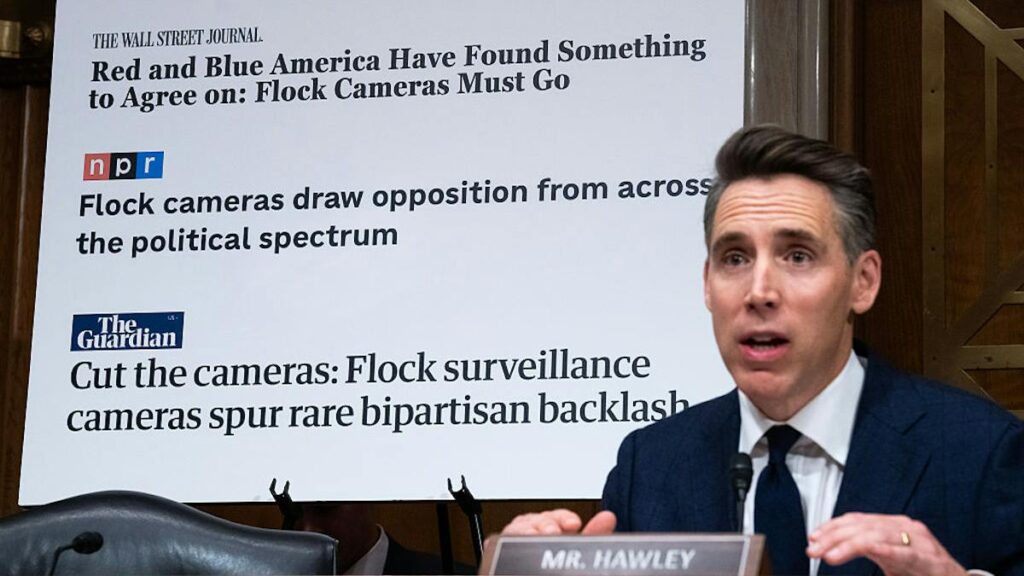
The decision by the CEOs of the mass surveillance cameras unit of our economy to no-show for the Senate hearing chaired by Sen. Josh Hawley (R-MO) and rDick Durbin — not exactly a common political alliance — was an act of surrender. Maybe the surveillance bros thought that if they didn’t show, the scene would get less attention. Instead, Fox News made the rare decision to run a huge chunk of a subcommittee hearing. That’s what you do when people are watching.
The big news today is that Flock is actively weighing a selloff, either to Motorola or Axon, as its public profile takes hit after hit — likely with the knowledge that more is coming. The number of states and cities taking down cameras and ending contracts is only accelerating. And then there’s the legal ramifications — add the five cops charged in Indiana yesterday to the pile for the future class action. “Were you stalked by Flock? Sign up here.”
It isn’t hard to see why. The testimony from those innocents wrongly targeted or identified through the use of Flock, thrown into jail in the middle of the night, is the stuff of nightmares right out of “Fargo”: “This is a problem, you understand, because for you to be right the state would have to be wrong. Is that what you’re saying? That the state is wrong?”
Lindsey Isaacs, driver wrongfully accused and jailed with Flock AI camera speaks about incident: “13 days in jail for a crash I had nothing to do with.” https://t.co/pVLUetMiEf
— CSPAN (@cspan) September 23, 2026
The hand-waving solutions Flock offers — changing a dropdown menu, shortening data retention times — aren’t going to satisfy any of these basic objections. It reads as dismissive, a series of tweaks to a product people just plain do not want.
The big mistake Flock seemed to make was assuming that their utility for law enforcement, and promises to greedy local officials eager for potential income, would win out over an American populace with a decidedly different attitude toward mass surveillance than citizens of other nations. The second mistake they made was recruiting a bunch of advocates who seem to think mass surveillance, the second you leave your house, is something Americans would accept. And the third was treating their critics as if they were a bunch of loud, dumb cranks who don’t know what’s good for them — something Flock CEO Garrett Langley did repeatedly.
Flock’s CEO mocks people showing up at council meetings, saying we should “trust that the system works.” Meanwhile, his “huge team whose entire job is going to city council meetings” went to “close to 10,000 city council meetings” just last year. https://t.co/5XbiFDvBqs
— Have I Been Flocked? (@HIBFlocked) August 25, 2026
What I’ve come to agree with is the notion of a horseshoe mentality, that it’s just a very very small number of people, incredibly small, that tend to be really loud.
I imagine you’ve never been to a city council meeting.
Interviewer: I never have.
And I imagine you never will, because generally, I hope you vote, you should vote, and then you trust that the system works, that the person you voted for as generally aligned views, and like they’re going to go do the hard work, because that’s what you elect them to do.
As a general rule, “trust the government, if you aren’t doing anything wrong, you have nothing to fear” hasn’t had much purchase in the American mindset — and in the post-Covid era, it has even less. The Left already doesn’t trust cops. And while the Right is generally pro-cop, they are extremely uncomfortable with the idea they’re being constantly watched.
The tolerance Americans have for being constantly watched is an odd thing. Your phone, your television, your car — they’re all listening to you pretty much all the time now. But that ubiquity makes many Americans more on edge about intrusions into their privacy, not less. Americans don’t actually want to live in a world where privacy is reserved for the few cubic centimeters in your skull.
After sacrificing so many of our liberties in recent years, that’s a heartening thing to see.