<p><!-- BEGIN THEIA POST SLIDER --></p>
<p> <br />
</p>
<div>
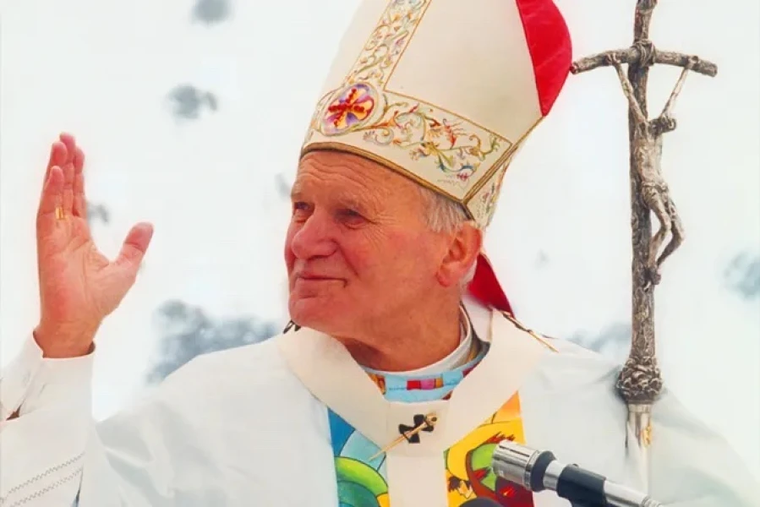
<p>The Polish pope, canonized by Francis in 2014, demonstrated throughout his life that faith and peaceful resistance could overcome seemingly immovable obstacles — even walls that divided nations.</p>
</p></div>
<div>
<p>As Germany marks the 35th anniversary of the Berlin Wall’s fall this year, key witnesses are highlighting the crucial role played by St. John Paul II in bringing about the peaceful revolution that transformed Europe.</p>
<p>“I am absolutely convinced that without Pope John Paul II, German reunification would not have been possible,” Martin Rothweiler, director of EWTN Germany, told CNA Deutsch, CNA’s German-language news partner.</p>
<p>Rothweiler was in Rome on the historic night of Nov. 9, 1989, when East German citizens began crossing freely through the Berlin Wall for the first time in nearly three decades.</p>
<p>“It seemed surreal,” Rothweiler recalled. “Watching people climb over the wall, seeing masses streaming from East to West Berlin — it was simply incredible. We had grown up accepting the division as unchangeable: the Eastern Bloc, the West, the Warsaw Pact on one side, NATO on the other. It all seemed set in concrete — literally.”</p>
<p>The late Cardinal Joachim Meisner of Cologne, who died in 2017 and was a close friend of John Paul II, offered similar testimony in a 2016 EWTN interview: “Without him, there would have been no Solidarity movement in Poland. I seriously doubt whether communism would have fallen without John Paul II. His contribution to communism’s collapse cannot be overestimated.”</p>
<h3><b>A pope’s Mission</b></h3>
<p>Even after becoming pope in 1978, John Paul II continued supporting opposition movements behind the Iron Curtain. After surviving an assassination attempt in 1981 — widely believed to have been orchestrated by Soviet-bloc security services — he decided to consecrate Russia to the Immaculate Heart of Mary, fulfilling a request made by Our Lady at Fátima.</p>
<p>Cardinal Stanisław Dziwisz, who served as John Paul II’s personal secretary for decades, emphasized the spiritual dimension of these historical events. In a 2016 interview with EWTN, he explained: “From the moment of that consecration, a process began that culminated in freedom for nations oppressed by communism and Marxism. Our Lady had both requested this consecration and promised that freedom would follow.”</p>
<p>“After this event, the world became different,” Dziwisz added. “Not only did the Iron Curtain fall, but also Marxism in the world, which was especially rooted in universities and circles worldwide.”</p>
<h3><b>Witness to History</b></h3>
<p>The impact of John Paul II’s role was acknowledged even by secular leaders. Former German Chancellor Helmut Kohl recalled a decisive moment during the Pope’s 1996 visit to reunified Berlin. Walking through the Brandenburg Gate — once a symbol of division — the Pope turned to Kohl and said: “Mr. Chancellor, this is a profound moment in my life. That I, a pope from Poland, stand here with you, the German chancellor, at the Brandenburg Gate — and the gate stands open, the wall is gone, Berlin and Germany are united, and Poland is free.”</p>
<p>Perhaps the most striking testimony came from an unexpected source: Mikhail Gorbachev, the last leader of the Soviet Union, who acknowledged that without John Paul II’s influence, the peaceful revolution of 1989 might never have occurred.</p>
<h3><b>Today’s Echoes</b></h3>
<p>The legacy of those events resonates today as Europe again faces conflict. On March 25, 2022, shortly after Russia invaded Ukraine, Pope Francis chose to renew John Paul II’s consecration of Russia to the Immaculate Heart of Mary.</p>
<p>“We have strayed from the path of peace,” Francis said during the ceremony at St. Peter’s Basilica. “We have forgotten the lessons of the last century’s tragedies and the sacrifice of millions who fell in the world wars.”</p>
<p>As war continues in Ukraine two years later, John Paul II’s example offers a reminder that transformative change often comes unexpectedly. The Polish pope, canonized by Francis in 2014, demonstrated throughout his life that faith and peaceful resistance could overcome seemingly immovable obstacles — even walls that divided nations.</p>
<h3><b>Historical Context</b></h3>
<p>The Berlin Wall stood from 1961 to 1989 as the most visible symbol of the Cold War division of Europe. The Communist East German regime called it the “Anti-Fascist Protection Rampart,” but for most of the world, it represented the Iron Curtain that Winston Churchill had warned about.</p>
<p>More than 100 people died trying to cross from East to West Berlin before the Berlin Wall came down in November 1989.</p>
<p>Rothweiler, who later brought EWTN to Germany in 2000, sees John Paul II’s influence continuing today through Catholic media. “His legacy reminds us that spiritual power can transform political realities,” he told CNA Deutsch.</p>
<p>“The fall of the Berlin Wall wasn’t just about politics — it was about the triumph of human dignity and faith over oppression.”</p>
<p><i>This story </i><a href="https://de.catholicnewsagency.com/news/17589/35-jahre-mauerfall-wie-johannes-paul-ii-dabei-half-deutschland-zu-vereinen" target="_blank" rel="noopener"><i>was first published </i></a><i>by CNA Deutsch, CNA’s German-language news partner. It has been translated and adapted by CNA.</i></p>
</p></div>
<p><br />
<br /><a href="https://www.ncregister.com/cna/how-st-john-paul-ii-helped-bring-down-the-berlin-wall-35-years-later">Source link </a></p>
<p><!-- END THEIA POST SLIDER --></p>

35 Years Later| National Catholic Register