


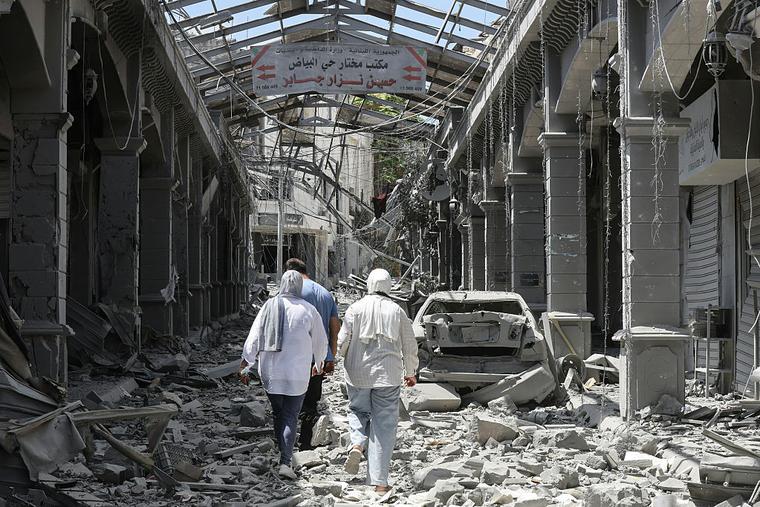
COMMENTARY: The consequences of this war will only be revealed over time, months and even years into the future.
Did America just lose a war to Iran in the Middle East? Or was it a great American victory whose full import will only be seen over time?
Partisans of Iran were quick to claim victory — but they always say this. Some supporters of Israel are furious and fear that the deal that supposedly ended the war will only strengthen the Iranian regime. Others compared the war to the 1956 Suez Crisis that humbled the might of colonial powers Britain and France.
Vice President JD Vance went on CBS News on June 15 to shoot down some of the more extravagant claims, such as that Iran will be rewarded with $300 billion in new funding. Vance noted that the agreement “ensures that Iran will never have a nuclear weapon, while simultaneously opening the Strait of Hormuz” to transport much-needed oil to the world. In the eventuality that Iran fulfills all of its commitments, it would eventually be rewarded. Vance touted this as an opportunity for the United States and Iran — bitter adversaries for nearly half a century — “to turn over a leaf of 47 years of a failed relationship.”
In our world of instant news and instant reaction, everyone’s a pundit and everyone is sure what this war’s outcome actually means. But, of course, the reality is that some of the consequences of this war, like so many others, will only be revealed over time, months and even years into the future. It is quite possible that both those celebrating and those “dooming” will be proven wrong and there is still much of the agreement, and any possible side deals, that are still opaque.
Some results should be immediate. Gas prices will decline and inflation fears will ease. The United States will be at peace for the 250th anniversary celebration of its founding. As analyst Jonathan Spyer explained, “Trump, caricatured before his presidency as a warmonger, is nothing of the kind. The place, very clearly, where he feels comfortable is where deals are made.”
Some wanted the president to double down on the conflict but that is not a path he wanted to pursue. It seems significant that in 1956, it was President Eisenhower who forced France and Britain (and Israel) to withdraw from Suez. In 2026, it was the American president who decided not to continue.
Despite the pundits, most Americans seemed to focus on almost anything other than Iran’s fate. For Iranians, Israelis, Lebanese and Gulf Arabs — in addition to those in the Global South paying for higher energy prices — the worrying impact hits much closer to home.
As America has the luxury to step back a bit and survey the scene, some big Middle Eastern questions loom.
What will become of Lebanon? Can ongoing negotiations between Israel, the Lebanese state and the United States rescue the country from constant cycles of war and destruction or will Hezbollah’s stranglehold remain?
This is not just an academic question. For some Lebanese Christians, the breaking of Hezbollah’s hold on power is a matter of life or death, of whether or not Christians in Lebanon persist and remain in their ancient lands.
The government of Israeli Prime Minister Benjamin Netanyahu is deeply skeptical, to put it mildly, about the agreement. With elections expected later this year, it could prove fatal for Israel’s longest-serving prime minister. But is Israel truly in a weaker position than when the war started? Or does it maintain its hard-fought dominance over the Levant, at least? Many, or most, in Israel believe that this war was left unfinished. Away from the battlefield, Israel faces the massive challenge of rising antisemitism and anti-Zionist fervor in the West. Although Iran is a major threat, this rising anti-Israel prejudice is a growing problem for Israel that is of and in the West.
Is Iran truly now a “top five world power,” as American academic Robert Pape has said? The answer to that is No. But is Iran better off now or in the long run as a result of the war? Some of the answers lie in how soon Iran can recover from the damage caused by the war, and what money it gets out of the deal, but Iran was already in deep economic trouble even before the war began. The currency is worthless, the country’s capital is running out of water, and no one knows what the new crop of regime leaders will actually do.
One thing that the engagement with Trump has done is expose, more clearly than before, the fissures existing within the regime, not between moderates and hardliners, but between hardliners and other hardliners.
And to what end? Has the Iranian Revolution now positioned into power younger, committed revolutionaries? Or are they the counterrevolutionaries, the Napoleons or Thermidorian Reaction, of the future?
Perhaps those expecting that a fanatical regime will inexorably return to its fanaticism, exactly like before, are exaggerating the regime’s core stability and strength?
Many Catholics criticized this war. A few defended it.
At the beginning, I wrote that “Trump will also be judged by history on how the conflict ends and what comes out of it.” We are just beginning to enter this stage, the blame game and the praise game.
Pope Leo XIV recently noted that just war theory was “outdated,” and that may certainly be the case. But the biggest, still unanswered, question coming out of this latest conflict — however one judged it — is whether or not it will engender more wars or whether anything better or different can come out of it, especially for the peoples of the Middle East.