


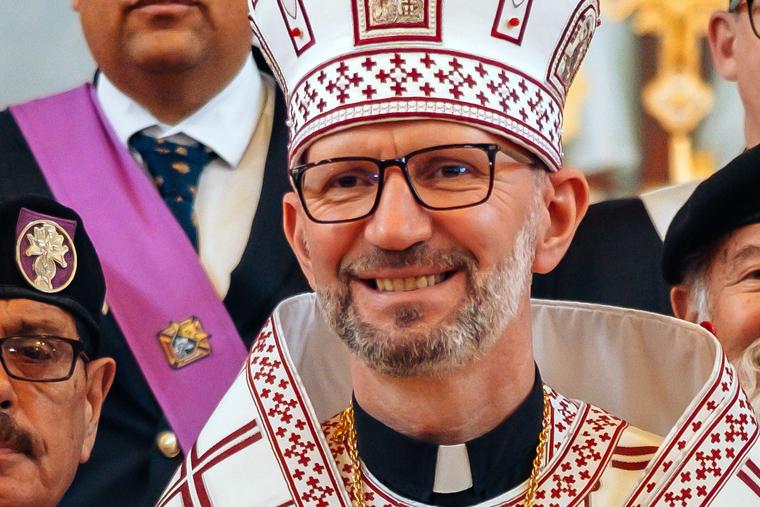
On Jan. 28, Father Artur Bubnevych was consecrated and enthroned as the sixth bishop of the Holy Protection of Mary Byzantine Catholic Eparchy of Phoenix. Originally from Ukraine, Bishop Artur has served in the United States since 2013 and brings pastoral experience and missionary energy to his new role. In this interview, he reflects on his vision for the Church, challenges ahead, and the beauty of Eastern Catholic witness in the modern world.
You’ve served in the Eparchy of Phoenix since your arrival in the United States in 2013. What insights have you gained about the eparchy through your service?
It’s a very big eparchy in territory covering 13 states all the way to Alaska and Hawaii — very diverse and multi-national. The faithful are not an East European Church at all. We are a missionary eparchy, with converts and returnees to the Faith.
I found a good team of clergy and laypeople with active outreach who go out to bring people into the Church. We are a very mission-oriented Church, looking to be known in the world and to present our Byzantine Catholic Church through church events, bazaars, catechetical and educational events.
It embraces different cultures and languages. The parishes predominantly have young people, with young growing families, and vibrant worship. We have a strong pro-life, tradition-oriented laity committed to traditional Catholic teaching and looking for good liturgy. They come looking for a spiritual challenge that will nourish their souls — through our chant, our prayers, our ascetical life — and can be an example to the more ethnically-oriented Eastern Catholics.
As you’re aware, our Eastern Catholic Churches have both challenges to overcome and opportunities for growth. What areas do you want to focus on in your episcopal ministry?
Our challenge here is the great distance between parishes which are so far from each other. It’s important that we have a good communication system to maintain the fraternity between the bishop and the clergy. Another challenge is vocations; we have a good number of vocations but a serious shortage of ordained priests.
Another opportunity for growth is to bring the eparchy to the next level in the world of digital evangelization in apologetics, doing podcasts about our Church. This will help us because we are so widespread and also to make our Church better known.
I would like to create a hub for our Eastern Catholic Churches in the western states that can share the best of theology, preaching, teaching, charitable work with one another. Religious education and catechesis need to be improved; formation of new cantors is needed as chant is so important in our worship. Marriage and family life always need support and revival. We also need to strengthen our monastic foundations where people can come and pray and grow spiritually.
Many Eastern Catholic bishops in the U.S. are relatively new, including Bishop François Beyrouti (Melkite Eparchy) in 2022 and Bishop Robert Pipta (Byzantine Catholic Eparchy of Parma) in 2023. How much are you leaning on and learning from your brothers in the episcopacy?
I had to lean a lot on the bishops! Our Byzantine Catholic bishops have been very supportive. Archbishop William was very helpful with anything that I asked of him for advice, and very welcoming. Bishop Kurt really acted as a fatherly guide to solving some of the immediate challenges that arose when we had to make plans and organize everything. Bishop Beyrouti and Bishop Pipta have both been very open to help and provide some guidance. The bishops are helpful in liturgical matters and providing rules and guidelines for making parish visitations and how to celebrate the complex Hierarchical Liturgies. That includes help in meeting the challenges of the first year as a bishop.
As a priest, you were specially chosen by the USCCB to be a delegate to relay your experience as a parish priest to the Synod on Synodality. Can you speak a bit about the insights you shared and what your vision for greater synodality is for your Eparchy?
God works in each parish. A parish is a story of God acting in the world now. Even though the priests at the synod were from so many different countries, we had similar joys, problems and sorrows. It was very constructive to share them in the ‘conversation in the Spirit’ that could unite us so fast into working teams. We were intimately bound together through our prayers and through our eucharistic worship.
We want to have a brotherhood among the clergy, with trust and good communication. We need to listen and share with each other through those “conversations in the Spirit.” I want to have accountability and financial transparency to the People of God. That is very important in the Catholic Church right now and must be dealt with. Building up a Listening Church needs to happen; that is the important element. We had to listen, pray, be heard, and then act upon what came among the priests at the synod.
As a bishop, I should invite clergy, listen to them, affirm them and let them talk openly. I think it will bring good change for the Church. If there is no fraternity between bishops and priests and deacons and seminarians, then how can we achieve this in parishes?
Our readership is primarily Latin Catholic, as an Eastern Catholic bishop what message would you like to share with our readers to shine a bit of “the light of the East” on them?
As Eastern Catholics we offer them a fullness of the Church. Pope St. Paul II said that his vision was to have a Church that breathes with both lungs. We brought the East to the West through our reunion with Rome (1646) and we have martyrs who suffered and died for the fulfillment of Jesus’ priestly prayer, “that all may be one” (John 17:21).
Our Byzantine Catholic Church is a sign that the Church can be East and West united. Many Latin Catholics find their spiritual hunger quenched in our spiritual and liturgical traditions. Our liturgical texts are very rich with dogmatic theology and Scripture, especially the power of the Resurrection. Our Ruthenian-style chant is beautiful and transforming. People see the beauty of the iconostasis, hear the chant, smell the incense, and they fall in love with our Church. We must enrich the spirituality of the Catholic Church through what we offer.
Is there anything else that you would like to share about your background or episcopal vision that would be of interest to our readers?
My vocation was born through the prayers of my grandmother. My mother had a very difficult and long labor with me in the Soviet Union, and the doctors had to work hard to save her life. They put me aside, and my grandmother was looking in and began to pray to the Lord to keep me in his plan. She was very prayerful, fasted every Friday, listened to Radio Vatican every Sunday (which was forbidden in the U.S.S.R.) and always blessed me. I was baptized by an underground priest. She had a prayer corner in the house, and I took her old prayer book, learned the prayers, kissed the cross, drank the holy water — that was what we knew.
A man who had been a seminarian in the time of Blessed Theodore Romzha (killed by the Soviets in 1947) sought me out and invited me to consider the priesthood and that’s how it all started. I just had to say “yes.”
We did not know much about the Faith, and that man was my evangelizer. He taught me about the Bible, the Church, the role of the pope, and prayed for me. I was in the first official class of the restored seminary, in 1994, as everything had been underground since 1949. I come from a Church of martyrs, a Church that has suffered for its union with the Holy See, a Church that, in the words of Pope Leo XIV, can help the Latin Rite “recover the sense of mystery that remains alive in your liturgies, liturgies that engage the human person in his or her entirety, that sing of the beauty of salvation and evoke a sense of wonder at how God’s majesty embraces our human frailty!”