<p><!-- BEGIN THEIA POST SLIDER --></p>
<p> <br />
</p>
<div>
<p>Siegfried Sassoon’s late-life conversion and poetry offer a moving meditation on faith, suffering and the redemptive light of Christ.</p>
</p></div>
<div>
<p>One of the finest religious poems of the 20th century is “Lenten Illuminations” by Siegfried Sassoon, written shortly after the poet’s reception into the Church in 1957. In the poem, the poet places himself in a church, on his knees before the tabernacle, musing upon the mysterious grace which had led him to finally embrace the Catholic faith in the 72nd year of his trouble-filled life.</p>
<p>As he contemplates his journey, he finds himself haunted by the presence of his pre-convert self, his “unforeknowing Ego, visitant in thought.” The remainder of the poem is a meditative monologue in which the Catholic poet muses on his past, wondering what his old self would have thought of the decisive step he had now taken, speaking, as it were, to the very ghost of himself.</p>
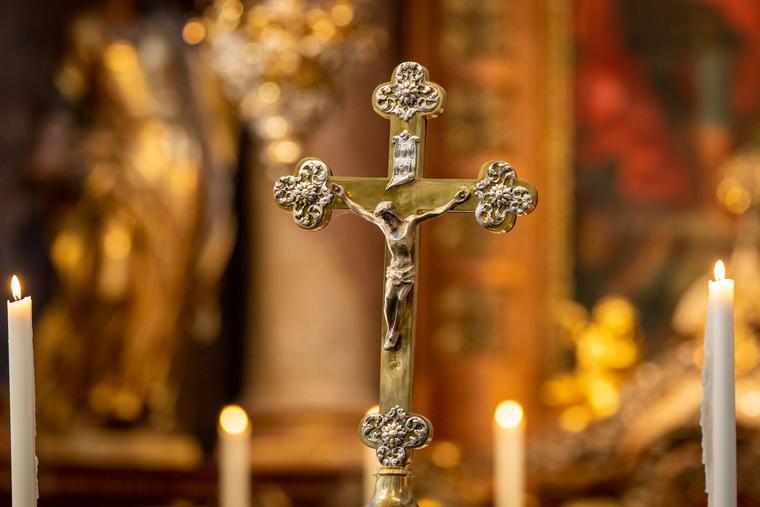
<p>He recalls that he had always been attracted by the beauty of the Church, in “anthems, organ music, shaft-aspiring stone, / And jewelled windows into which your mind might melt.” But “not in the Crucifix,” not in the light of the cross, the light that shines in the midst of the darkest periods of suffering, not in the “wrought remedial gift of tears.” </p>
<blockquote><p>Not in the Crucifix. (Though each Good Friday you had felt <br />Almost unbearable the idea of how He died.)</p></blockquote>
<p>Forty years earlier, in the stench and animal horror of the trenches of World War One, he had been haunted by the crucified Christ. In poems, such as “Golgotha” and “Stand-to: Good Friday Morning,” he had screamed in pain and anger at the Christ who seemed so distant from the suffering of crucified humanity. </p>
<p>“While you were in your purgatorial time,” he tells the ghost of his former self, “In watches of the night, when world event with devildom went dark, / You implored illumination.” But the light was denied by the poet’s own pride, “never being bowed obedient.” Now, however, kneeling in humble submission, the poet recalls the vanity of the false paths taken:</p>
<blockquote><p>There had been many byways for the frustrate brain,<br />All leading to illusions lost and shrines forsaken &#8230;<br />One road before us now — one guidance for our gain –<br />One morning light — whatever the world’s weather — wherein wide-eyed to waken.</p></blockquote>
<p>The poem’s final lines are poignant with the peace that resignation brings:</p>
<blockquote><p>I never felt it more than now, when out beyond these safening walls<br />Sculptured with Stations of the Cross, spring confident, unburdened, bold,<br />The first March blackbird overheard to forward vision flutes and calls.<br />You could have said this simple thing, old self, in any previous year.<br />But not to that one ritual flame — to that all-answering Heart abidant here. </p></blockquote>
<p>The Lenten light abidant in “Lenten Illuminations” would illuminate the poet’s final years, culminating in “A Prayer in Old Age” which is not only gloriously beautiful poetry, but a gloriously beautiful prayer:</p>
<blockquote><p>Bring no expectance of a heaven unearned<br />No hunger for beatitude to be<br />Until the lesson of my life is learned<br />Through what Thou didst for me.</p>
<p>Bring no assurance of redeemed rest<br />No intimation of awarded grace<br />Only contrition, cleavingly confessed<br />To Thy forgiving face.</p>
<p>I ask one world of everlasting loss<br />In all I am, that other world to win.<br />My nothingness must kneel below Thy Cross.<br />There let new life begin.</p>
</blockquote></div>
<p><br />
<br /><a href="https://www.ncregister.com/blog/pearce-lenten-illuminations">Source link </a></p>
<p><!-- END THEIA POST SLIDER --></p>

Finding Grace in the Light of the Cross| National Catholic Register