<p><!-- BEGIN THEIA POST SLIDER --></p>
<p> <br />
</p>
<div>
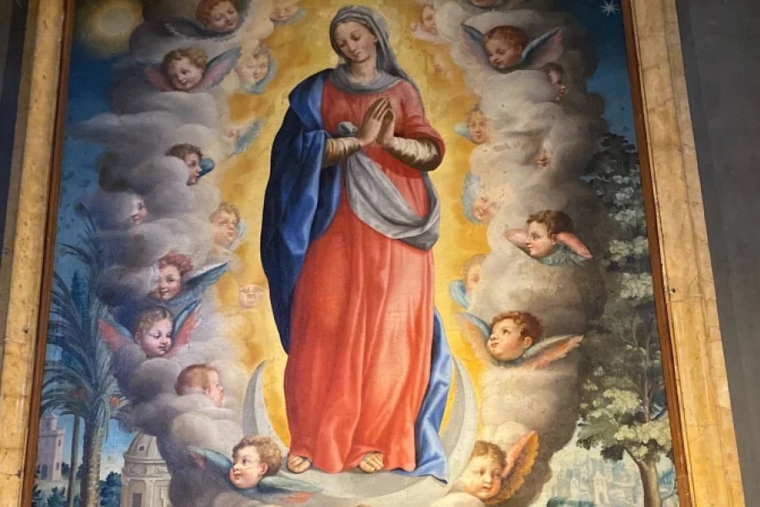
<p>The similarities between the Rome and Mexico City images are striking.</p>
</p></div>
<div>
<p>The Church of St. Vitale, built in 386, is the oldest Christian church still standing in the center of Rome. It is the “only place of worship from the fourth century that has remained intact throughout the centuries,” emphasized its parish priest, Father Elio Lops.</p>
<p>This early Christian church, discreet and given little attention on typical tourist routes, safeguards an artistic and devotional treasure that is practically unknown: the first image of Our Lady of Guadalupe painted in the Italian capital.</p>
<p>“It has never been given the importance it deserves,” Father Lops told ACI Prensa, CNA’s Spanish-language news partner, referring to a representation of the Virgin Mary that immediately brings to mind the image imprinted on St. Juan Diego’s tilma in 1531.</p>
<p>The similarities are striking. “There is no doubt about its identity,” the parish priest pointed out.</p>
<p>Although the position of the hands shows a slight variation and the rays that usually surround the figure are missing, “the gaze is the same,” he explained. The painting also retains “the same belt that symbolizes Our Lady’s maternity and the large crescent moon beneath her feet,” Father Lops noted, citing the essential iconographic elements of the Guadalupe narrative.</p>
<p>The image was painted “around the year 1550” by the Jesuit Giovanni Battista Fiammeri, an artist active in Rome who, on the occasion of the Jubilee of 1600, decorated the entire church of St. Vitale.</p>
<h3><b>What Is the Painting’s Origin?</b></h3>
<p>Although there are no documents that conclusively certify it, the parish priest supports a compelling hypothesis: The Jesuit Fiammeri painted the picture based on a sketch of the miracle made by Spanish missionaries upon their return to Rome, after learning about the events that occurred on Tepeyac Hill two decades earlier.</p>
<p>One detail reinforces this interpretation. At the bottom of the painting, “below the Virgin, there is a small caravel, depicting the ship on which they traveled to Mexico,” the priest explained. This is an unusual element in later iconography of Our Lady of Guadalupe, but it was commonly used in the context of the first contacts between the New World and the Holy See.</p>
<p>Whatever the precise origin of the model used by Fiammeri, it is certain that this image predates by several decades the other representations of the Virgin of Guadalupe preserved in Rome, which date from the mid-17th century, almost a hundred years after the apparitions, the 500th anniversary of which will be celebrated in 2031.</p>
<p>This fact confers on the painting in St. Vitale a singular value as a testament to the early European reception of a devotion that, over time, would become one of the pillars of the Americas’ religious identity.</p>
<p><i>This story </i><a href="https://www.aciprensa.com/noticias/120231/la-primera-guadalupe-de-roma-oculta-desde-hace-siglos-en-la-iglesia-mas-antigua-del-centro" target="null"><i>was first published</i></a><i> by ACI Prensa, CNA’s Spanish-language news partner. It has been translated and adapted by CNA.</i></p>
</p></div>
<p><br />
<br /><a href="https://www.ncregister.com/cna/where-the-first-painting-of-our-lady-of-guadalupe-in-rome-is-preserved">Source link </a></p>
<p><!-- END THEIA POST SLIDER --></p>

First Painting in Rome of Our Lady of Guadalupe Is Preserved in Fourth-Century Church| National Catholic Register