<p><!-- BEGIN THEIA POST SLIDER --></p>
<p> <br />
</p>
<div>
<p>COMMENTARY: The entire Church sings his words today in praise of the Eucharist.</p>
</p></div>
<div>
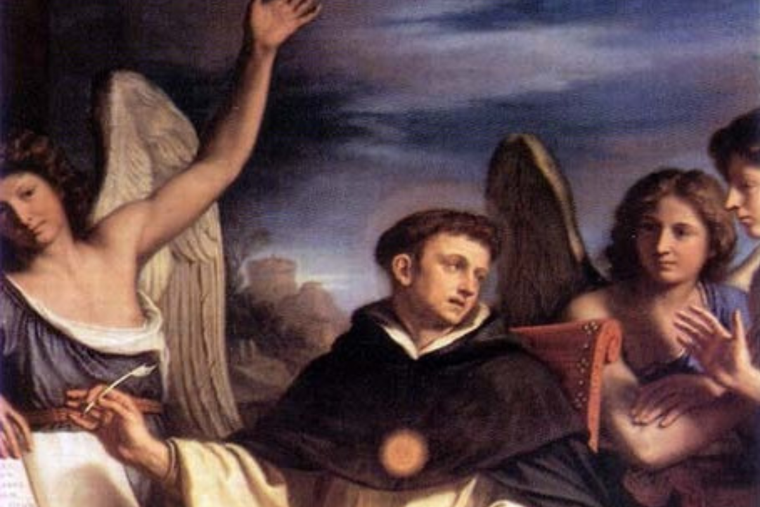
<p>This year the Catholic Church is living between two great Jubilees of St. Thomas Aquinas — the 750th of his death (1274) and the 800th of his birth (1225). His philosophical and theological works are essential to Catholic thought, but the Church pays him an even greater compliment by including his hymns in the liturgy. </p>
<p>The Eucharistic hymns of St. Thomas adorn the feast of Corpus Christi. The <i>Lauda Sion</i> is the sequence sung at Mass. In the morning during the Divine Office, <i>Verbum Supernum Prodiens </i>is sung at Lauds; the last two verses are the well-known <i>O Salutaris Hostia</i>, often sung at exposition of the Blessed Sacrament. His Corpus Christi Vespers hymn is <i>Pange Linqua</i> (the last two verses of which are the <i>Tantum Ergo</i>) often sung at Benediction. </p>
<p>Then there is his hymn, <i>Adoro te Devote</i>, which often accompanies Eucharistic devotions.</p>
<p>All of which makes Thomas suitable for reflection on Holy Thursday. After all, Corpus Christi is a liturgical extension of Holy Thursday and the institution of the Eucharist at the Last Supper. Despite the massive influence of his scholarly works, at no time is Thomas more prominent than on Holy Thursday night, as the Church in every time and place sings <i>Pange Lingua</i> to accompany the Blessed Sacrament to the altar of repose. Songs reside in the memory in a way that theological tracts do not.</p>
<p>Toward the end of his life, Thomas, after writing on the Eucharist, had an ecstatic experience. He heard the Lord say to him, “You have written well of me, Thomas; what reward will you have?” Thomas replied, “Nothing but you, Lord. Nothing but you.”</p>
<p>On Holy Thursday we witness part of Thomas’ reward: The entire Church sings his words in praise of the Eucharist.</p>
<p> </p>
<h3><b>Ideas About the Immaculate Conception</b></h3>
<p>Much of the commentary about Thomas in his jubilee year includes a mention that he “did not believe” in Mary’s Immaculate Conception. It is usually mentioned as evidence that even the greatest of all theologians are capable of mistakes. </p>
<p>It would be better not to say that Thomas was wrong. Better to say that he was not entirely correct. It’s important to understand clearly what Thomas taught.</p>
<p>First, it should be remembered that Mary’s Immaculate Conception was an open theological question when Thomas lived. Therefore, there was a legitimate discussion of various theories.</p>
<p>Second, Thomas taught that Mary had no personal sin — mortal or venial — as that would be incompatible with the holiness of being the Mother of God (<i>Summa Theologiae</i> III:27:4).</p>
<p>Third, if Mary was without personal sin, was Mary marked by original sin? Thomas argued that if Mary had been free of original sin, “she would not have needed redemption and salvation which is by Christ” (<i>Summa Theologiae</i> III:27:2).</p>
<p>Fourth, in his commentary on Peter Lombard’s <i>Sentences</i>, Thomas does write that Mary “was immune from original and actual sin.”</p>
<p>Thus we see Thomas trying to reconcile two things — Mary’s sinlessness with her need for redemption. If it was fitting that she was sinless, then she would not have original sin. If it was fitting that she needed redemption, then original sin marked her soul. Both are fitting!</p>
<p> </p>
<h3><b>Anticipatory Action</b></h3>
<p>In defining the dogma of the Immaculate Conception in 1854), the Church taught that Mary did need redemption, but she was preserved from all sin, even original sin, by an anticipatory application of the merits of the redemption. Thomas would have been pleased with that solution, which is consistent with his logic, even if he did not formulate it as such. </p>
<p>Holy Thursday is good occasion to think about grace by anticipation, as the Immaculate Conception is analogous to what happens in the institution of the Eucharist. At every Mass, the offering of the Cross is made present after Good Friday. </p>
<p>At the Last Supper, the offering of Good Friday was made present ahead of time, just that once. Jesus offers His body and blood in the Upper Room before He offers it on Calvary. In every Mass since, the Church offers that same Body and Blood after Calvary. Calvary is present for us as an event in the past; it was present on Holy Thursday as an event in the future. </p>
<p>So too all of us are saved from sin after the redemption won on the Cross. For Mary, and just that once, she was saved ahead of time. Grace is applied in anticipation of the saving action. </p>
<p>On Palm Sunday, the passion according to St. Mark was read. It opens with the account of the woman breaking open the jar of precious oil to anoint Jesus. The apostles are “infuriated.” Jesus defends her: </p>
<blockquote><p>“She has anticipated anointing my body for burial. Amen, I say to you, wherever the gospel is proclaimed to the whole world, what she has done will be told in memory of her” (Mark 14:8-9).</p></blockquote>
<p>Jesus was speaking there of Mary of Bethany (John 12:3), who anticipated what was yet to come. But those words could also be applied to Mary, Mother of God, who was anointed by grace in anticipation of the life and death of Jesus, conceived in her womb. And the world does tell what she done — and what the Almighty has done for her — wherever the Gospel is proclaimed.</p>
</p></div>
<p><br />
<br /><a href="https://www.ncregister.com/commentaries/holy-thursday-thomas-aquinas-and-the-immaculate-conception">Source link </a></p>
<p><!-- END THEIA POST SLIDER --></p>

Holy Thursday, Thomas Aquinas and the Immaculate Conception| National Catholic Register