


When Pope Francis opened the Jubilee Year of Hope on Dec. 24, 2024 — marking the start of a special holy year of grace and pilgrimage that usually only happens once every quarter-century — few people could have predicted just how extraordinary 2025 would prove to be.
Throughout the year, the Church celebrated the virtue of hope during a time marked in many ways by fear — amid reports of heightened political violence, the continued explosion of artificial intelligence (AI) and the ethical quandaries it has created, the upheavals surrounding a second Trump administration, ongoing wars, and the continued persecution of Christians worldwide. As Catholics sought hope this year, they ended up finding it in unexpected places — including in stories about a well-attested rise in conversions to Catholicism worldwide, especially among young people.
And as Pope Leo XIV continues to settle into his new role, there’s no doubt that 2025 has set the stage for a supremely interesting pontificate. Here’s a look back at some of the most significant stories, themes and pivotal players in the memorable Catholic news year that was 2025.
Pope Francis’ Death; Pope Leo’s Election
The biggest quake that shook the Catholic Church in 2025 was the death of Pope Francis and the profoundly surprising election of his successor, Pope Leo XIV, the first Augustinian and first U.S.-born pope.
While recovering from double pneumonia, the 88-year-old Francis died peacefully April 21 at his Vatican residence. His dozen-year pontificate included a major focus on mercy, care for creation, and attention to what he called the “peripheries” of both the Church and society.
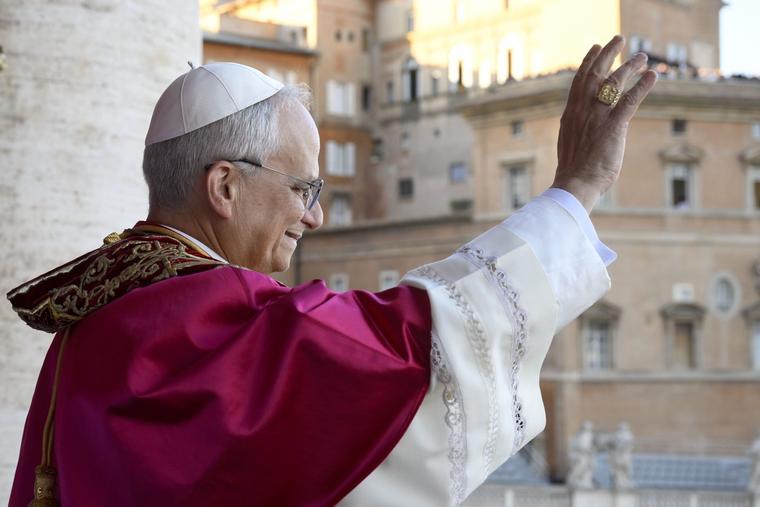
Just weeks later, on May 8, Cardinal Robert Francis Prevost stepped out of relative obscurity and onto the loggia, taking the name Pope Leo XIV. A Chicago native and former missionary, Leo introduced himself with the words, “Peace be with all of you!”
Leo’s First Papal Actions
Despite joking that he had been hoping to retire before his election, Pope Leo — having not yet presided over any earth-shattering changes or controversies during his nascent pontificate — has settled into his new role in a manner observers have described as “serene.” Catholics and the public at large have marveled at the spectacle of a pope speaking natively in English and receiving numerous gifts related to his favorite baseball team, the Chicago White Sox.
In various speeches and audiences, the polyglot Leo has stressed the primacy of Christ and the importance of unity, both within the Church and among all people. In the first major document of his pontificate, the apostolic exhortation Dilexi Te (“I Have Loved You”), the Pope wrote that the poor are not only objects of charity but also evangelists who can prompt us to conversion through their example.
For his first papal trip, Pope Leo traveled to Turkey in November to commemorate the 1,700th anniversary of the Council of Nicaea. He then flew to Lebanon, where he visited grieving families at the site of the 2020 port explosion and celebrated Mass on the Beirut waterfront.
Pope Leo also made new episcopal appointments in the U.S., most notably his pick of a fellow Chicagoan for the New York see.
New Friends in Heaven
Amid a flurry of joyful interest from around the world, Pope Leo officially canonized Italians Pier Giorgio Frassati and Carlo Acutis in September. Both men, though they lived decades apart, died young and have since inspired millions around the world with their devotion to Christ and to the poor.
The first canonizations of Pope Leo’s pontificate were combined together on a new date, Sept. 7, after the death of Pope Francis precluded the original April date for Acutis’ canonization — though the decision to move Frassati’s canonization caused consternation among some pilgrims, who ended up missing it.
In October, the Church added a further seven new saints: Ignazio Choukrallah Maloyan, Peter To Rot, Vincenza Maria Poloni, Maria del Monte Carmelo Rendiles Martínez, Maria Troncatti, José Gregorio Hernández Cisneros and Bartolo Longo.
Catholics Continue to Scrutinize — And Use — AI
Signaling a focus on AI ethics and responsibility from the very start of his pontificate, Pope Leo has continued to elevate the Church’s engagement with the technology amid what he calls a new “industrial revolution.”
Many Catholics already use secular AI tools like ChatGPT in their daily lives — despite some persistent flaws and concerns over those tools’ effects on developing minds — but 2025 also saw several interesting new AI tools that were developed by and for Catholics. Also of note: The Vatican Apostolic Library is using AI to aid in digitizing a collection of millions of books, documents and manuscripts.
While AI holds many potential opportunities for the Church, important stories in 2025 also cast light on some of AI’s most persistent dangers: the proliferation of fake videos depicting Pope Leo XIV and other Catholic figures; the ongoing urgent need to protect children and other vulnerable people online in an age of AI “companionship”; the ways that AI is facilitating the surveillance and oppression of Christians; and the global work that still needs to be done to decouple an AI-hungry world from exploitative economic systems.
Harrowing Scenes at Annunciation School
On the morning of Aug. 27, a young female-identifying man murdered two children in the pews during an all-school Mass at Annunciation Catholic School’s parish church and injured more than a dozen others. It was the deadliest mass shooting event to take place during a Catholic Mass in the U.S. in decades.
The devastating event in Minneapolis prompted Catholic churches and schools all over the country to reevaluate their security protocols and lawmakers to consider new measures to protect religious nonprofits.
The incident brought the U.S. Catholic community together in an exceptional way, and glimmers of hope have emerged following the tragedy. After spending 57 days in the hospital with severe injuries, 12-year-old Annunciation student Sophia Forchas was able to go home in late October after a recovery her family described as “miraculous.”
And in early December, three months after the shooting, the bishops of Minneapolis celebrated a special Mass of reparation at the church to restore it for worship.
Political Violence Bubbles Over
After a contentious campaign last fall that included the attempted assassination of then-candidate Donald Trump, political violence proved to be a recurring theme in 2025.
Figures on all ends of the political spectrum suffered violence and threats this year, including the attempted murder in April of Democratic Gov. Josh Shapiro of Pennsylvania and his family; the shooting deaths of two Israeli embassy staff outside the Capital Jewish Museum in Washington, D.C., in May; the December murders of at least 15 people at a Jewish holiday celebration in Sydney, Australia; and the brutal June killings of two Minnesota state lawmakers.
In September, the shocking assassination of Charlie Kirk — a conservative activist and young father — prompted countless tributes from Catholics and may even have contributed to a spike in Bible sales, as many people appeared to posthumously gain a deeper appreciation for Kirk’s Christian faith.
Catholics, like most Americans, are deeply disturbed by these violent acts. Overall, 84% of Catholic voters consider political violence either a very serious or somewhat serious problem, according to the results of a new EWTN News/RealClear Opinion Research Poll released in December.
Hope Amid Nature’s Fury
The year kicked off with the news of devastating wildfires in Southern California, ultimately the costliest in U.S. history. The Palisades Fire consumed thousands of homes and numerous churches, including historic Corpus Christi Catholic Church — though the parish’s tabernacle survived the blaze unscathed.
Spring brought powerful tornados to middle America, including one that left $1.6 billion in damage in St. Louis and others that killed at least 19 people in southeastern Kentucky in the Diocese of Lexington.
Later in the year, in July, record-breaking flash floods in central Texas devastated communities along the area’s rivers and killed multiple people — including at least 27 girls at a Christian summer camp.
Young People Give the Faith a Boost
The COVID-19 pandemic and lockdowns left years of uncertainty in their wake: Would Catholics return to Mass? And where are young people headed when it comes to religion?
But in 2025, hopeful signs emerged on both fronts. Data released in February suggested that Mass-attendance levels had quietly returned to 2019 levels in the U.S. and nearly to 2019 levels in Britain.
But far more compelling were the stories — largely anecdotal — that emerged in 2025 regarding an apparent renewed interest in Catholicism among young people. From France to New York City, and on numerous U.S. college campuses, priests and youth ministers reported notable rises in interest in the Church and, subsequently, a rise in conversions.
The youthful energy of 16,000 young U.S. Catholics was on full display at the National Catholic Youth Conference (NCYC) in November, during which Pope Leo spoke directly to five teenage questioners during a historic live digital dialogue.
The Scandals
While it remains to be seen exactly what actions Pope Leo will take to further the protection of minors and vulnerable adults in the Church, many Catholics are still awaiting his decision regarding arguably the most well-known and notorious ongoing alleged abuse case, that of artist Father Marko Rupnik, who is accused of sexually and spiritually abusing dozens of religious sisters. In November, Pope Leo asked victims to have patience as a trial on the priest’s alleged abuse begins at the Vatican.
In April, former cardinal Theodore McCarrick died at age 94, having been two years prior ruled incompetent to stand trial for his numerous crimes, which included sexually abusing minors and adults. The name of the disgraced former archbishop of Washington, D.C., had become almost synonymous with the renewed revelations of sexual abuse and cover-up that have emerged in the U.S. Church since 2018.
Crisis for Christians
Christians around the world continued to suffer for their faith in 2025.
On Dec. 15, Catholic human-rights advocate and media mogul Jimmy Lai was found guilty of multiple violations of China’s national security laws. The 78-year-old, who now faces the prospect of life in prison, has been hailed as a hero for his courageous defense of democracy and freedom in the face of the Communist Chinese regime.
2025 also brought renewed attention to an ongoing crisis too often forgotten, even among Catholics: the brutal persecution of Christians in Nigeria, where tens of thousands have been murdered since 2000. The stunning late-November kidnapping of more than 300 Nigerian Catholic schoolgirls, some as young as 6, finally saw the hundreds of students freed from the clutches of armed separatists in separate releases.
The Vatican’s response so far under Pope Leo has been received coolly by some advocates. In late October, Cardinal Pietro Parolin, the Vatican Secretariat of State, declined to characterize the Nigerian violence as a genocide of Christians by Muslim militants, noting that an array of other factors are also involved. Just weeks later, Pope Leo highlighted the dangerous situation for both Christians and Muslims in the country amid widespread terrorist activity and economic disputes.
At the end of the same month, President Trump fulfilled a long-requested plea from advocates when he designated Nigeria a “Country of Particular Concern” (CPC), meaning the country would be held responsible for particularly severe violations of religious freedom under U.S. law. In an effort to stem the violence against Christians, the U.S. conducted Christmas airstrikes on ISIS in Nigeria.
Peace Efforts
As Russia’s war in Ukraine approaches the four-year mark, the war in Gaza has surpassed year two, despite a fragile U.S.-brokered ceasefire, and the largely ignored but staggeringly brutal civil war in Sudan has shown little sign of abating, Catholics continue to play an important role in calling for and mediating peace around the world.
Notably, regarding Gaza, Cardinal Pierbattista Pizzaballa, the Latin patriarch of Jerusalem, has been a constant voice advocating for the small but devout Christian presence in the besieged strip.
Responding to ongoing conflicts around the world, the Pope has continually called for dialogue between warring factions, including most recently as regards Venezuela amid still-ongoing tensions between the South American nation and the United States.
Meanwhile, on Ukraine, Pope Leo XIV in December criticized President Donald Trump’s plan to end Russia’s war against Ukraine, saying it threatens to break apart the alliance between Europe and the United States. The Pope has also sent aid to Ukraine.
Pope Leo has repeatedly called for a ceasefire and humanitarian aid in Sudan, condemning in November the “indiscriminate violence against women and children, attacks on unarmed civilians, and serious obstacles to humanitarian aid,” especially in the war-torn region of North Darfur.
His Christmas Urbi et Orbi focused on peace. “From the Child of Bethlehem, we implore peace and consolation” for those suffering from crisis and conflict worldwide, Leo said.
The Bishops and Trump
Throughout his second term, the overall relationship between Trump and the U.S. Catholic bishops has been rocky, to say the least.
Trump’s mass-deportation agenda, a major campaign pledge fueled by the unprecedented surge in illegal border crossings during the Biden administration, has arguably driven the largest wedge between the administration and the Church, with the bishops in November issuing a rare unified message to oppose “the indiscriminate mass deportation of people” — even as a majority of Catholic voters report that they back Trump’s immigration actions. (The Catechism of the Catholic Church sums up the Church’s position on immigration, stating that prosperous nations should welcome newcomers, while immigrants are obliged “to respect with gratitude the material and spiritual heritage of the country that receives them, to obey its laws and to assist in carrying civic burdens.”)
The bishops have also yet to find common ground with the administration on its full-throated support for in vitro fertilization, a practice the Church opposes. Trump’s enthusiasm for resuming federal executions has also drawn criticism from the bishops and other Catholics, as did the administration’s cuts to Medicaid and food stamps and the military’s alleged striking of civilian drug runners on boats in the Caribbean throughout the final months of the year.
Hope for the Future
Through all these major developments and changes over the past year, Our Lord’s love and mercy remained constant. And while the Jubilee of Hope will conclude on Jan. 6, 2026, the Church — and Pope Leo — will continue to promote hope to a world still sorely in need of it.
“As pilgrims of hope, we must view our troubled times in the light of the Resurrection,” the Pope said in an audience with Jubilee pilgrims in St. Peter’s Square Oct. 25.
“To hope is not to know,” he said. “We do not already have the answers to all the questions. But we have Jesus. We follow Jesus. And so we hope for what we do not yet see.”