<p><!-- BEGIN THEIA POST SLIDER --></p>
<p> <br />
</p>
<div>
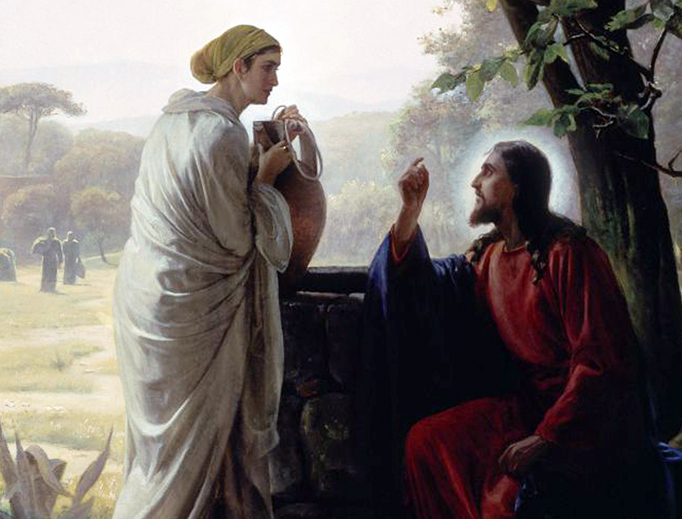
<p>The Samaritan woman at Jacob’s Well brings Divine Mercy to its fullest light.</p>
</p></div>
<div>
<p>Modern people tend to immediately regard “outcasts” as victims of intolerance — it’s one of our more spiritually generous reflexes. But often enough, the distinction is well earned.</p>
<p>It’s likely we’ve all been excluded from a group at one time or another. Perhaps we annoyed friends by being overeager to impress or please. Perhaps we irked classmates by droning on about a topic no one else found interesting. (I’ll cop to that one.) Or perhaps we simply lost the respect of our community by failing to honor our commitments.</p>
<p>The latter example almost certainly accounts for the social isolation of the Samaritan woman at the well from the fourth chapter of John’s Gospel. Having been married five times and cohabitating with a sixth man — which is something of a feat for a woman in a Samaritan hill village — she is forced to journey to the well alone under the midday sun. Her social status excludes her from the convoy of village women who would perform the task together in the cool of the morning.</p>
<p>While the spiritual implications of the story are myriad, modern preachers are fond of framing it in terms of simple bigotry. For them, the central issue is the lack of mercy afforded to the adulteress by the village women. The moral is similarly straightforward: that we too should journey out &#8220;to the margins” of society and accompany those who’ve been cast out.</p>
<p>It’s a point well taken — indeed, Catholics <i>should</i> reach out to the marginalized at every turn. Not a single soul is beyond the mercy of God. But the totality of this interpretation is, shall we say, <i>light</i>. The woman at the well is among the most spiritually rich historical occurrences recorded in the New Testament. And yet, ordinary Catholics are often left with the impression that the story is a mere meditation on social justice.</p>
<p>More than intellectually meager, the “bigotry” framing also tends to misinterpret the practicalities of the situation. The more plausible explanation for her isolation is that the village women simply didn’t want her around their husbands. And who could blame them?</p>
<p>It is a moral obligation to be merciful, not to be stupid.</p>
<p>Perhaps worse, the “bigotry” framing reduces Jesus to a Very Nice Guy, indistinguishable from any other plucky and soft-hearted social justice activist. It casts emphasis on the plight of the Samaritan woman rather than on the radical mercy of Christ.</p>
<p>Meanwhile, a more realistic interpretation of the story — one that accounts for the culpability of the Samaritan woman — yields far greater spiritual treasures, as well as transformative truths about human identity in relation to God in the person of Jesus Christ. Only by acknowledging her sin can we begin to grasp the utter gratuitousness of God’s mercy and our need for a savior.</p>
<p>It’s easy to imagine the bitter ruminations cycling through the woman’s mind as she lugged pails through the midday heat on the day Christ found her at the well. <i>Curse those uppity prudes!</i> she might have thought to herself. <i>No wonder they couldn’t hold onto a man with an attitude like theirs! </i>And<i> </i>then: <i>How could I be so selfish? So cruel? </i>And finally: <i>I am worthless. I don’t deserve love.</i></p>
<p>It is a pitiable state, one in which we are most alone and believe in God’s mercy least. And worse, we enter into it freely rejecting both law and love. We do it to ourselves.</p>
<p>Herein lies the magnificent truth of the woman at the well: that even when we spit on God’s law and curse our neighbors; even when we limp under the heat of our own shame and despair; even when we wish we’d have never existed in the first place, <i>even then</i> the light of Christ pursues us with the desperation of a parent in search of a lost child.</p>
<p>The woman at the well brings the abandon of God’s rescue mission for each of his children to its fullest light. Whereas the titular character in the parable of the lost sheep carries the aspect of naive innocence, the woman at the well is no mindless beast. Indeed, she is cunning, seductive and entirely aware of the sins she persists in committing. It is <i>she</i> who references Jacob and the tradition of her ancestors, after all, as well as a keen understanding of the religious conflicts of her day. Her sophistication confirms the gravity of her sin. And yet, despite her many conscious rejections of him, the Lord, in his inexhaustible and passionate involvement with the salvation of each of his children, journeys out to the margins to retrieve her.</p>
<p>The &#8220;bigotry&#8221; interpretation of the woman at the well falls short because its emphasis is too human. It doesn’t make sense for a shepherd to risk losing his whole flock for the sake of one sheep, nor does it make sense for a young preacher to risk being seen alone with a woman of ill repute. As is often the case, the nature of God’s love does not compute neatly in human terms.</p>
<p>The story of the Lord’s pursuit of the woman at the well should not be diluted to be made more palatable, or worse, more <i>relatable</i>. It should instead remind us that no matter how many times we fall into sin, nor how isolated we might be, Christ will continue to pursue us as if we were his only. </p>
<p>And he won’t stop until we’ve all returned safely home. How’s that for “inclusive?”</p>
</p></div>
<p><br />
<br /><a href="https://www.ncregister.com/blog/how-modern-preaching-on-the-woman-at-the-well-falls-short">Source link </a></p>
<p><!-- END THEIA POST SLIDER --></p>

How Modern Preaching on the Woman at the Well Falls Short| National Catholic Register