


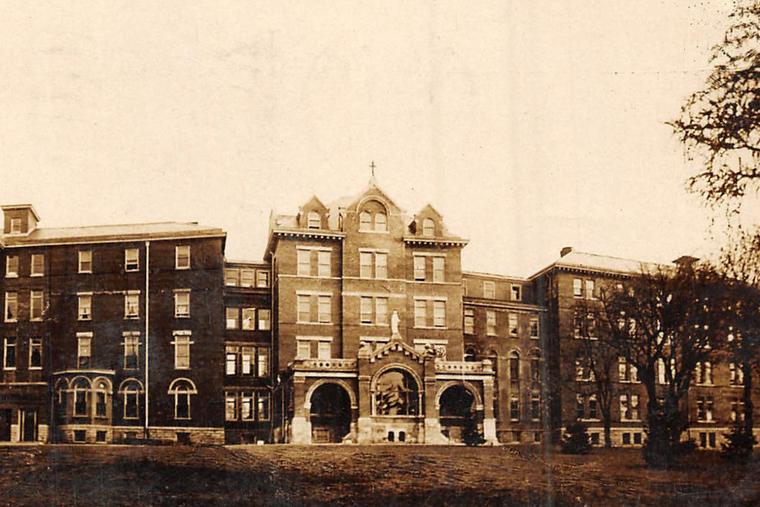
A version of this reflection was delivered Sept. 27 at the nursing White Coat Dedication ceremony, Saint Mary’s College, Notre Dame, Indiana.
So, salt and light. St. Matthew records Jesus calling his disciples and, by extension, us to be salt and light — no, not called to be, but in fact actually are salt and light.
That is, as his followers, we are salt in the world — realizing the love of Christ through our actions and very presence, the way salt brings out flavor in our food and helps preserve it; we are light in the world — like stadium lights set up high, dispelling darkness and illuminating that which others long to glimpse and even possess: hope, healing, goodness, beauty, truth. Love!
And note that Jesus emphasizes that the light itself isn’t the focus of those who benefit from it — that is, nobody is looking at the lighted lamp, but rather at what the lamp reveals. Like when somebody says, “I see the light,” she’s not looking at the light, but at what the light makes visible to her.
The same could be said for the salt, which is meant to enhance, not overpower. People buy fancy salt from around the world, but it’s still just salt — never the point of any dish it seasons, but, instead, a point-er, directing our taste buds to the dish’s essence.
In other words, to be salt and light doesn’t mean that we ourselves or our actions become the center of attention. Indeed, quite the reverse. More often than not, our effectiveness as salt and light — like real salt and light — is at its height when we’re not noticed at all: when our enhancing and illuminating are so subtle that our role is overlooked altogether.
And I want to suggest to you that such is precisely the case in nursing — this job which is always (or should be) more than a job. Yes, we tend to the sick, dress their wounds, assist at births, bring comfort to the dying, but it’s also about coming alongside those who are suffering, afraid, in need; seasoning their lives with our lives; chasing away their shadows with the light we’ve received.
To make my point, I want to share a story. And it begins right here on our campus with the Sisters of the Holy Cross. On the backside of Regina Hall, you’ll find the sisters’ cemetery. Among those buried there is Mother Angela, who, during the Civil War, accepted a commission from the War Department to send sisters to the front lines to serve as nurses.
Originally, the Sisters of the Holy Cross was exclusively a teaching order, yet Mother Angela was determined to meet the dire need of the moment. So, in 1861, she and six sisters, with only the most rudimentary nursing training, headed to the front and started caring for the wounded.
By war’s end, Mother Angela had retrained and deployed some 80 teaching sisters to serve as nurses in combat zones — including staffing the U.S. military’s first floating hospital on the Mississippi, the Red Rover (which you’ll also see over at Regina, in a painting that hangs in the lobby). Such were the heroic origins of our nursing department here at Saint Mary’s, as well as the origins of Holy Cross involvement in healthcare more broadly.
Not all the Holy Cross sisters went to the front, however, and those who remained on the sidelines included Maria Moes and her sister, Catherine, two young emigres from Luxembourg who had joined the Sisters of the Holy Cross in 1856. Maria, as Sister Alfred, and Catherine, Sister Barbara, received a solid Holy Cross religious formation, became teachers, and also had the fortuitous (as it turned out) privilege of observing firsthand Mother Angela’s courage, resourcefulness and resolve in transforming teachers into nurses.
But things didn’t pan out for the Moes sisters to stay with the Holy Cross family, and eventually Sister Alfred and Sister Barbara, and a couple others, started their own Franciscan congregation in Illinois. Dedicated to Catholic education, their little community flourished, and soon they had expanded into four other states, staffing 11 schools.
In time, the community settled its headquarters in rural Rochester, Minnesota, where they had previously opened an academy, and they continued to thrive. But then disaster struck: On Aug. 21, 1883, a massive tornado leveled much of Rochester and the surrounding area. A local physician, Dr. William Worrall Mayo, called on the sisters to help care for the injured, and Sister Alfred — now Mother Alfred — drew on the example of Holy Cross Mother Angela and rose to the occasion. She and her teaching sisters worked tirelessly tending to those in need in the days that followed.
In fact, Mother Angela did Dr. Mayo one better and, once the crisis had passed, she called on him to help her build a hospital for the growing Rochester community. Dr. Mayo agreed, and in 1889 the Franciscan sisters opened Saint Mary’s Hospital — which would in time become an institutional anchor for the illustrious Mayo Clinic, now one of the most respected medical facilities in the world.
At the time, the sisters still lacked formal nursing training, but they were dedicated and unabashed, completely committed to their benevolent undertaking and fully confident in God’s assistance. It was as if they embodied Mother Alfred’s favorite prayer that included a line from Psalm 37: “Commit your way to the Lord, trust in him and he will act.”
One of the sisters whom Mother Alfred tapped for this work was Sister Mary Joseph Dempsey. Formerly a school director in Kentucky, Sister Mary Joseph began working as a nurse at Saint Mary’s Hospital the moment she arrived in Rochester, and she remained there for the next 47 years. Much of her tenure was in administrative roles, but she was also a skilled surgical nurse, and served as the first surgical assist to none other than Dr. William James Mayo, another of the prestigious Mayo family of physicians.
This Dr. Mayo specialized in stomach cancer, and Sister Mary Joseph had innumerable opportunities to assess his patients. At some point, she made the connection that many of those patients had in common an unusual mass that could be felt around the belly button, and she brought it to Dr. Mayo’s attention.
Dr. Mayo confirmed the pattern — that the mass was frequently a clinical sign associated with advanced abdominal cancer — and he wrote it up in a medical journal. Twenty years later, a different surgeon wrote about the sign in a different medical journal, and he named it after Sister Mary Joseph. Look it up! Almost a hundred years later, that curious clinical sign is still known as a “Sister Mary Joseph nodule.”
So, in terms of salt and light, it seems like Sister Mary Joseph made her mark, right? I mean, first surgical assist to the Dr. Mayo of the Mayo Clinic. Plus, to top it off, getting a new medical discovery named after you. Not to mention decades of leadership at one of the most famous hospitals in the world — even receiving a special visit from President Franklin D. Roosevelt.
But no. “I do not deserve the plaudits given to me tonight,” Sister Mary Joseph said when honored at a Mayo Clinic banquet, “but I will take them to distribute among the sisters with whom I have worked so many years to make Saint Mary’s Hospital a house of God and a gateway to heaven for his many suffering children.”
That is, the salt and light that truly mattered, according to Sister Mary Joseph, were the countless, and largely anonymous, acts of sacrificial love that, cumulatively, distinguished Saint Mary’s Hospital as a premier medical facility.
But I think there’s an additional lesson in this story if we circle back to … the Sisters of the Holy Cross! Recall that it was the example of Mother Angela and her teaching sisters who flew to the front lines of the Civil War to serve the wounded that inspired Mother Alfred to do something similar after Rochester’s tornado.
It was Mother Angela’s light that made way for Mother Alfred’s vision; it was the salt of those battle-tested novice-nurse sisters permeating the religious legacy that produced the likes of Sister Mary Joseph and the other nurses who established Mayo Clinic’s reputation.
So, what’s my point? The point is this, dear students and future colleagues: You will never know the full reach of your compassion and selfless service as a nurse. You may suspect that your listening ear, tender touch and attentive care impacts the lives of your patients — and you’d be right! — but you’ll never know how you will impact your patients’ family and friends, let alone coworkers, who witness your generous efforts and love.
What’s more, as I’ve told some of you, your enthusiasm for taking up the challenge of being salt and light in today’s conflicted healthcare arena is already a gift to the nurses you’re working with in clinical, not to mention me and my colleagues here.
So, yes, you’re well on your way to becoming excellent nurses, but you are also salt and light for so many right now — I know, we know, because we see it, and we hear about it, and, frankly, we ourselves benefit from it.
So, be salt. Be light. We need you. The world needs you.