


I first learned about the Camino de Santiago about 30 years ago from a novel by David Lodge, about a writer suffering from a midlife crisis who goes on the storied pilgrimage in Spain.
I’m not recommending the book to our readers (Therapy, it was called) because I don’t remember much about it and I expect it was hardly orthodox in its Catholicism, but I remember being completely enchanted by the idea of the Camino.
To follow the path of medieval pilgrims traveling to the tomb of St. James the Apostle, to spend my days with nothing to do but walk and sort out what I then thought was “the meaning of life” in the company of others doing much the same thing, sounded very much like something I wanted to do. I’m sure the mere thought of it planted a seed (not the only seed) that led to my eventually becoming a Catholic.
So last year, when my editor asked me to write an article about “how pilgrimages are having a moment,” I had a hunch, I confess, that working on this article would help me find my way to “The Way.” I hadn’t been on the Camino yet because I was afraid that if I didn’t go with a group of Catholics — and ideally a Catholic priest — it might be disappointing, more like a hike than a pilgrimage. And I hadn’t found that group yet.
In the end, it all fell into place almost too easily — being a Catholic is like that. A Google search led me to Father David Dufresne, the parochial vicar at St. Charles Borromeo Church in the Diocese of Arlington, Viginia, who takes his parish of mostly young adults on annual walking pilgrimages. He was very clear that it was only open to parishioners or veterans of his past pilgrimages, but I’m afraid I still not very subtly dropped a hint that I might like to join them some day. I may have even said, half-jokingly, that I might be willing to join his parish if I had to.
A few months after an article I wrote on pilgrimages was published, I was surprised and thrilled to receive an email from Father David.
“I recall you expressed interest in the next Camino — so I wanted to give you a ‘save the date,”’ he wrote. I was in!
The pilgrimage would be along the Camino Ingles — translated the “English Way” — which is the shortest complete route to Santiago, originally traveled by pilgrims who had sailed to Galicia from the British Isles during the Middle Ages. Over the course of five days, we would walk the 117-km route (just shy of 73 miles), which was just enough to earn a Compostela, the Latin-inscribed certificate awarded by the Santiago de Compostela Cathedral to pilgrims traveling the Camino for religious reasons.
Pilgrims collect stamps or sellos in their pilgrim passports at churches, hotels and even bars along the way, to later prove that they walked at least 100 km of the Camino. Many pilgrims join the more popular routes, such as the Francés route, for the last 100 km, starting in Sarria. The traditional starting point of that route, from St. Jean Pied de Port in France, takes 30 to 40 days, way too long for the young adults at St. Charles’ who have jobs and limited PTO.
Over the next few months, I acquired gear and trained to be able to walk up to 18.5 miles a day for five days, from Ferrol to Santiago. I was determined to limit the weight on my back to 10 pounds, to lighten my load both physically and mentally. I relished the prospect of taking just two T-shirts, one pair of hiking pants and a lightweight dress (I ended up taking two) for Mass and strolling around town. My light-as-a-feather pack was to be a reminder that I was leaving anything unnecessary at home to be more open to anything God might want to show me on this pilgrimage.
I thought I was ready to go, every item carefully weighed and test-driven. Blister-inducing socks and unnecessary layers were ditched after failing on walks I took with my husband to Georgetown for smoothie bowls. But a few weeks before our Camino, Father David said something that made all my preparations seem beside the point.
At a ceremony where he blessed the shells marked with the cross of St. James, which we would later attach to our backpacks, the priest offered a few words of advice.
“Be the pilgrim you want to encounter,” he said. We should, he elaborated, be “inviting, listening, generous and jovial” companions on the road to Santiago.
“When you think of your worst thing on the Camino, who do you want to lift you up? Who do you want to say that word of encouragement?”
I hadn’t thought of this at all and was suddenly struck by a painful truth: All my careful planning revolved around making the Camino great for me. And — worse! — I began to wonder if my approach to life in general was just as selfish. But hold on, this was all good — the pilgrimage was already bearing fruit, and I hadn’t left the States yet.
And there was something else: I felt the release of a huge weight I didn’t know I was carrying when I realized this pilgrimage wasn’t meant to be a gloomy march. It was supposed to be … well, fun. And we were going to be responsible for making it fun.
“The grass is brown everywhere. It’s not a competition — everyone is going to have a struggle,” Father David said.
In other words, there might be people taking this pilgrimage who are in a lot of pain, perhaps having experienced a great loss or having received a worrying medical diagnosis. In nudging us to prepare to be good company for one another — because you never know what someone is going through — Father David set the tone for the trip from the beginning.
From the moment the 39 of us on the Camino Ingles met in Ferrol, our pilgrimage would indeed be a lot of fun. We ranged in age from 1 (she was a trouper!) to over 70 but found common ground in our shared faith and the Camino.

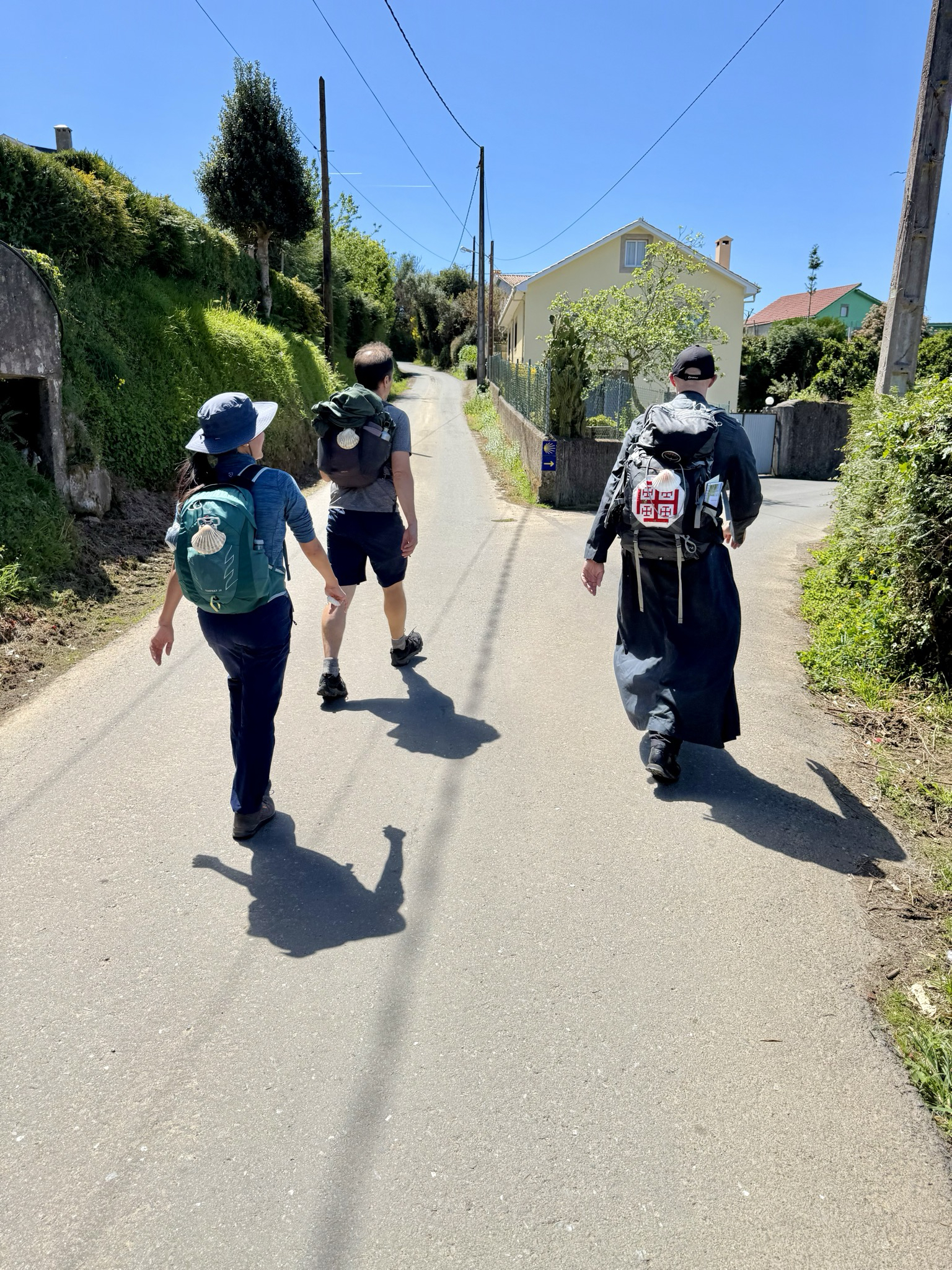
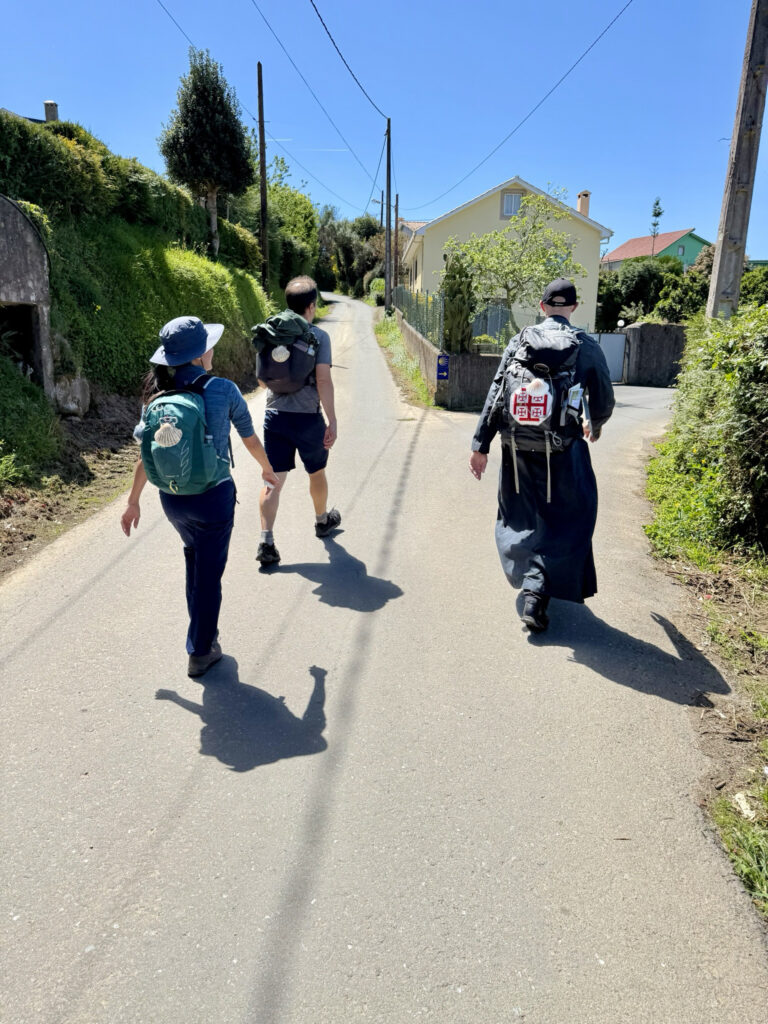
There were a lot of laughs and the sharing of snacks, blister pads and bandages as we walked and talked together, growing in friendship. I think we were mostly the “jovial” companions Father advised us to be, but that’s not to say conversations were all superficial; for the most part, they just seemed to develop organically as we got to know each other.
While we had prepared for rain — this being Galicia — we were blessed with mostly cool, sparkling, sunny days as we walked through the lush, green countryside. We followed stone-paved roads from village to village and wandered along dirt paths scented by flowering trees. Crumbling farmhouses stood beside modernized homes on the route, with blue-and-yellow Camino signs pointing out the way to Santiago. Stone crucifixes (crucieros) dating as far back as the 14th century dotted the road, serving as reminders of the pilgrims who passed this way before us.

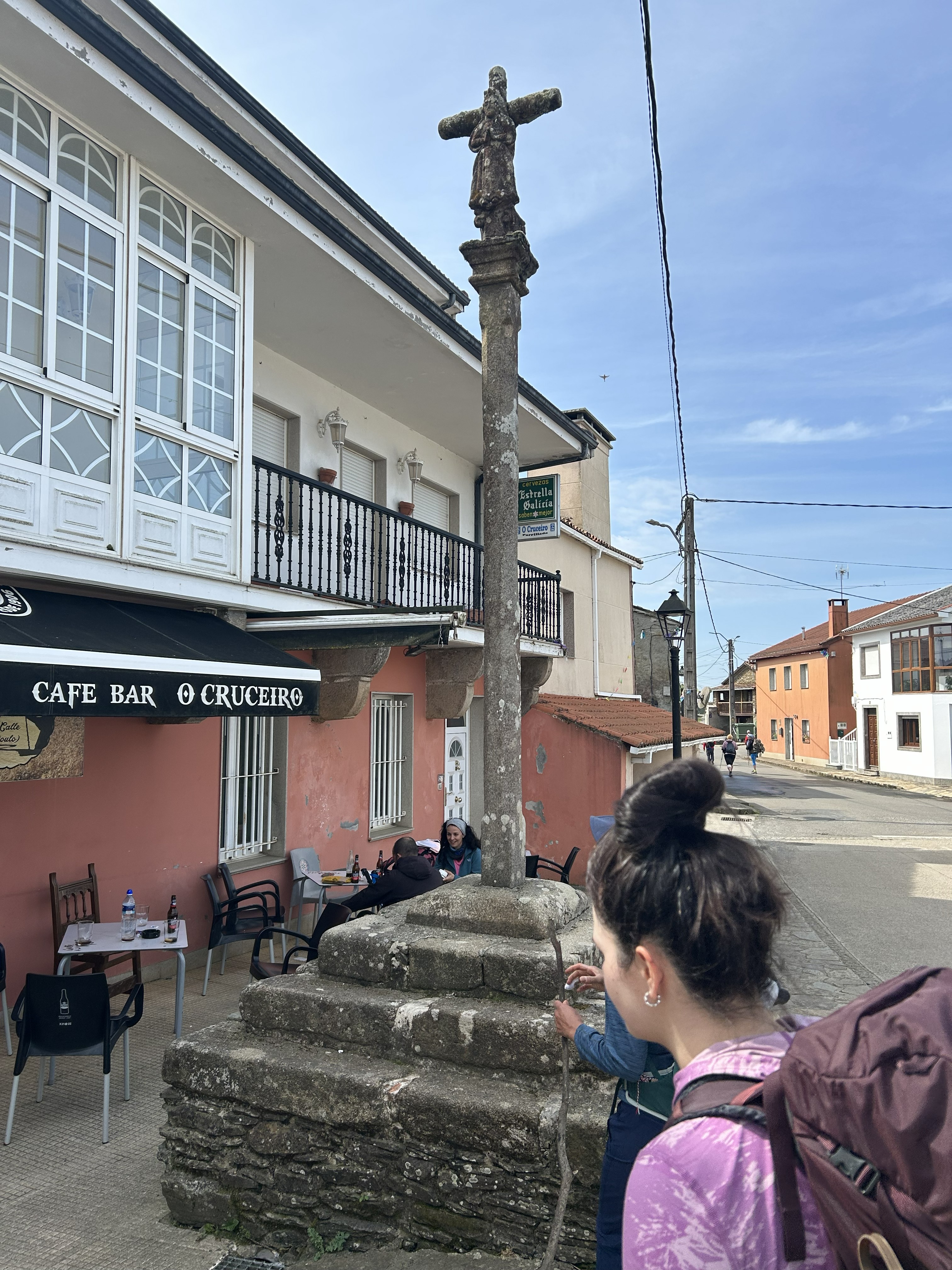
A highlight of each day — many said it was one of their favorite parts of the pilgrimage — would be stopping at roadside bars for coffee or beer and pinchos (Galician tapas that come with a drink) where we would inevitably see familiar faces. Since the Camino Inglés is one of the least-traveled routes of the Camino de Santiago, we practically had the route to ourselves.
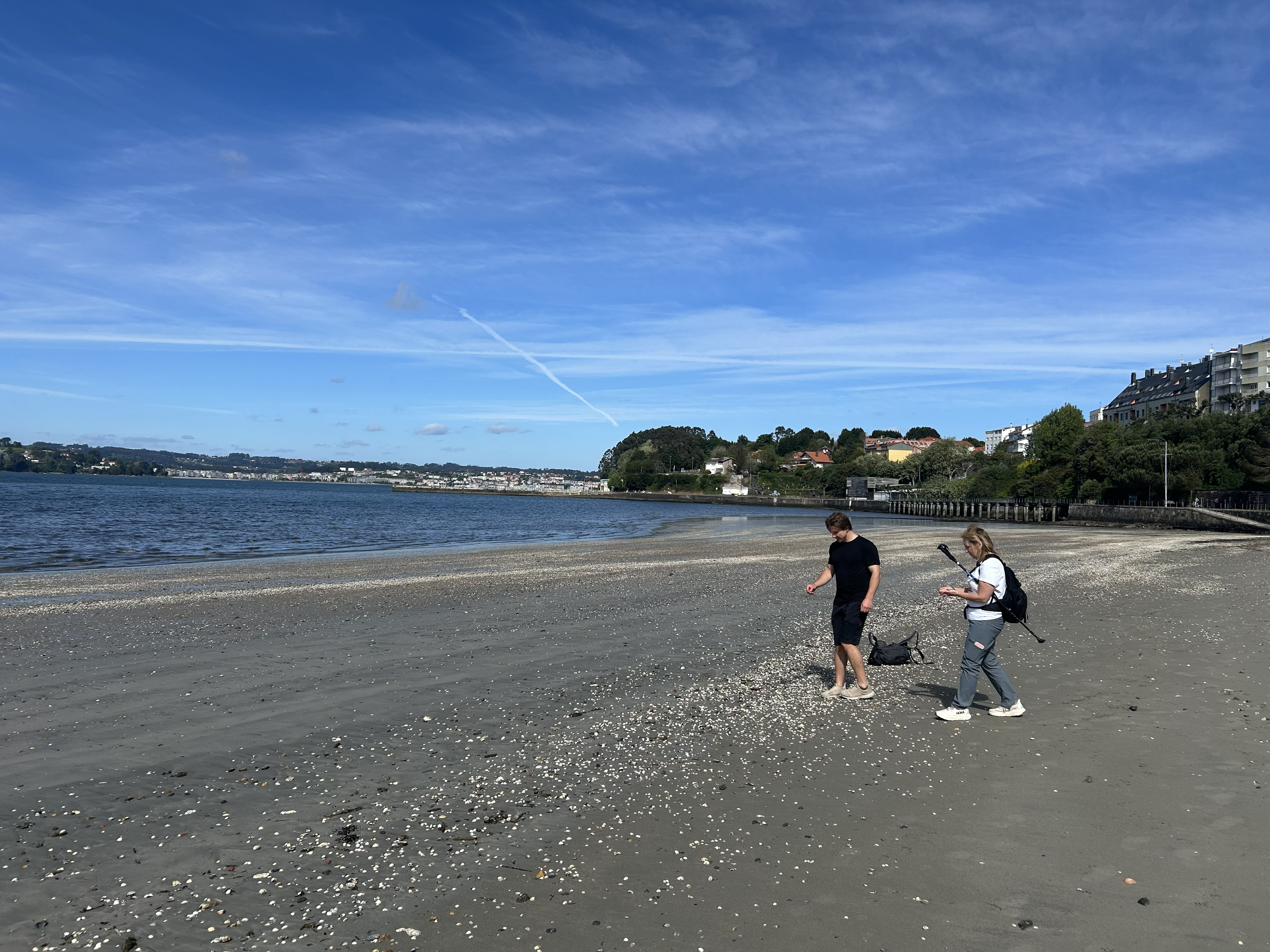
There was no rush. It felt like we had all the time in the world to share stories from the Camino: about the symphony of snores (and worse) at the albergue we stayed in the night before, about the wonderful café run by a woman who we later learned had decided to make welcoming peregrinos her vocation after recovering from a serious illness, about almost falling for a miles-long detour that was apparently designed to siphon foot traffic to a village (and its bars and cervecerias), and about a spur-of-the-moment picnic enjoyed on a deserted sandy beach just a mile off the road.

Stopping in bars along the route allowed each of us to find our own balance between the social and the spiritual. It was a chance to reset. You might stop in with one set of companions and leave with another group.
Or you might leave by yourself, suddenly finding yourself with nothing to do but pray and reflect for miles. And what a gift that was! Something about walking the Camino made praying come as naturally as breathing.

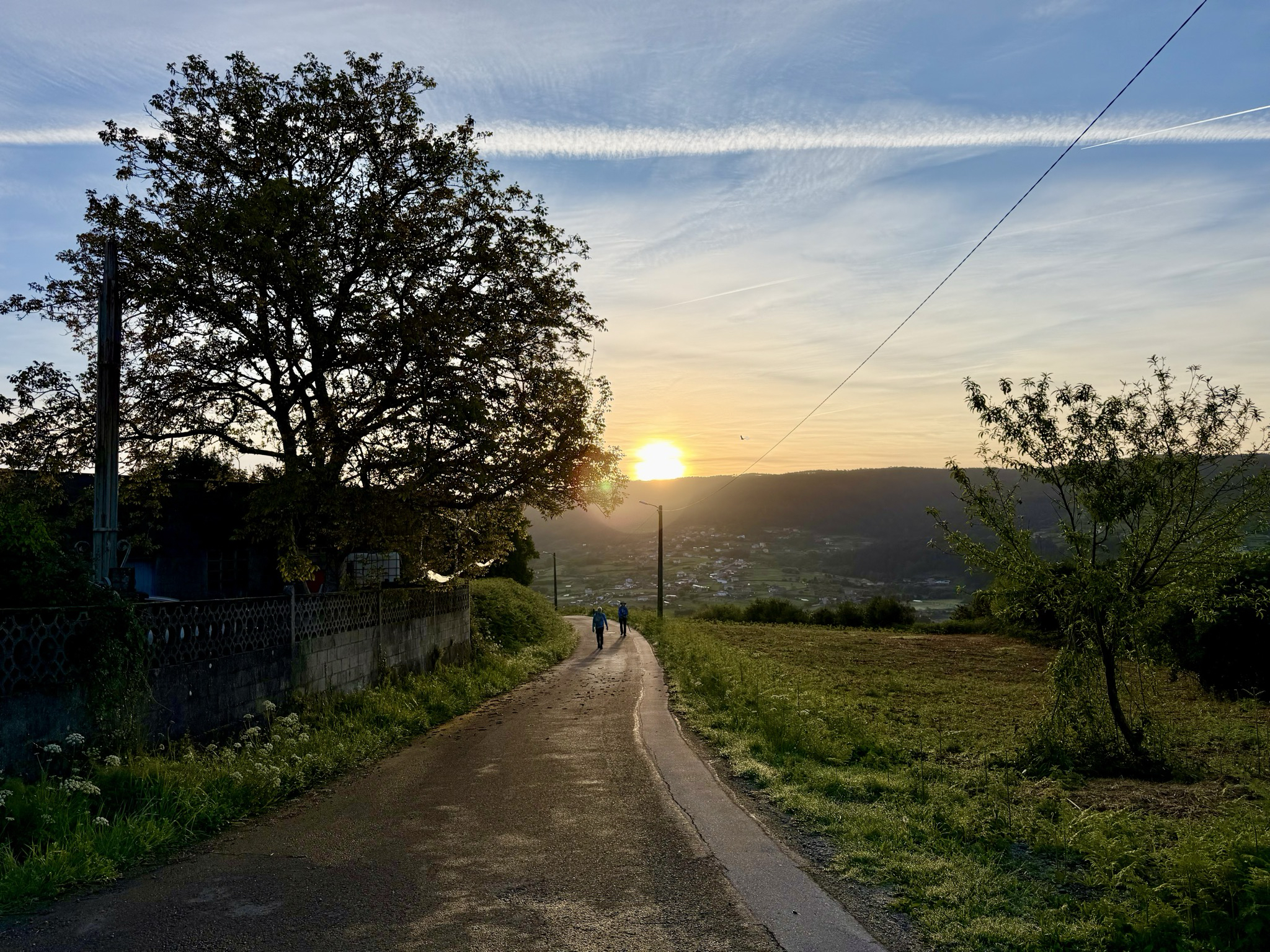
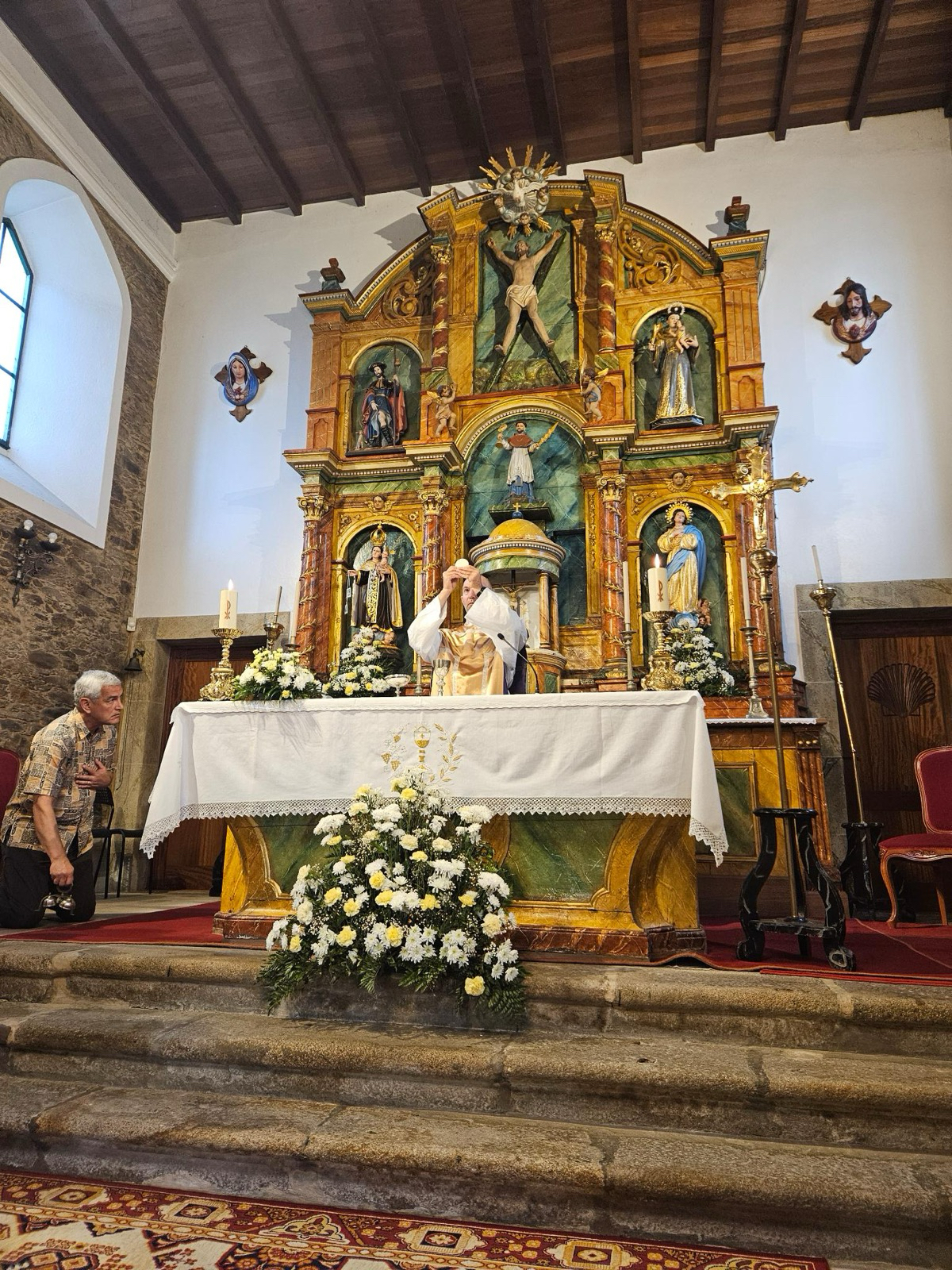
In the evenings, Father David would celebrate Mass at a church in the town where we were staying (I wish I had recorded our pilgrimage’s incredible cantor, Christa Nuno Schultz, whose hauntingly beautiful voice transported us to the Middle Ages).

Afterwards, we gathered for dinner at a restaurant offering a multicourse “pilgrim’s menu” of regional dishes that kept coming and coming, canceling out any calories burned from the day’s walk (it was worth it).
I soon began to dread the end of our pilgrimage, so much did I enjoy this daily rhythm and spending time with this group. It wasn’t lost on me, though, that maybe the Camino might offer lessons for “real life.” It might be possible to bring that same more prayerful and more social spirit to my life at home. Or at least try to.
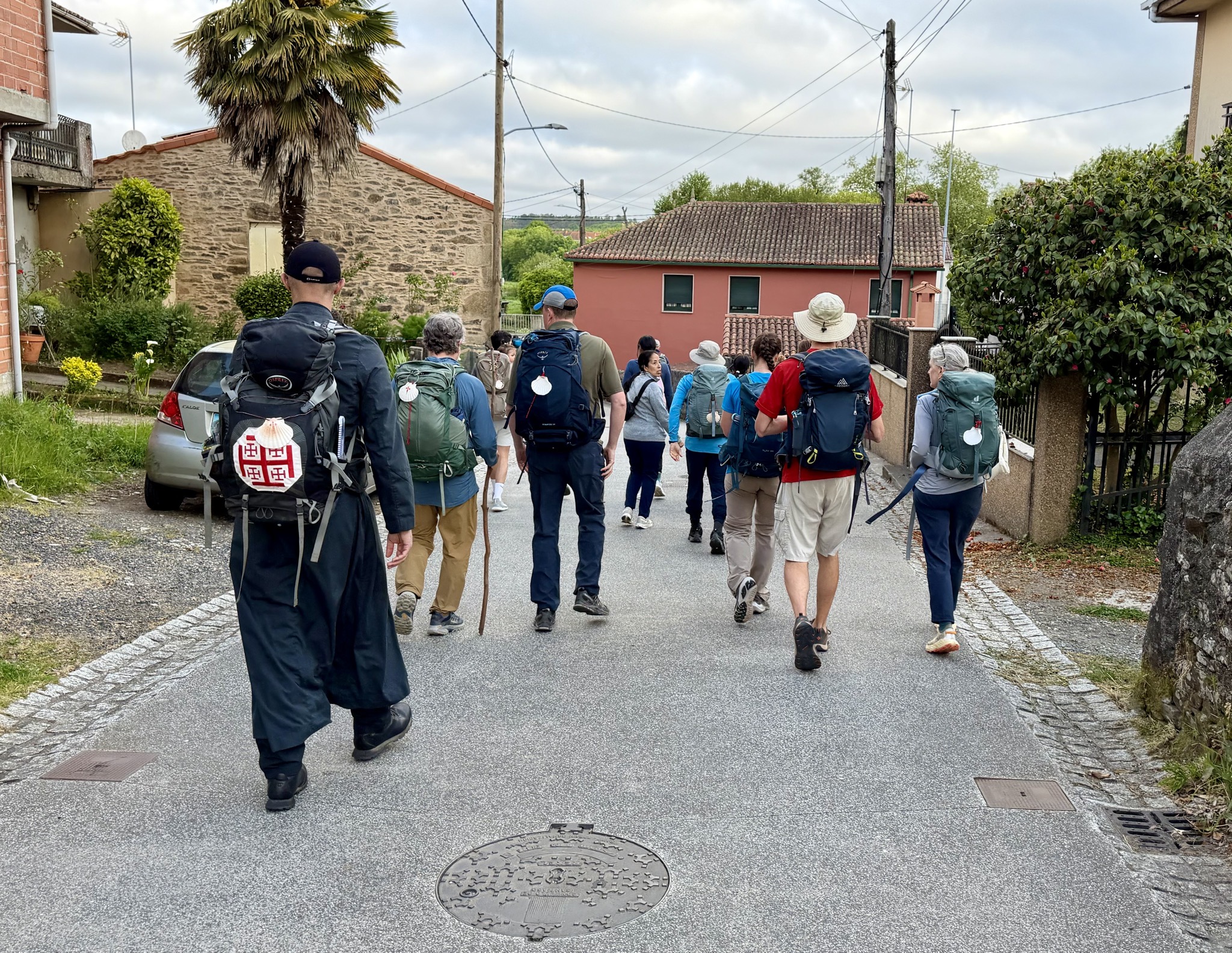
On the last day, we walked the final miles together as a group, from Sigüeiro to Santiago de Compostela, stopping at a church where Father David made himself available to hear confessions before we would reach the tomb of St. James in the Cathedral of Santiago.

After spending much of the last five days in prayer and reflection, I felt unusually well prepared to enter the confessional. My penance, Father said, was to be one Our Father at the tomb of St. James, where I could leave the last of my “baggage” and call on the apostle to be my intercessor in heaven.
As we approached the medieval center of the city, following the black-cassocked Father David, accompanied by the sound of bagpipes, I was walking on air. Some of us had picked up walking sticks along the way (as well as blisters) and were walking a bit more gingerly than before, but there was a palpable sense of triumph.

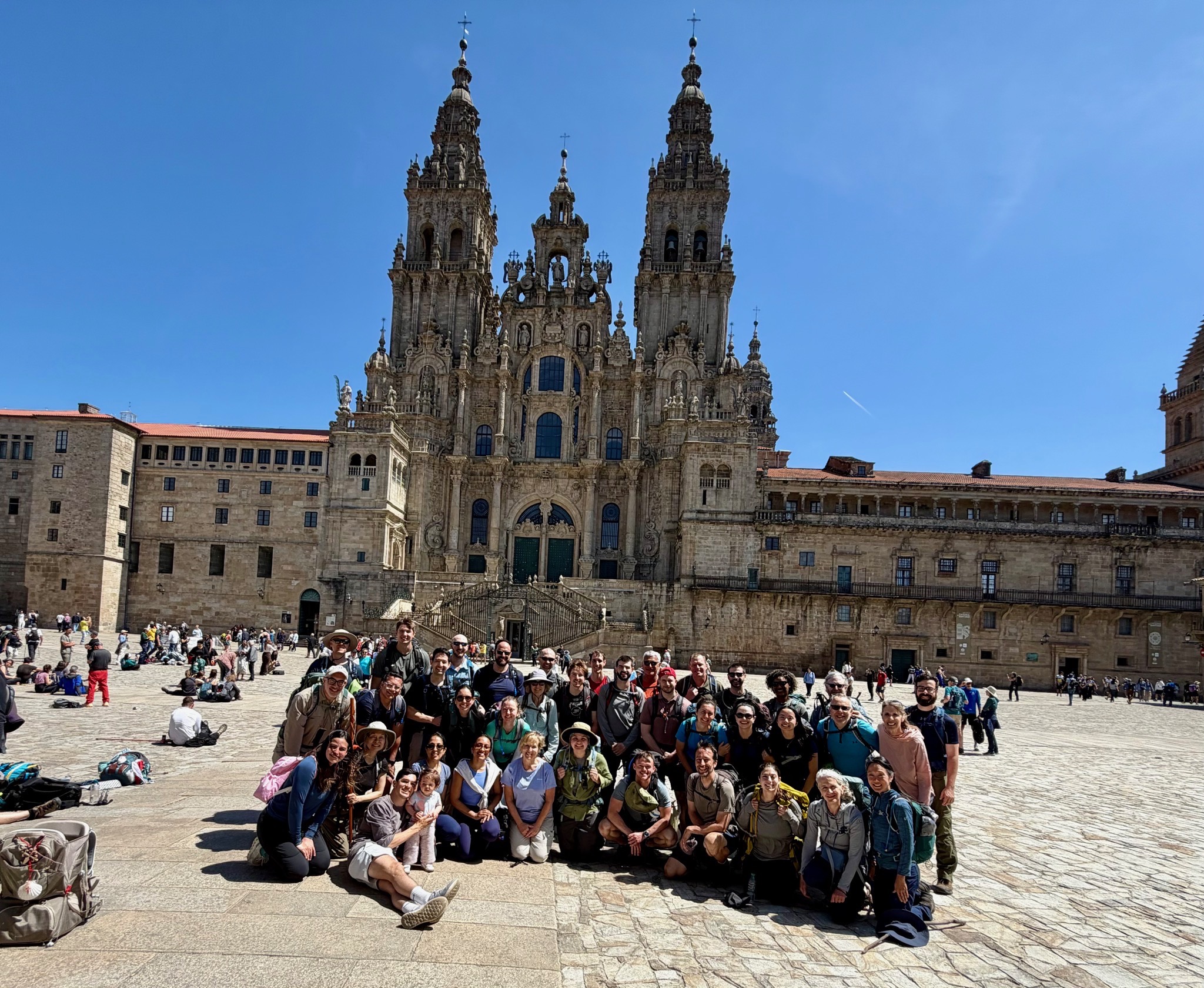
I headed to the cathedral to visit the apostle’s tomb, where I was surprised to find myself in line to “hug” the 13th-century statue of St. James, a traditional way pilgrims show gratitude to the saint. It ended up being a rather awkward embrace, as you have to reach from behind the statue. But it felt oddly familial, rather like the way you might show affection to a loved one who’s hunched over his laptop at the kitchen table. I bought a bookmark with an illustration of St. James on it so I won’t forget that I had asked him to be my intercessor.
At the final celebratory dinner, held at a restaurant located in the same building as the oldest hotel in Spain, the Parador de Santiago de Compostela, which was built in 1499 and once served as a hospital for pilgrims, we received our official Compostelas.
Mine certified “Griseldem Caldwell” (my Latinized name!) had completed the pilgrimage to the tomb of St. James on April 25, 2026, as an act of devotion. I later looked it up and was reminded that Zelda is a diminutive of the Germanic name Griselda, which means “grey battle-maiden,” which is appropriate enough in my case and made me like it more.
I plan to have it framed, but first I need to find a wall where I can display it — somewhere where there is plenty of extra space — because I definitely want to do this again.