<p><!-- BEGIN THEIA POST SLIDER --></p>
<p> <br />
</p>
<div>
<p>1968 was a turbulent year for America. As the Vietnam War raged and leaders such as Martin Luther King Jr. lost their lives at assassins’ hands, cities across the United States were convulsed by riots. </p>
<p>Amid the chaos, three men left the earth behind, trading the strife of the world below for the silent, contemplative vacuum of space. While orbiting the moon, they shared a Christian message with an enraptured audience of hundreds of millions. </p>
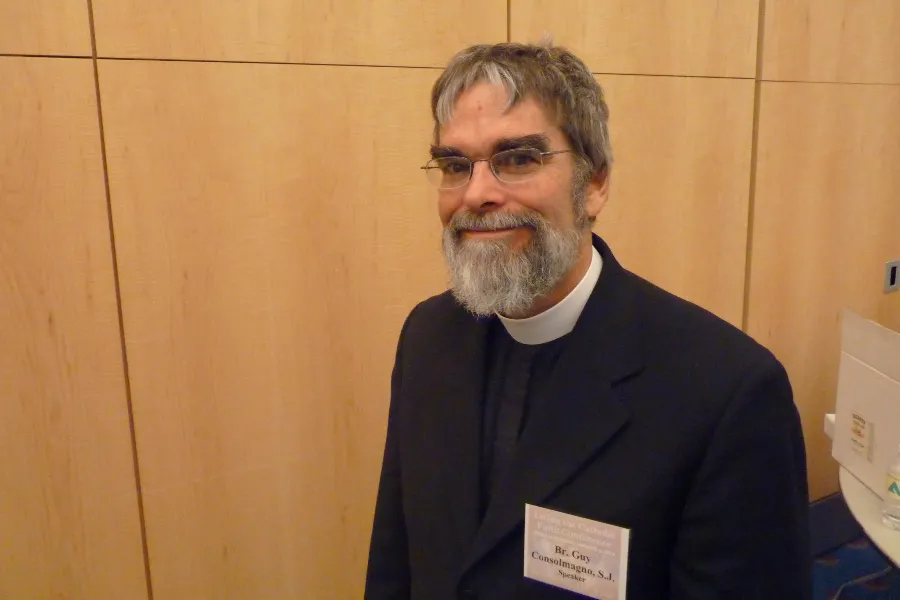
<p>Jesuit Brother Guy Consolmagno, a Ph.D. astronomer who directs the <a href="https://www.vaticanobservatory.org/" target="null" rel="noopener">Vatican Observatory</a>, told CNA that he remembers watching the NASA astronauts blast off while huddled with friends and family around a grainy TV set. He also remembers hearing the astronauts read a passage from the Bible — a choice that Brother Guy found unexpected and deeply moving. </p>
<p>More than five decades later, the Jesuit brother still loves talking about this episode from history. It helped set him on the path he’s on today, as a joyful practitioner of his faith but also as an accomplished scientist. The first Christmas in space was, he said, “fulfilling and affirming in a way that I would never have guessed.”</p>
<div class="embed-block"><img alt="Brother Guy Consolmagno, S.J., pictured on March 3, 2012. Peter Zelasko/CNA." class="img-fluid" src="https://admin.catholicnewsagency.com/storage/image/cna-4f5545902c465-7166.jpg"/></p>
<p class="embed-block__description">Jesuit Brother Guy Consolmagno, pictured on March 3, 2012 | Peter Zelasko/CNA</p>
</div>
<p>Mankind had dreamed of reaching the moon for millennia, but it wasn’t until the 20th century that it finally became achievable. The United States launched the Apollo program in 1961 in response to President John F. Kennedy’s challenge to put a man on the moon by the end of the decade. Amid the chill of the Cold War, the Soviet Union had been making strides in its own space program, and there were rumors that it would beat the U.S. to the moon. NASA shifted into high gear. </p>
<p>The mission on which the USA’s lunar ambitions rested, <i>Apollo 8</i>, was stunningly ambitious. The rocket they were planning to use had never carried a crew before, and a recent unmanned test mission, <i>Apollo 6,</i> had failed. </p>
<p>Worst of all, a 1967 fire in a test capsule claimed the lives of three Apollo astronauts. To say the odds were stacked against NASA would be an understatement.</p>
<p>Moreover, the timing of the mission was critical, as the distance between the earth and the moon varies. By NASA’s calculations in the fall of 1968, the optimum date for a shot at lunar orbit was just a few short months away, in late December. </p>
<p>By Dec. 21, 1968, a Saturn V rocket was ready on NASA’s launchpad in Florida, with astronauts Frank Borman, Jim Lovell and William Anders aboard. The Saturn V is the most powerful vehicle created by humans before or since, and at that point, it had never carried humans before. </p>
<p>After blastoff, the astronauts kept a running diary, chronicling sights no human had ever seen before. Borman, Lovell and Anders became the first human beings to leave Earth’s orbit and the first to glimpse the far side of the moon. Oh, and not to mention, they set a new speed record for the human race: 24,200 mph.</p>
<p>By Christmas Eve, <i>Apollo 8</i> reached lunar orbit. The spacecraft had a TV camera on board, and the men would send back a total of six broadcasts, the last of which was during prime time. It was this broadcast that Brother Guy remembers so clearly. </p>
<p>For the Christmas Eve broadcast, NASA hadn’t given the men any specific instructions on what they should say, only that they say something “appropriate.” </p>
<p>And so, with an audience of 1 billion hanging on their every word, Bill Anders spoke first, followed by Lovell, and then by Borman:</p>
<p>“For all the people on Earth, the crew of <i>Apollo 8</i> has a message we would like to send to you:</p>
<p>“In the beginning God created the heaven and the earth.</p>
<p>“And the earth was without form, and void; and darkness was upon the face of the deep.</p>
<p>“And the Spirit of God moved upon the face of the waters. And God said, ‘Let there be light: And there was light.’</p>
<p>“And God saw the light, that it was good: And God divided the light from the darkness.”</p>
<p>“And God called the light Day, and the darkness he called Night. And the evening and the morning were the first day.</p>
<p>“And God said, ‘Let there be a firmament in the midst of the waters, and let it divide the waters from the waters.’</p>
<p>“And God made the firmament and divided the waters which were under the firmament from the waters which were above the firmament: And it was so.</p>
<p>“And God called the firmament Heaven. And the evening and the morning were the second day.”</p>
<p>“And God said, ‘Let the waters under the heavens be gathered together unto one place, and let the dry land appear’: And it was so.</p>
<p>“And God called the dry land Earth; and the gathering together of the waters called the Seas: and God saw that it was good.”</p>
<p>The astronauts later said they picked the passage from Genesis 1 because of its importance not just for Christians but for many of the world’s major religions. </p>
<p>Brother Guy said the choice of that particular passage of Scripture was unexpected, but it made a lasting impression on him. </p>
<p>“I would have expected a Psalm about how the heavens proclaim the glory of God, but instead to have chosen that particular reading was an act of genius that I would never have thought of,” he mused. </p>
<p>“To hear the story of Genesis read out in that way, in that very respectful way, it was fulfilling and affirming in a way that I would never have guessed.”</p>
<p>On Christmas morning, the astronauts ignited the craft’s engine and headed for home. As they gathered speed, they feasted on a Christmas dinner of turkey, stuffing and small bottles of brandy. </p>
<p>A few days later, their spacecraft splashed down in the Pacific Ocean and an aircraft carrier picked them up. They had spent the first Christmas in space and made it home safely in time to ring in the new year, 1969.</p>
<p>The mission was an amazing achievement that galvanized the public, as the possibility of touching and traversing the lunar surface became all the more real. And by July 1969, the astronauts of <i>Apollo 11</i> would do just that.</p>
<p>There’s a sad side to this story, however. Anders, who read part of the Bible passage, said in later years that seeing the tiny Earth below them actually contributed to a loss of his Catholic faith — perhaps because it made the world, and his own life, seem so small and insignificant. </p>
<p>Moreover, the reading of the Bible passage rankled some viewers. One public atheist even filed a lawsuit against NASA, claiming the publicly funded agency was promoting religion — the Supreme Court later rejected the suit, but hard feelings remained in some quarters. </p>
<p>Brother Guy said the backlash wasn’t particularly surprising — after all, prominent atheists had publicly objected just a couple of years earlier when <i>A Charlie Brown Christmas</i>, which had an explicitly Christian message, had aired on network television.</p>
<p>“It shouldn’t be a political thing. Faith is for everybody,” Brother Guy said.</p>
<p>“What I have found in the world of science in the last 50 years is that there’s a much broader acceptance of faiths, many faiths of many people. That’s the joy of having diversity in the field now, not nearly as much as we ought to, but a heck of a lot more than we used to. [T]o express your faith is permission for other people to express their faith. And that enriches everybody.”</p>
<p><i>This article was first published on Dec. 26, 2022, and has been updated. A version of it appeared on CNA&#8217;s award-winning storytelling podcast, </i><a href="https://www.catholicnewsagency.com/podcasts/4/cna-newsroom" target="null" rel="noopener">CNA Newsroom</a>, <i>and you can listen to that episode </i><a href="https://soundcloud.com/cnanewsroom/ep-88-the-merriest-little-christmases?si=db782f56df8d43c5adce169453ca5c2c" target="null" rel="noopener"><i>here</i></a><i>.</i></p>
</p></div>
<p><br />
<br /><a href="https://www.ncregister.com/cna/jesuit-astronomer-remembers-the-first-christmas-in-space">Source link </a></p>
<p><!-- END THEIA POST SLIDER --></p>

Jesuit Astronomer Remembers the First Christmas in Space| National Catholic Register