


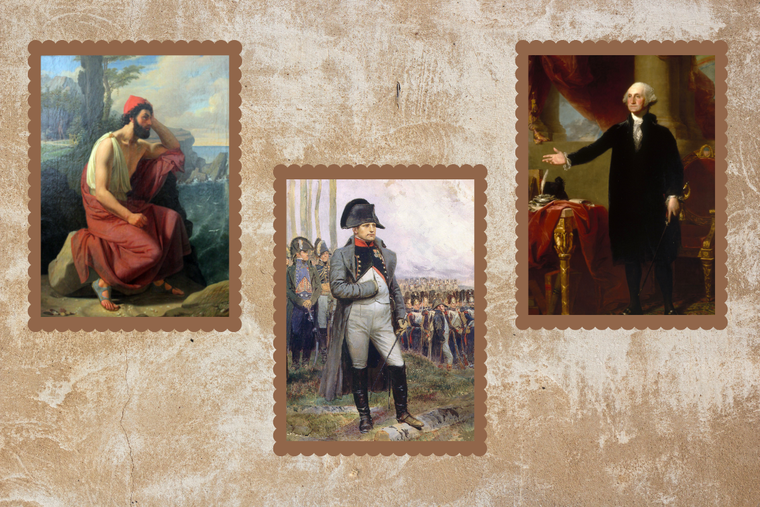
COMMENTARY: It is not quite true that we live in a post-heroic age but certainly true that our cynical modern era has real issues with heroism, whether sacred or profane.
It was the Welsh singer Bonnie Tyler who crooned in 1984, “Where have all the good men gone, and where are all the gods? Where’s the streetwise Hercules to fight the rising odds?” Holding Out for a Hero was a bombastic, catchy tune perfectly in sync with the go-go 1980s (and part of the soundtrack to the hit movie Footloose) but we’re still looking for heroes.
Director Christopher Nolan’s new version of Homer’s The Odyssey has become an event film, both praised and reviled, engendering a thousand hot takes equal to those thousand ships that Helen of Troy’s capture caused. Conservatives have both praised it and criticized it. Vanity Fair magazine gloated that the film “was going to drive the right wing completely insane” because it was a liberal/left riff on the ancient tale. Matt Damon’s Odysseus — tormented by his role in the Trojan War, morose and filled with regret — doesn’t seem very heroic or clever. Professor Emily Wilson, whose recent translation of Homer was used by Nolan, said that the film “has an interest in shame, but I don’t think it has any interest in glory.”
Some (especially a few conservatives) see the new Odysseus as being clearly “Christianized” in his journey and interpret a clear Christian or conservative subtext — repentance, homecoming, fatherhood, order — in the new film. Others who liked it perceived a liberal, Christian-lite message suffused in Nolan’s other films and essentially at odds with the original. But this latest take is not entirely a complete invention of the writer/director nor is it unique. Hollywood films are littered with weary, doubting protagonists. Nolan’s Oppenheimer and Odysseus are related, both filled with remorse over the super weapon, atom bomb and Trojan horse, they unleashed.
The Nolan conception is not created out of whole cloth. Homer’s Odysseus does weep remembering the fall of Troy and he is certainly not some sort of pagan Rambo. In the epic poem, he and his small retinue do unapologetically slaughter the 108 suitors who had invaded his home but Homer also makes it clear that this killing, justified as it was in ancient Greece, is a moral problem igniting a potential vendetta on Ithaca that is only solved through direct divine intervention. Nolan “solves” this dilemma in another way that does not involve Zeus and Athena.
I am glad that the film has provoked much heated discussion, although I do wish that director Nolan had been able to secure a better screenwriter.
It is not quite true that we live in a post-heroic age but certainly true that our cynical modern era has real issues with heroism, whether sacred or profane. While the world still loves its sports heroes, we’ve seen a type of idolatry in recent years directed toward unlikely figures like Dr. Anthony Fauci and activist Greta Thunberg. That ambivalence and schizophrenia is manifested in our partisan politics, culture and popular culture. For instance, Sir Ridley Scott’s Napoleon (2023) produced a disagreeable, “small” portrayal of the French emperor, a man both beloved and deeply despised even when he was alive. It was certainly hard to imagine that this impoverished portrait of Bonaparte was the great man who inspired armies and even charmed his enemies. Like Nolan, Scott seemed to want to turn an epic with a larger-than-life protagonist into a revisionist anti-war film starring a “lumpy, grumpy little man.”
But Hollywood is not completely anti-or post-heroic. Just watch a film starring Jason Statham, or anything from the Marvel or DC superhero franchise. The unabashedly patriotic Top Gun: Maverick made $1.5 billion at the global box office only four years ago.
Christian filmmaker Jon Erwin’s new film on Young Washington certainly presents its subject as heroic and generally stays faithful to the actual historical record, with a few embellishments and dramatic license. The biopic about the first U.S. president has been a modest hit and will have a sequel with the faith-based Angel Studios. Erwin had earlier made the excellent, quite heroic series House of David for Amazon Prime.
My sense is that people in our cynical, modernist age absolutely do seek heroes but are often discouraged and disappointed by them. Modern scrutiny being what it is, we’ve been burned too many times by disconcerting revelations of both living and deceased iconic figures. While Erwin’s King David and George Washington are clearly heroes, they aren’t portrayed as flawless (David certainly isn’t flawless in Holy Scripture). Indeed, Erwin portrays Washington as having inadvertently triggered a world war.
Angel Studios produced a careful, well-made 2024 film on Mother Cabrini that was generally well-reviewed but also criticized as dull. It was not a box-office success. But these days we are also seeing big superhero productions filled with action (Supergirl, The Marvels, The Flash) that are massive box-office flops. No one knows what will become a hit nor what will truly be influential and impact the culture.
Maybe Mel Gibson will actually make that epic miniseries on the Siege of Malta.
The Church is, of course, blessed with many heroes and not just that multitude of heroic figures worthy of emulation that we call saints. Perhaps this recent controversy around figures like Odysseus, Napoleon and Washington has lessons for us as well. Holiness and sacrifice certainly are types of heroism and it is a continuing challenge for Catholics, whether artists, clerics or the lay faithful, to effectively communicate those virtues as they were and are lived by very real people.
As people debate whether or not we are entering a post-literate or post-heroic age, we will definitely be in need of storytellers who can compellingly tell heroic stories that are beautiful and true.