<p><!-- BEGIN THEIA POST SLIDER --></p>
<p> <br />
</p>
<div>
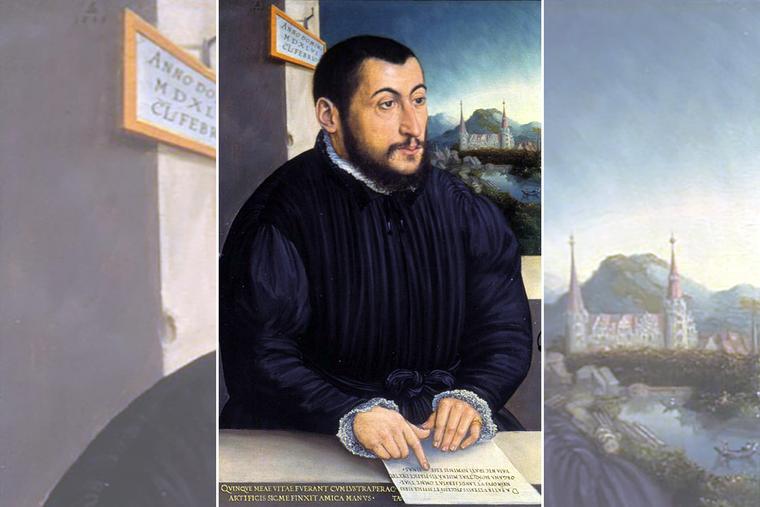
<p>SAINTS &; ART: Jesuit missionary St. Peter Canisius leveraged the printing press to counter Protestant errors and spread Catholic teaching.</p>
</p></div>
<div>
<p>St. Boniface, who lived on the bridge between the 7th and 8th centuries, is honored as the <a href="https://www.ncregister.com/blog/st-boniface-saints-and-art">“Apostle of Germany”</a> because of his work in Christianizing the pagans of those lands. <a href="https://www.newadvent.org/cathen/11756c.htm">St. Peter Canisius</a> (1521-1597) is honored as the second Apostle of Germany because, thanks to his labors, large parts of the German-speaking world were recovered for Catholicism in the 16th century.</p>
<p><b>St. Peter Canisius’ life coincided</b> with two major events in religious history: the Protestant Reformation and the founding of the Jesuits. Born in what today is the Netherlands, Canisius came into the world three-and-a-half years after Martin Luther launched his Reformation in Wittenberg. Protestant ideas were spreading fast: by that time, Zwingli was already pushing his version of the Reformation in Switzerland.</p>
<p>Peter went to Cologne to study law and theology, receiving a master’s degree in 1540. While in Cologne, he came into contact with influential Catholic figures. In 1543, he undertook the “Spiritual Exercises” under the direction of Peter Faber, one of the first generation to enter the Society of Jesus along with Ignatius Loyola and entered the Jesuits. In 1546, he was ordained. In 1549 he would make his solemn profession of vows as a Jesuit, received by Ignatius, and his doctorate in theology. Then began his labors in the German lands.</p>
<p><b>I say the “German lands” because</b> what in that language is called the <i>Deutschtum </i>extends beyond national borders to all those regions which, whatever their momentary political affiliations might have been, lay within and/or were strongly influenced by German culture.</p>
<p>Remember that what we today call “Germany” did not exist as one country until 1870 (and, even in our modern times, was split apart from 1945-90). “Germany” was a patchwork of independent cities, principalities and dukedoms, all nominally but loosely connected to the “Holy Roman Emperor” (an institution existing from Charlemagne in 800 to 1814). Austria had much earlier acquired its “Germanic” core and was fast becoming imperial. Switzerland was a set of confederated cantons that jealously guarded their autonomy and which almost came to civil war under Zwingli.</p>
<p>And there was strong German cultural influence in what we call Alsace and Lorraine, today in France (including the city of Strasbourg) as well as parts of Bohemia (today’s Czech Republic) and western Poland. Protestantism had gained a foothold in the region, both because many of the “founding generation” of Protestants were Germanic in origin and because the local rulers of this amalgam of jurisdictions often found playing the religious sides served their political benefit.</p>
<p>It was into that world that Canisius stepped again in 1549 (by which point the Reformation was also churning ahead in England).</p>
<p><b>For the next 10 years, Canisius would be</b> an indefatigable preacher, teacher and administrator across the <i>Deutschtum </i>and adjacent lands. Starting in Bavaria, that decade also included labors in Vienna, Lower and Upper Austria (those parts of today’s Austria abutting Germany and the Czech Republic), Prague, Strasbourg and Poland. He was proposed to become archbishop of Vienna but managed to get away after a year only as administrator. His visit to Poland helped launch the Counter-Reformation in that country that returned the nobility to the Catholic faith. (In Poland, in contrast to England, the power dynamic between king and nobility often pulled in the latter’s direction, which jealously guarded their privileges).</p>
<p>Being Jesuit, Canisius could not go anywhere without founding schools, and he served as rector of the University in Ingolstadt, Bavaria (a precursor to today’s Catholic University of Eichstätt-Ingolstadt, where I had the pleasure of studying in the summer of 1989). He was also involved with the movers and shakers of his day, including Hapsburg and later Holy Roman Emperor Ferdinand I, who had allowed a Protestantizing priest to serve in his court.</p>
<p><b>The period from 1559 to 1566 was a time</b> of some stability for Canisius, who was attached to the Cathedral in Augsburg as a popular preacher and confessor. It was only a matter of “some” stability, because while many ecclesiastical controversies swirled around Augsburg, Canisius also found time to establish Jesuit schools at Innsbruck in Austria and Munich in Bavaria as well as participate as a theologian at the Council of Trent.</p>
<p>Following the preaching period in Augsburg, Canisius was once more on the road, both in Strasbourg as well as Trier, which in part reclaimed the Rhineland for the Catholic Church, then back to Innsbruck, Regensburg and Ingolstadt. Throughout his life, he was also active in the congregations of his young religious order. His life attests to the merit of the old saying: “If you need something done, give it to a busy man.”</p>
<p><b>The year 1580 brought the last major stabilization</b> to his life when he went to Fribourg in Switzerland. Canisius helped reclaim the canton for the Church (neighboring Bern was Protestant) and laid the foundations for a Jesuit school in the city. He remained in Fribourg until his death: it’s said he had a vision of the city’s patron, St. Nicholas, telling him he should not leave the place. He died there in 1597 and was buried there, where he remains. He was canonized and declared a Doctor of the Church in 1925.</p>
<p><b>One reason for the rapid spread</b> of the Protestant Reformation was Gutenberg’s invention of the printing press. Canisius was an avid promotor of the printing press, urging its active use to promote Catholic writing. Not only did he promote printers, but his prodigious output also gave them enough work to print. His “Catechism” explained religious doctrine amid religious controversy to peoples not necessarily deeply religiously literate.</p>
<p>While always distinguishing between erroneous doctrine and the people who espoused it, St. Peter Canisius is perhaps to some degree in eclipse in some quarters because of his strong polemics with the Protestant Reformation. In some parts of the <i>Deutschtum, </i>the ecumenical impulse seeks to paper over religious differences that saints like Canisius or <a href="https://www.ncregister.com/blog/st-fidelis-of-sigmaringen-pray-for-us">Fidelis of Sigmaringen</a> confronted. As Germany struggles with its religious identity, let us pray to St. Peter Canisius for a new birth of Catholic religious commitment.</p>
<p><b>The painting of St. Peter Canisius</b> probably comes from the 16th century, the work of a monogrammist “AE.” It is held by the Alte Pinakothek in Munich and is the usual depiction of the saint. The date on the wall, 1546, marks the year of his ordination.</p>
<p>To read more, see <a href="https://www.newadvent.org/cathen/11756c.htm">here</a>.</p>
</p></div>
<p><br />
<br /><a href="https://www.ncregister.com/blog/saints-and-art-st-peter-canisius">Source link </a></p>
<p><!-- END THEIA POST SLIDER --></p>

St. Peter Canisius, Hero of the Counter-Reformation| National Catholic Register