<p><!-- BEGIN THEIA POST SLIDER --></p>
<p> <br />
</p>
<div>
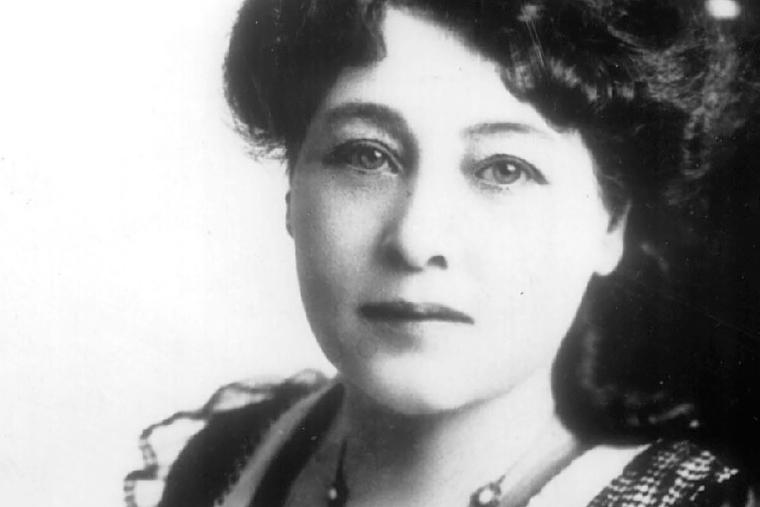
<p>After her prodigious output in the early 1900s, Alice Guy moved to America and launched a movie studio in New Jersey.</p>
</p></div>
<div>
<p>You’ve likely heard of the Lumiere Brothers, Georges Melies, and D.W. Griffith … but how about Alice Guy? A compelling case can be made that Guy was the first director of a narrative (fiction) film, way back in 1896. That she was a woman is groundbreaking as it is. But she was also Catholic, and her faith emerges in her filmmaking career, as we will see. </p>
<p>Guy’s parents, Marie and Emile, were married at the Church of the Sainte-Marie-Madeleine in Paris in 1863. Alice was the fifth and final child, born in 1873. At six, Alice joined two older sisters at a boarding school, Sacred Heart Convent, on the French-Swiss border run by the Faithful Companions of Jesus. </p>
<p>At 21, Gaumont Studios employed Alice as a secretary. In less than two years, Guy herself was staging narrative tableaux, a major turning point in film production. Before Guy, it can be argued, motion pictures were only limited to documentary-like snippets, a few seconds long, a brief glimpse into everyday life at the time. Her first probable film, now lost, was likely <a href="https://en.wikipedia.org/wiki/La_F%C3%A9e_aux_Choux"><i>La Fée aux Choux</i></a> (<i>The Fairy of the Cabbages</i>), an original story written by Guy, and only one minute long. In 1900, Guy directed<i> Les Fredaines de Pierrette</i>, a two-minute silent that predates Edwin S. Porter’s <i>The Great Train Robbery</i> by three years. Alice Guy was now head of film production for Gaumont, and her output of short vignettes — what commercials and videos were in the 1980s and TikTok videos are today — soared into the hundreds. </p>
<p>In 1900, Guy purchased a copy of the <a href="https://www.brooklynmuseum.org/exhibitions/james_tissot">Tissot Bible</a>, a popular work published in 1894. The artist James Tissot produced about 350 watercolors depicting scenes from the New Testament. The story of Tissot is fascinating in its own right — while visiting the Church of Saint-Sulpice in the heart of Paris, the successful artist of secular work experienced a heightened religious experience. He abandoned his current projects, traveled to the Holy Land, and set to work on what became known as the Tissot Bible. Alice Guy absorbed the work. </p>
<p>Meanwhile, Guy went on to direct <i>La Esméralda</i>, a 10-minute short from 1905 based on Victor Hugo’s <i>The Hunchback of Notre-Dame</i>. But it was a year later when the influence of the Tissot Bible emerged for Alice Guy in artistic form. Drawing on Tissot’s art for inspiration, Guy employed a hyper-realism style to<a href="https://www.youtube.com/watch?v=3lnT4Zt4pVI"><i> La vie du Christ</i></a><a href="https://www.youtube.com/watch?v=3lnT4Zt4pVI"> (</a><a href="https://www.youtube.com/watch?v=3lnT4Zt4pVI"><i>The Life of Christ</i></a><a href="https://www.youtube.com/watch?v=3lnT4Zt4pVI">)</a>. </p>
<p>The ambitious project was a huge undertaking for Guy artistically and Gaumont financially; there is little doubt Cecil B. DeMille, who would become famous for his larger-than-life biblical epics, scrutinized this film as a young man. Broken into 25 vignettes, beginning with the arrival into Bethlehem and concluding with the Resurrection, Guy shoots the familiar accounts of Christ’s life mostly in static wide shots, evoking Tissot’s watercolors. While this framing produces a stage-like, theatrical feel, it was still not quite common for the camera to cut between different shots in the same scene, or to move the camera. However, the wide angles, combined with excellent set design, creates a sense of authenticity, or in film terms, verisimilitude. Moreover, the film shifts from interior sets to outdoor sequences, such as scenes shot in the Fontainebleau forest south of Paris, that further this <i>cinéma vérité</i> flavor.</p>
<p>And yet, it should be noted Guy does break from common tropes of the time by using different shots, particularly depicting St. Veronica holding the veil in a striking medium shot. Guy also moves her camera in a long pan while Christ climbs Golgotha, another innovation of the time. The inclusion of Veronica and Guy’s emphasis on the women figures around Jesus clearly suggests her Catholic influence.</p>
<p>During production, while Guy is preoccupied with the pressure of making the film, she is the subject of sabotage from a Gaumont colleague. René Decaux sought to destroy the elaborate sets, and succeeded in tearing backdrops, resulting in delay and budget overrun — exactly Decaux’s plan, hoping it would result in Guy’s firing. But the head of the Gaumont board came to Guy’s defense, a famous Parisian civil engineer named Gustave Eiffel. </p>
<p>The film was shown at the Société Française de Cinématographie. According to the Société’s annual Bulletin from 1906, “The scenes were set with perfect taste with a talent for staging by Ms. Guy … each [scene] was greeted with lively and unanimous applause from the assembly.”</p>
<p>After her prodigious output in the first decade of the 20th century, Alice Guy moved to America and launched Solax, a studio in New Jersey. She continued to churn out one-reelers, prolific as rival D.W. Griffith at nearby Biograph during this time. But the outbreak of World War I effectively ground Solax’s momentum; it eventually went bankrupt. Guy’s career stalled and never recovered. She directed her last film in 1920, and would spend her remaining years in a kind of wandering limbo, unsuccessfully searching for copies of her old films while her daughter tried to raise awareness of Guy’s contribution to film history.</p>
<p>There is one more notable work from Guy — <i>My Madonna</i>, from 1915. Olga Petrova stars as Lucille, who poses for artist Robert in a Madonna painting. The two fall in love, and Robert goes on to great success, growing indifferent to his wife in the process. Accused of a crime he did not commit, Lucille believes in his innocence. She is now a charity worker helping the poor, and in this capacity helps clear Robert’s name. Though Robert is freed, he is a crushed man, believing Lucille has long left him after the way he ignored her. He walks into a church — where his Madonna painting hangs. Robert is despondent underneath the painting, believing he has lost the one person in life who truly loved him. Lucille herself then enters the church, and below their Madonna art the two reconcile and are reunited. The film fades out. Guy co-scripted the scenario, based on Robert W. Service’s poem, “My Madonna”:</p>
<blockquote><p>I haled me a woman from the street,<br /> Shameless, but, oh, so fair!<br />I bade her sit in the model’s seat<br />And I painted her sitting there.</p></blockquote>
<blockquote><p>I hid all trace of her heart unclean;<br />I painted a babe at her breast;<br />I painted her as she might have been<br />If the Worst had been the Best.</p></blockquote>
<blockquote><p>She laughed at my picture and went away.<br />Then came, with a knowing nod,<br />A connoisseur, and I heard him say;<br />“’Tis Mary, the Mother of God.”</p></blockquote>
<blockquote><p>So I painted a halo round her hair,<br />And I sold her and took my fee,<br />And she hangs in the church of Saint Hillaire,<br />Where you and all may see.</p></blockquote>
<p>Though Alice Guy is not as well-known as other moviemaking pioneers, her presence is critical for not only establishing film as an innovative way to tell visual stories with emotion and feeling, but also in the application of a strong religious conviction that clearly shaped her filmography, both during the height of her career, with <i>La Vie Christ</i>, and as it neared its end, with <i>My Madonna</i>.</p>
</p></div>
<p><br />
<br /><a href="https://www.ncregister.com/blog/alice-guy-catholic-pioneer-filmmaker">Source link </a></p>
<p><!-- END THEIA POST SLIDER --></p>

The Catholic Pioneer Filmmaker You’ve Never Heard Of| National Catholic Register