<p><!-- BEGIN THEIA POST SLIDER --></p>
<p> <br />
</p>
<div>
<p>From what can be gathered from the publicly restricted discussions at the Synod on Synodality, delegates talked a great deal about welcoming and inclusion, about some potentially radical changes in Church governance, and specific issues such as women’s ordination, homosexuality and immigration. </p>
<p>The focus, therefore, appears to have so far been primarily on the temporal, on matters clearly pertaining to this world and mostly according to merely worldly perspectives, both regarding the Church and society.</p>
<p>By contrast, how much has the essence of the faith and the supernatural been discussed? More to the point, when have the delegates spoken of the importance of the Church’s primary role as an instrument of the salvation of souls? Connected to that, how much has the reality of the Four Last Things — death, judgment, heaven and hell — figured in their discussions and deliberations? </p>
<p>Until relatively recently, the teaching of the Four <a href="https://www.ewtn.com/catholicism/teachings/last-things-49">Last Things</a> had been of great importance in the life of the Church, providing a framework for understanding human existence, morality and the afterlife. Given its significance in correctly orienting the faithful, it would presumably be a crucial point of reference in the synodal discussions whose overall theme is “Communion, Participation, and Mission.” </p>
<p>And yet the reality and profound significance of every person’s eternal salvation and a true and healthy fear of a just and righteous God has “barely been discussed in any of the [synod] sessions,” <a href="https://vitaminexp.blogspot.com/">wrote</a> Auxiliary Bishop Rob Mutsaerts of De Hertogenbosch in the Netherlands. Unsurprisingly, therefore, the word “salvation” appears just three times, and only in a seemingly cursory way, in the synod’s synthesis document that was published on Saturday. </p>
<p>Pope Francis, quoting Benedict XVI, stressed in his <a href="https://www.americamagazine.org/faith/2023/10/04/pope-francis-homily-opening-mass-synod-246198#:~:text=We%20are%20here%20to%20walk,all%2C%20a%20gaze%20that%20blesses.">opening homily</a> the importance of better communicating the Gospel “so that it becomes salvation,” but for the rest, the focus was on this world and how to avoid being a “rigid Church, which arms itself against the world and looks backward.” </p>
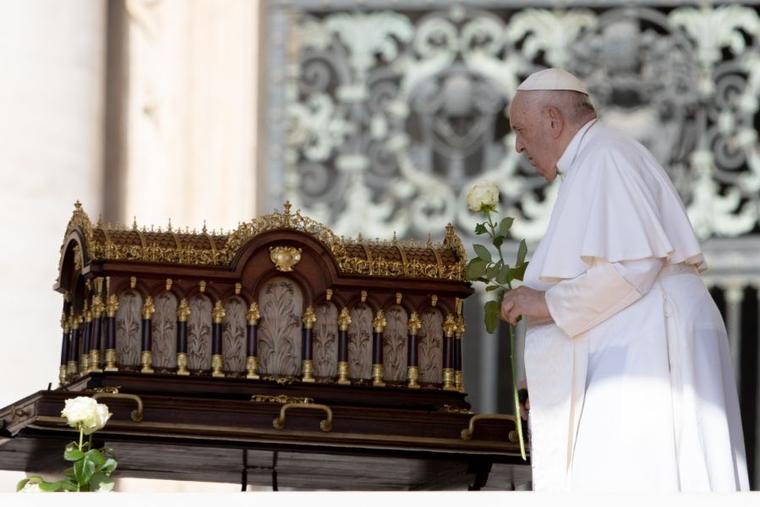
<p>This month, Pope Francis published <a href="https://press.vatican.va/content/salastampa/it/bollettino/pubblico/2023/10/15/0719/01566.html#en"><i>C’est la Confiance </i>(It Is Confidence)</a>, an apostolic exhortation to mark 150 years since the birth of St. Thérèse of the Child Jesus and the Holy Face. </p>
<p>Not mentioned in the document was one of St. Thérèse’s most cherished writings, a work by Father Charles Arminjon, a priest from the mountains of southeastern France. His retreat talks, primarily based on the Four Last Things, were turned into a highly acclaimed book entitled <a href="https://sophiainstitute.com/product/the-end-of-the-present-world/"><i>The End of the Present World and the Mysteries of the Future Life</i></a>, written in 1881 and currently back in print thanks to Sophia Institute Press<i>. </i> </p>
<p>Father Arminjon speaks powerfully and in a firmly uncompromising fashion about having heavenly aims rather than temporal enthusiasms — of not ignoring our heavenly destiny. So truthful and effective were his words that St. Thérèse said reading the book not only “plunged my soul into a happiness not of this earth,” but that she found it “one of the greatest graces of my life.” </p>
<p> </p>
<h3><b>Reality of Hell</b></h3>
<p>Perhaps its most searing and deliberately disquieting chapter is, predictably, on the reality of hell — a truth that is not mentioned in the synod’s final summary document and a subject that is so rarely mentioned in the Church today.</p>
<p>Father Arminjon’s chapter is arguably one of the most vivid descriptions of perdition in Christian literature, serving as a salutary reminder of what matters most in this life — loving the Lord above all things and placing him at the center of one’s life for our, and our brothers’, eternal good — and as a warning that, as the Bible teaches, the danger of ending up in hell is real for every person, and for more individual souls than one would dare to think. </p>
<p>St. Ignatius of Loyola, he recalls, used to say that he “knew of no sermons more useful and beneficial than those on hell.” </p>
<p>In part of the chapter, Father Arminjon writes:</p>
<blockquote><p>“St. Augustine tells us that the pain of damnation (loss) is the most terrible and incomprehensible of all the punishments of hell. … The damned person has the certainty that he has lost God, that he can no longer be united to the One who created him. He is forever deprived of the supreme good and of the sight of infinite beauty; and this knowledge causes him such an acute pain that it alone would be enough to enkindle the flames that consume him.</p></blockquote>
<blockquote><p>“During the present life, when we are weighed down by our earthly shell, amused and led astray by the spectacle of visible things, we cannot realize the immensity of such a loss; but when the soul is separated from the totality of creatures by death, it has no other object from which it can draw comfort. </p></blockquote>
<blockquote><p>“It becomes apparent to the soul that God is the only treasure and end; it rushes toward Him with all the force of its desires, and on that divine beauty concentrates its whole strength, its whole fervor, and the fullness of its aspirations.</p></blockquote>
<blockquote><p>“Imagine a fish cast out of its liquid environment, or a magnetic needle swinging continuously from side to side, without managing to settle in the direction of its pole, or a derailed locomotive plunging into a void — all these comparisons give us only an imperfect picture of the indescribable state of a lost soul, cut off from its final end and powerless ever to return to the right path. There is no future for it.”</p></blockquote>
<p>Most striking is how he stresses the eternal reality of the punishment. There’s no going back. The opportunity for the sinner to repent is no longer available and his devastating loss of God is total:</p>
<p>“What is certain, and what all theologians teach, is that the devils and the damned are deprived of every grace and supernatural enlightenment. In this respect, they are sunk in darkness and struck with an incurable blindness; but they lose none of their strength, nor the use of their natural faculties.</p>
<p>“… As Suarez says, the damned lack all probity of judgment in everything relating to the direction of their thoughts and desires and the right ordinance of their actions. Bowed down under the weight of their accursed state, the devils and the damned cannot adhere to the truth, and their minds aspire only to indulge in illusions and lies; their depraved hearts cannot open to love, and are always gnawed by hate; their imaginations are assailed by frightening phantoms and ever-recurring terrors. … </p>
<p>“When God relinquishes them at the moment of their unhappy end, He withdraws all that remains in them of theological virtues, such as faith and hope. He deprives them of their moral virtues, of strength, prudence, justice, temperance, disinterestedness, fidelity to the laws of honor, charm, and nobility of manners — virtues they have abused in order to serve their pride and its culpable satisfactions. He does not permit any trace of perfection to subsist in those whom He has rejected. </p>
<p>“Thus the damned are profoundly degraded beings; they do not have any respect, love, or compassion. As beings separated from the supreme good, they become supremely detestable and, like the devils, cannot inspire any feeling other than horror and execration. </p>
<p>“To form a better idea of their lamentable fate, let us imagine a town where the Cains and Neros and all other wicked men who have defiled the earth — men whom human justice gets rid of by casting them into dungeons and convict prisons — were put together. Let us further suppose that in this town there were no police or military to prevent these wretches from killing and tearing one another apart. Well, that would be hell such as it is described by the prophet Job: ‘a land … where no order but everlasting horror dwells.’ </p>
<p>“Such is the punishment of <i>damnation</i>. Having lost God, the damned have thereby lost all hope, all dignity, and all consolation.” </p>
<p>The book naturally has a chapter on purgatory and is balanced by eloquent subsequent reflections on the “Eternal Beatitude and the Supernatural Vision of God,” “Christian Sacrifice and the Means of Redemption,” and the “Mystery of Suffering in Relationship with the Future Life.” </p>
<p> </p>
<h3><b>Earthly Perdition</b></h3>
<p>But it’s Father Arminjon’s chapter on eternal punishment — a supernatural reality that, as the French priest rightly argues, has to exist otherwise there would be “no moral order” — that is by far the most sobering. </p>
<p>Father Arminjon reasons that hell has to be a reality or else, without the sanction of eternal punishment, “vice and virtue” would “reach the same conclusion” and would be “two means toward an equal security: that it is optional for man to follow one or the other as he pleases; and that the most sordid lives and the most pure lives are of equal merit and dignity, since both lead to the same perfection and happiness.” </p>
<p>He also underscores how, assuming all are saved or simply that hell doesn’t exist — a common but heretical belief widespread in the Church today and no doubt pervasive among not a few delegates in the synod hall — would naturally lead to hell on earth. </p>
<p>“Once such a scheme is granted,” he warns, “morality, public order, and all semblance of honesty must disappear from the earth. Justice is stripped of its sanction; conscience is prejudice; virtue and sacrifice are a stupid exertion. Remove the fear of eternal punishment from mankind, and the world will be filled with crime; the most execrable misdeeds will become a duty whenever they can be committed without risk of prison or the sword. Hell will simply happen sooner: instead of being postponed until the future life, it will be inaugurated in the midst of humanity, in the present life.” </p>
<p>As the Synod on Synodality enters its second phase, its delegates and organizers might recognize that today’s society has been on this path for some time, and that their seeming determination to accommodate the world and its values through this process may, rather than making the Church more effective in saving souls, be achieving the opposite — and with consequences too horrific to contemplate.</p>
</p></div>
<p><br />
<br /><a href="https://www.ncregister.com/commentaries/the-synod-on-synodality-st-therese-and-the-unspoken-reality-of-perdition">Source link </a></p>
<p><!-- END THEIA POST SLIDER --></p>

The Synod on Synodality, St. Thérèse and the Unspoken Reality of Perdition| National Catholic Register