


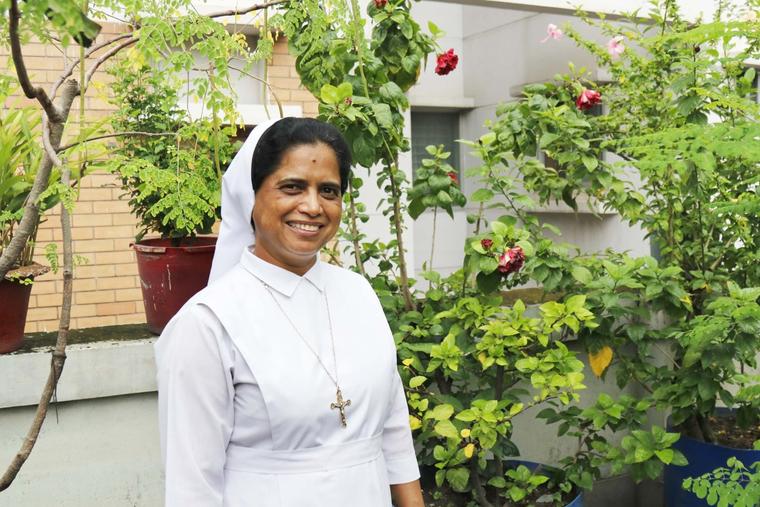
Sister Lipy Gloria Rozario has been on the front lines against Bangladesh’s rising suicide crisis, offering psychological counseling services in the Muslim-majority nation since 2010 as founder and director of the Healing Heart Counseling Unit (HHCU).
Sister Lipy Gloria was born in 1971 during Bangladesh’s war of independence with Pakistan. She joined the sisters of Our Lady of Sorrows in Italy, taking her final vows in 2001. She holds a bachelor’s degree from Rome’s Libera Università Maria Santissima Assunta and a double master’s degree in spirituality and counseling from Santa Clara University in California. The first person in her country to hold a Ph.D. in counseling, which she received from Dhaka University in Bangladesh, she is currently an adjunct faculty member of Dhaka University’s Department of Educational and Counseling Psychology.
Sister Lipy Gloria provides training related to professional counseling at HHCU for NGOs and religious organizations. She specializes in building awareness in the country through social media and school seminars, believing it is possible to prevent suicide through mental-health support.
The religious sister, who is not related to Register correspondent Stephan Uttom Rozario, recently spoke with the Register about suicide prevention and Pope Leo’s call to pray for those living in darkness and despair.
What is the significance of Pope Leo’s recent call to prayer for the prevention of suicide?
In November, we remember the dead and think about our deaths, so that we can walk on the right path, on the path shown by Jesus. For example, how aware am I of my neighbor or their mental status, and what can I do to help?
It is our responsibility to see how our neighbors are and know what they are doing. People commit suicide when they have no other options. We should talk to them and try to show them the right path. It is important that we be kind to each other and forgive others.
What is the situation of suicide like in Bangladesh?
There is no new research on suicide in Bangladesh. However, I have learned through the newspaper that 54 people commit suicide every day in Bangladesh. Recently, 62 suicides were reported in the city of Gazipur district, near the capital, Dhaka, in October. But the number of suicides in the entire district is unknown. The police say that most of these 62 suicides were committed due to family conflicts and financial problems. While the suicide rate is decreasing in the world, it is increasing in Bangladesh.
What are the main motives for suicide?
Suicide among university students is very high. They do not have the financial solvency required for their studies or know what they will do for work after completing their studies, and they get depressed and commit suicide. They also tend to commit suicide due to their love and relationships, especially due to breakups.
Many people have financial and family problems, which create depression, and they choose the path of suicide. They can’t see the point of living in suffering so much. For example, one of my clients was saying, “I do not see one reason for my survival.” This is alarming for us.
We definitely need research because without research the real picture cannot be obtained. Then people will understand those who are suicidal and talk to them, inform their family, stand by them, or take them to treatment.
Is suicide common in the Christian community?
Yes, I have seen many cases in my area, despite a lot of religious formation. We have to be more aware and talk about the three aspects of body, mind and spirituality. Leaving out the mind and the body is not possible. We also have to work on our mental health from a spiritual perspective, in a holistic way. Our Church needs to bring this mental-health component into our discussions. We need more in-depth work and to learn from trained people.
Why did you become interested in working with this counseling ministry?
I saw people who were victims of mental abuse and physical abuse, as well. I thought about how to save people from this, and I saw that studying psychology could be the way.
The Gospel of St. Mark attracted me the most because it talked about many miraculous works, such as healing the sick. I am not a doctor, but I am interested in how to heal the sick.
What work are you doing now?
From the very beginning, I have felt the lack of skilled manpower in the field of counseling. And so, we arrange training at our center. Those who have degrees in psychology from various universities come here and gain practical experience. Those who plan to work in mental health come here and receive training.
Some trainings are open to all, where teachers, NGO workers or others participate. Training is my main focus. Rather than spending a lot of time healing one patient at a time, it is more effective to train others who will heal many patients. I also work directly with clients two days a week.
What kinds of initiatives can be taken at the government or private level to prevent suicide?
The government of Bangladesh has not taken any initiative and has no budget for mental health. So people are working on it in a private setting.
The work we are doing is not recognized by any kind of government [entity], and we do not have a license. It is clear how backward we are due to how much we are neglecting the issue of mental health. For example, just as doctors or nurses have licenses, those who work with mental health also need to have licenses. When we tell them, the government remains silent.
How do you care for a client who is at risk of suicide?
You have to listen carefully to the person. At the same time, understand or find out the reason why they want to commit suicide. Their feelings are valid.
We sign an agreement with them, a form that says that everything they say will be confidential. Only if they have suicidal tendencies do we discuss it with their family. Then we make the family aware of how to keep them safe.
How much awareness is there about suicide and mental health in our Catholic society?
I recently talked to a parish priest about whether it is possible to talk about mental health with everyone after Mass on Sunday. He did not show much interest. I think we need to do awareness work. Because we have to love our neighbors as we are. But if we are not good ourselves, how can we love others? So we need to bring these issues to the discussion in our Church.
We see the opposite, for example, when we want to talk about suicide in school. The teachers say that if we talk about suicide, the students will be more inclined towards it. Our thoughts do not match the thoughts of these teachers. There is a big mistake in our mentality here.
How can we end suicide?
I know about 25 to 30 priests and religious sisters who have studied psychology abroad. But I don’t know why they don’t work with people or why they have kept their training to themselves. We have to come forward together. This initiative has to start at the Church level.
The health commission of the Catholic Bishops’ Conference of Bangladesh should be included here. But they have not accepted it either. There is a problem here, a lack of knowledge. This coordinated initiative has to come from above. I am trying, but they must take the initiative.
Suicide is contrary to the dignity of life, as the Catechism of the Catholic Church explains, but help and hope are available. If you or someone you know needs help immediately, call or text 988; Catholic resources may be found here.
Editor’s Note: This interview has been edited for length and clarity. Stephan Uttom Rozario is a journalist and photographer based in Dhaka, Bangladesh.