


Feminism enjoys nearly universal acceptance across today’s political and intellectual landscape. To declare oneself antifeminist in 2026 is often enough to be labeled as indifferent to women’s dignity, hostile to progress, and suspect even among some conservatives. The legitimacy of feminism itself is rarely questioned but treated as a necessary stage in women’s liberation process.
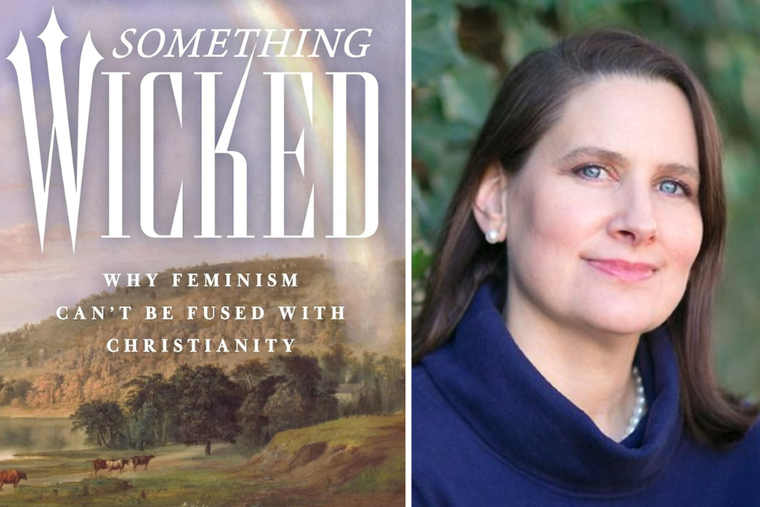
It therefore takes a measure of intellectual courage to oppose the established narrative. This is precisely the task that Carrie Gress, a Catholic scholar and philosopher, has been pursuing for several years through a series of books.
In her latest work, Something Wicked: Why Feminism Can’t Be Fused With Christianity, Gress does not merely argue that feminism has gone too far or lost its way. She argues bluntly that feminism is intrinsically flawed, being itself a heresy of late Christianity — one that borrows Christian language while ultimately emptying it of Gospel truth.
‘More Harmful Than Communism’
Gress doesn’t approach feminism as a movement in need of reform, but as an ideology that must be judged by its fruits, in other words by what it has actually produced in the lives of women, men and families.
She does so by placing feminism alongside other modern ideologies that claimed moral authority while hollowing out Christian teachings. In the 1940s, as highlighted in Something Wicked, Pius XII commissioned Fulton J. Sheen to analyze communism not only as an alternate political system but as a counterfeit religion, a deeply disordered and destructive ideology. Feminism, Gress argues, deserves the same diagnosis.
“I actually think feminism has been more harmful than communism,” she told the Register, “Because people don’t have their guard up against it.” She believes that, like Marxism, feminism borrows a moral vocabulary of equality and justice but reorders it around conflict — no longer class struggle, but sex struggle.
This logic, Gress argued, was present from the beginning, and early feminism took shape in explicit opposition to Christianity itself. She grounded this claim in history with the famous example of Mary Wollstonecraft, often portrayed as the movement’s pious founding mother. “Historically, that’s very inaccurate,” Gress said. A protégé of the radical Enlightenment thinker Richard Price and an enthusiastic supporter of the French Revolution, Wollstonecraft, she explained, was a unitarian by conviction: She believed any male mediator between woman and God suppressed female potential, including Christ himself. From its origins, Gress added, feminism was not seeking to reform Christianity but to replace it with non-Christian egalitarianism.
The consequences are visible today. In Something Wicked, she states plainly that feminism has been responsible for “much of the decay of the Christian West over the last two centuries.” It has, she said, effectively “decapitated the family.” Gress traces this logic back to the French Revolution itself: It is no accident, she noted, that the guillotine became its emblem. “Just as the Revolution symbolically severed the head of the king, it also severed the authority of the Church from society and the father as head of the family.” Feminism today, she insisted, does not merely coexist with abortion, family breakdown, or sexual atomization — it requires them for the sake of radical autonomy.
The Autonomy Idol and the Sin of Envy
What Gress sees as a modern obsession for autonomy is, for her, one of the main expressions of the feminist ideology. “The key question,” Gress said, “is whether independence has become an idol focused on the self, or whether it’s a healthy female agency lived in relationship with God and service to others.”
Feminism, she lamented, promises emotional liberation yet intentionally cultivates anger, resentment and contempt. It speaks endlessly about feelings, but rarely about love as sacrifice. “That’s why so many women are losing the capacity for empathy,” Gress argued.
For Gress, this cult of autonomy that “ultimately isolates and exhausts women” coexists with a specific moral disorder: envy, a sin she believes modern culture — and feminist discourse in particular — largely neglects to name. “That’s what really drives feminism,” Gress said. “It’s the envy women have toward men, the life they think men have. This is what we’ve been sold.” Just as lust has long been recognized as a recurring sin for men, she added, envy has become the emotional fuel of feminism. In her view, feminism feeds on a constant comparison that persuades women that fulfillment lies in acquiring what men are perceived to have: authority, freedom, status and fewer constraints.
A Christian Heresy Based on Historical Amnesia
At the same time, she acknowledged a paradox many Christians intuit but rarely articulate: Christianity made feminism possible. “It builds on the Christian idea of the equal dignity of women,” she noted. It also borrows Christianity’s concern for victims and compassion for suffering. But here lies the distortion. “Those instincts are severed from their Christian source and turned against it.” One reason this replacement succeeded, Gress argued, is historical amnesia.
While feminism presents itself as a necessary response to centuries of female invisibility, Christian history tells a different story. “You don’t raise armies like the very Catholic Queen Isabella of Spain did if you’re enslaved by your faith,” Gress observed, while listing the accomplishments of Catholic women, like the medieval women who founded abbeys, educated nations, advised kings, financed culture, and in some cases even led armies.
What feminism framed as unprecedented liberation was often a rediscovery already underway, largely through the Church itself. One important example mentioned in the book is that of St. Elizabeth Ann Seton, who, in the early 19th century, founded schools for girls across the U.S., staffed by religious women who themselves had to be highly educated. By the end of that century, Catholic women religious were, as Gress emphasized, among the most influential educators in the country.
The irony, Gress noted, is that feminism arose from very specific conditions in England and then presented itself as a universal answer at the cost of erasing large parts of Christian history in which women held real authority.
From Ideology to Vocation
If feminism is a false solution, Gress stated, its reactionary mirror is no answer either. She is critical of certain contemporary countermovements, particularly within the American “manosphere,” which responded to feminism by swinging to the opposite extreme. “It’s the pendulum effect,” she says of men answering contempt with contempt. “In these circles, womanhood is often reduced to a narrow, idealized role that is no more Christian than the ideology it claims to resist.”
For Gress, this impasse reveals that both feminism and its backlash remain trapped in the same logics of power, radical autonomy and resentment.
Christianity, she concluded, offers a different horizon: one centered on vocation rather than ideology. Guided by a Christian approach to vocation, couples discern together, over time and according to circumstances, how God is calling each of them to live and serve.
The way forward, then, is neither an ahistorical caricature of the past nor a battle of the sexes, but a recovery of discernment: learning to receive one’s life as a vocational calling and to measure it not against abstract ideals of power or success but against faithfulness to the gifts entrusted to us by God.