<p><!-- BEGIN THEIA POST SLIDER --></p>
<p> <br />
</p>
<div>
<p>Pope Francis recognized this Armenian saint for his deep theological insights — yet many Catholics still don’t know his name.</p>
</p></div>
<div>
<p>If you don’t know who St. Gregory of Narek is or never heard of his feast before, you’re not alone. He’s a relatively new addition (ca. 2001) to the Roman Calendar and even only more recently (2015) declared a doctor of the Church. So, let’s get to know him.</p>
<p>Gregory was from Armenia, today a small mountainous country wedged between Turkey, Azerbaijan, Iran and Georgia, with problematic territories in Russia (think Chechnya) not too far away.</p>
<p>To the extent most Americans know anything about Armenia, it’s that somewhere between half a million to 1.5 million Armenians died between 1915 and 1917 at Islamic Ottoman Turkish hands in what Armenians call “genocide,” a term Turks deny.</p>
<p>The other thing Americans might have heard of is “Nagorno-Karabakh,” an Armenian exclave (Armenian territory not contiguous to Armenia) inside Islamic Azerbaijan. The territorial dispute arises from the fact that both modern-day Armenia and Azerbaijan were parts of the Soviet Union that gained their independence around 1991 but within borders that had been defined internally by the USSR.</p>
<p>As long as everyone was within the Soviet prison, the system worked, but upon independence, those lines produced “frozen conflicts” — standoffs that often got hot for the people involved — in Armenia/Azerbaijan, Georgia, Moldova and Ukraine. Azerbaijan seized Nagorno-Karabakh by force in 2023 and has been ethnically cleansing Armenian Christians.</p>
<p>Which brings us back in history. Westerners largely tend to be ignorant of anything east of Germany, so few realize that the first officially Christian country in the world was … Armenia. Christianity has been long rooted in the South Caucasus.</p>
<p>But Christianity in that part of the world was riven by division long before the Orthodox Schism of 1054. As Armenia was becoming Christian somewhere in the early fourth century, Christianity itself was horribly divided by various Christological and Trinitarian heresies. Those heresies struck to the very heart of who Jesus — indeed, who God — was. Was Jesus really the eternal Son of God? Was he really human in every essential sense of that word?</p>
<p>Those were questions that could not just be papered over nor were they going to go away overnight. Indeed, it took multiple ecumenical councils more than two centuries to make clear the requirements of Christian faith. During that time, the losers kept up a virulent resistance. Even after everything was settled, that didn’t mean all the resistance went away. They often went off and continued as their own “churches,” often in remote places — like Armenia.</p>
<p>Fast-forward to the 10th century. A boy named Gregory was born around 950 near Lake Van, then one of the leading Armenian kingdoms of the day in terms of culture. Today, that area is in eastern Turkey and was among the regions “de-Armenianized” between 1915 and 1917.</p>
<p>Gregory’s mother died while he was still very young, so he was raised by his widowed father. As a widowed father, he was eligible to become a bishop, so Gregory grew up in Church surroundings.</p>
<p>He grew up in tense Church surroundings because his father held to an orthodox understanding of Christology, apparently a minority among Church leadership in the area. (Remember that Sts. Hilary of Poitiers and Athanasius were exiled as bishops because they were faithful to Church teaching on Christology.)</p>
<p>Gregory later was educated in the Narek monastery, ordained a priest in 977, and remained there teaching theology until he died around 1005. One source said he was buried there and rested in peace until the 20th century, when it claims Turkey turned the monastery into a mosque.</p>
<p>So, what’s so great about him that he got into the calendar of saints and was even proclaimed a doctor of the Church?</p>
<p>Apparently because of his spiritual writings, which were considered deep and mystical. Standing at their head is his <i>Book of Lamentations</i>, a collection of 90-some prayerful conversations with God about spiritual perfection. It’s said the book is revered by most Armenians even to this day and, irrespective of its spiritual significance, is considered part of the canon of Armenian literature. Another work was his <i>Commentary on the Song of Songs</i>.</p>
<p>Pope Francis declared Gregory a doctor of the Church on the basis of his writings. No doubt the Pope was also interested in building Church unity, both with <a href="https://media.ascensionpress.com/2019/02/05/the-eastern-catholic-churches-part-2-the-armenian-rite/">Armenian Rite Catholics in union with Rome</a> as well as Orthodoxy in Armenia. As St. John Paul II was wont to note, the Church needs to breathe with “two lungs,” East and West.</p>
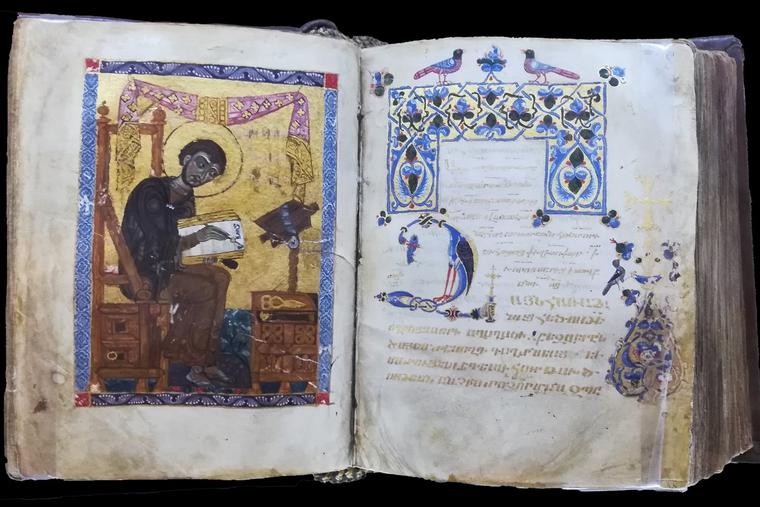
<p>To illustrate St. Gregory in art, I draw on a manuscript in Armenia’s national manuscript depository. The particular manuscript is a copied volume of Gregory’s <i>Book of Lamentations</i>, dating from around 1173, i.e., about 175 years after his death. The illustration apparently depicts St. Gregory composing his work.</p>
<p>For more on St. Gregory of Narek, see <a href="https://en.wikipedia.org/wiki/Gregory_of_Narek">here</a> and <a href="https://www.catholic.org/saints/saint.php?saint_id=46065">here</a>.</p>
</p></div>
<p><br />
<br /><a href="https://www.ncregister.com/blog/grondelski-st-gregory-of-narek">Source link </a></p>
<p><!-- END THEIA POST SLIDER --></p>

Why St. Gregory of Narek Became a Doctor of the Church| National Catholic Register