


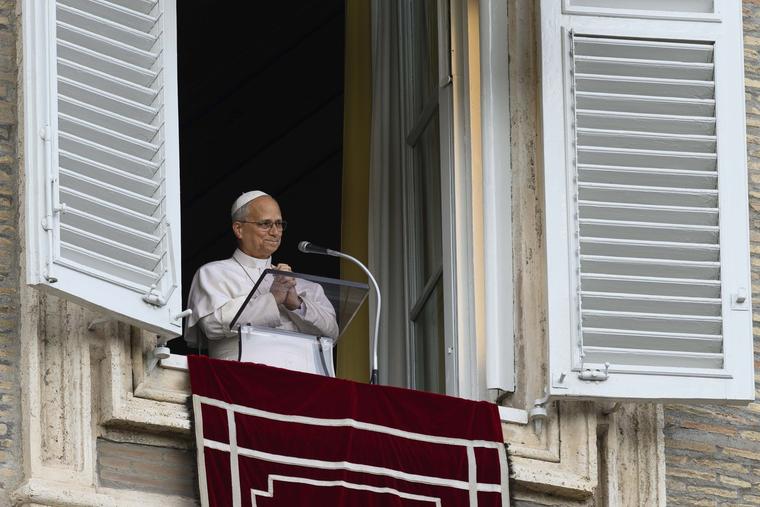
ANALYSIS: Could his cancer diagnosis change how Pope Leo governs the Vatican going forward?
Until the announcement of his hospitalization and lung surgery that led to the diagnosis of adenocarcinoma last week, the world took for granted that Leo XIV’s would be a broad-ranging pontificate spanning the better part of two decades, in which the Pontiff would have the opportunity to reshape and even redefine the Roman Curia, the bishops and the cardinals.
Although tests are still underway to determine the stage of cancer, initial reports from the medical team are that the Pope is recovering well from the surgery that removed the lower lobe of his right lung, and he has been cleared to proceed with his planned trip to South America from Nov. 6 to 17.
It’s true that the Pope had already proven himself to be a pope who takes his time. There have been no major reforms, no spoils system — only a few precise adjustments on some issues (technicalities of financial reform, the Vatican City State law), continuity on others (synodality and the synodal method applied to consistories, women heads of dicasteries), and even fewer high-profile appointments.
Although his recent hospitalization has introduced concerns about his health, Leo XIV’s pontificate is otherwise poised to blossom.
It also opened in the midst of a Jubilee, something that had happened only once before in history, and with the need to bring peace and unity to a Curia and a Church following a divisive pontificate like Pope Francis’.
Leo addressed these challenges by fulfilling all of Francis’ commitments until the Jubilee’s conclusion. He convened the first consistory the day after the Jubilee ended and then began the transition — albeit slowly — in the second half of the first year of his pontificate. The Pope even published in his own name a document prepared by Pope Francis, the apostolic exhortation Dilexi Te on caring for the poor.
Leo’s hospitalization came while celebrating the 10th anniversary of another divisive move by his immediate predecessor, the apostolic exhortation Amoris Laetitia on marriage and family.
This bishops’ meeting on Amoris Laetitia had already taken on the tone of a sociological discussion on the family. In his inaugural address to the meeting’s participants on Oct. 7, Leo had already called for a courageous response to present challenges and a renewed focus on the family. His March 19 letter marking the 10th anniversary of Amoris Laetitia’s release, in which he announced the October meeting, emphasized the need to consider the profound changes that have affected family life.
In short, with Leo XIV, we face neither a Pope who breaks with the Church’s tradition nor one who, in the name of continuity, accepts controversial interpretations that made their way in the previous pontificate.
Going Forward Post-Diagnosis
If the meeting on Amoris Laetitia was considered a watershed moment, we must understand how Leo’s cancer diagnosis affects the pontificate. Pressed by journalists’ questions, Cardinal Pietro Parolin, Vatican secretary of state, went so far as to say on Oct. 15 that the pontificate could be “reshaped” — and he later claimed he was mostly referring to the upcoming trip to Argentina, Peru and Uruguay that is still on. (The EWTN News reporting references Cardinal Parolin saying that “the Pope will also adjust his pontificate if it becomes necessary to do so.”)
Now, faced with serious surgery, cancer and convalescence, it’s entirely normal to decide to change one’s lifestyle and schedule. Cardinal Parolin was likely referring to this.
Regardless, for the cardinal secretary of state to say what he said while the Pope was still in the hospital could not fail to spark debate and raise questions.
In responding to journalists this way, Cardinal Parolin may have underestimated how each word could be interpreted, unless he intended it to be interpreted precisely that way.
What could it mean, then, to reshape the pontificate?
It could mean slowing down: slowing down decisions, slowing down audiences, slowing down travel plans, while calmly monitoring his health and surgical recovery. After all, Leo XIV has shown he is strictly following the doctors’ advice, which undoubtedly recommends rest.
It also means possibly adjusting his travel plans to South America next month, which would take him through three countries and 14 locations and involve about 20 flights by plane and helicopter, with a stop in Cuzco, more than 3,000 meters (almost 10,000 feet) above sea level.
The Pope’s doctor said over the weekend that Leo was medically cleared to travel. But it could be a bit too much for the Pope, who will still be recovering from the removal of a lung lobe. Typically after such a procedure, one prefers not to fly. But even if one does fly, making 20 flights in seven days is daunting.
Will the travel schedule change, even if the doctors said the trip is possible, and there are no clinical reasons not to go? For now, the trip is confirmed as originally planned.
Aside from the South America trip, reshaping the pontificate could mean speeding up.
After a year and a half of waiting, the Pope could speed up the appointment of trusted individuals to build an efficient, reliable government team capable of governing the Church, in case further absences occur due to hospitalizations. Until now, the Pope has generally enjoyed good relationships with those who speak his language: Cardinal Kevin Farrell, Cardinal Michael Czerny and Archbishop Paul Richard Gallagher.
The first will have to retire, the second has already done so — but retains control of the interdicasterial commission on artificial intelligence — and the third is firmly in place as the Vatican’s “foreign minister,” while Cardinal Parolin remains the head of diplomacy.
Then perhaps the Pope could decide to proceed decisively with a generational changeover and launch his personal governance program, which has yet to be fully realized.
In the days preceding his hospitalization, Leo confirmed the election of the dean of the College of Cardinals and the archpriest of St. Peter’s Basilica (Cardinal Luis Antonio Tagle and Archbishop Vittorio Francesco Viola, respectively), two important positions, as they do not cease even during a vacancy. The appointments were expected, but the fact they came on the eve of the papal hospitalization provided food for thought.
Should we therefore expect an acceleration in the pontificate? If so, how long might this acceleration last?
In all these hypotheses, however, one is not considered: that this is simply Leo XIV’s style. He has good relations with everyone and puts his trust in others without worrying about possible issues that could arise with new appointments or — even worse — gossip. Leo’s pontificate is not torn between the desire to maintain continuity and change.
Leo XIV doesn’t make sudden, impromptu decisions; he reflects and delves deeply into issues. He doesn’t develop strategies against anyone; he does so to empower everyone. And, God willing, he will find the formulas that heal division and restore peace in the Church.
For now, the pontificate remains undefined.
Perhaps his cancer surgery will help define it, even if only because everything becomes concentrated in the face of serious illness and decisions can no longer be so slow and deliberate.