<p><!-- BEGIN THEIA POST SLIDER --></p>
<p> <br />
</p>
<div style="position:relative" data-narration-container="true">
<p class="p1"><i>This piece is part of MI x DW, a collaboration that brings Daily Wire readers exclusive commentary and research from the Manhattan Institute’s world-class team of scholars.</i></p>
<p class="p1"><i>***</i></p>
<p class="p1">This summer marks 30 years since President Bill Clinton signed the landmark 1996 welfare reform into law. His successors in today’s Democratic Party will commemorate the event by repudiating everything that welfare reform symbolized. The party increasingly belongs to hardline socialists who promise universal benefits, unconditional cash, and higher taxes on “the rich” to pay for it all.</p>
<p class="p2">The leftward drift is measurable. New Manhattan Institute <a href="https://manhattan.institute/article/american-attitudes-on-welfare-waste-crime-and-the-political-environment" target="_blank" rel="noopener"><span class="s1">polling</span></a> finds that 49% of left-leaning voters identify more closely with democratic socialists than traditional liberals. That includes 67% of those under age 35.</p>
<p class="p2">But momentum inside the Democratic coalition should not be mistaken for momentum with the American public. MI’s polling shows that Clintonian politics — championing work, public order, and mainstream values — remains a winning formula for the Left, the Right, or whoever decides to seize the opportunity.</p>
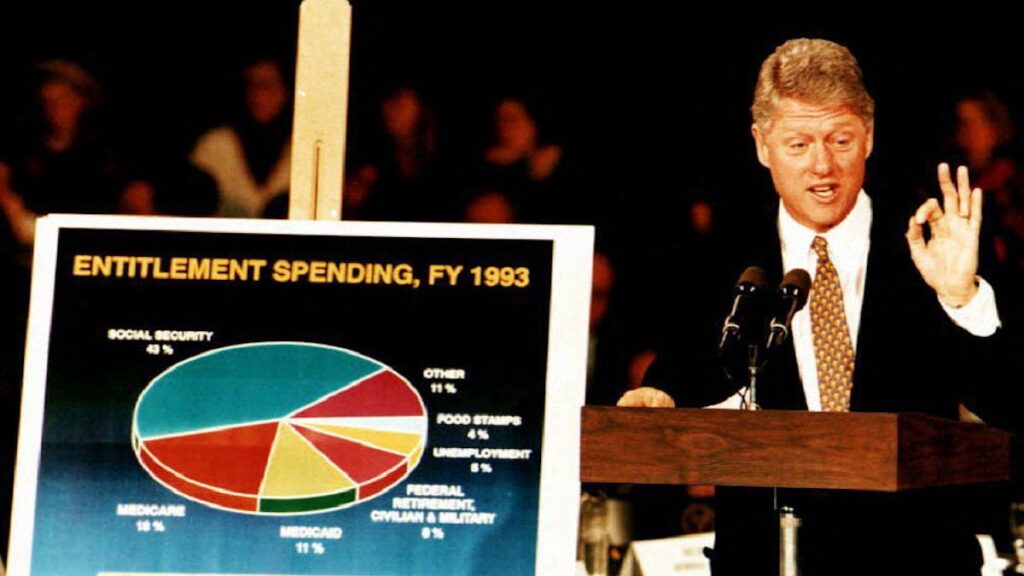
<p class="p2">Clinton, one of just two Democrats elected president between 1968 and 2008, won by demonstrating that a Democrat could say no to his political movement’s most radical faction. His public rebuke of one extremist even gave rise to the term “<a href="https://politicaldictionary.com/words/sister-souljah-moment" target="_blank" rel="noopener"><span class="s1">Sister Souljah moment</span></a>” to describe precisely that kind of political break. His promise to “end welfare as we know it,” another break, culminated in the Personal Responsibility and Work Opportunity Reconciliation Act — signed just months before he became the first Democrat since Franklin Roosevelt to win a second full presidential term.</p>
<p class="p2">Thirty years later, Democrats may have moved on from Clinton’s formula, but the American public largely hasn’t. Nearly three-quarters of voters (74%) support requiring welfare recipients to show that they are seeking work, including majorities of Democrats and more than six in ten somewhat left-leaning voters. Voters prefer assistance targeted to those genuinely unable to provide for themselves over universal benefits by 67% to 24%, and by 65% to 21% they say that the safety net should guarantee a decent minimum standard of living rather than reduce income inequality. Fully 80%, spanning every demographic and political subgroup, would rather provide benefits in the form of food, housing, and health care than as unrestricted cash transfers.</p>
<p class="p2">The socialist alternative has no mass constituency. Voters oppose universal basic income by 50% to 32%. Just 10% would raise taxes to fund more generous benefits. And when told that Nordic-style universal welfare systems require higher taxes on middle- and working-class households, only 13% would accept that trade-off for families like their own.</p>
<p class="p2">That doesn’t mean that Americans have turned against the safety net. A plurality believes welfare helps people get back on their feet rather than fostering dependency, while 48% say government has an obligation to guarantee every American a basic standard of living.</p>
<p class="p2">Still, there are signs that the Republican agenda on welfare is more popular than left-wing critics assert. Voters back the Republican-championed 2025 expansion of SNAP work requirements by 57% to 32%. Seventy-three percent say that waste, fraud, and abuse—a major focus of GOP officeholders in recent months—should be a congressional priority, including 57% of Democrats.</p>
<p class="p2">Taken together, the findings describe a coherent philosophy of welfare. Americans favor meaningful support for those who need it, conditioned on work where possible, coupled with an evenhanded approach to combatting fraud and abuse. That is, in fact, the bargain Clinton brokered a generation ago.</p>
<p class="p2">But it’s not obvious which party owns that deal today. Asked whom they trust to manage welfare programs responsibly, voters split, with 39% saying Democrats and 36% saying Republicans. Forty-six percent of independents trust neither party.</p>
<p class="p2">The DSA rejects the public consensus on welfare. Republicans have tapped into it, but not reliably. The right model for the GOP looks like Argentinian President Javier Milei’s campaign against bureaucratic bloat. When enforcement appears motivated by grievance, Republicans will squander an issue that should be theirs. That leaves a wide opening for Democrats willing to run on welfare pragmatism.</p>
<p class="p2">Crime and public order offer Democrats a similar opportunity. Voters support the death penalty for egregious crimes by 58% to 28%, with independents favoring it by more than two to one. Roughly four in five reject abolishing police departments, prisons, or U.S. borders, including majorities of even very left-leaning voters.</p>
<p class="p2">Clinton understood this terrain as well, pairing welfare reform with an unapologetic commitment to public order. Many Democrats understand that they need to ditch the “defund” movement, and leaning into law and order could help them win back the moderate center as Clinton did.</p>
<p class="p2">Some Democrats will argue that the party is winning even without moving to the middle, pointing to its lead on the generic congressional ballot and President Trump’s 44% approval rating. But that advantage depends primarily on opposition to Trump rather than enthusiasm for the Democratic agenda, with one in 10 voters still undecided and one-quarter of independents on the fence. Anti-Trumpism may help with short-term gains, but it has not delivered a consistent governing majority.</p>
<p class="p2">Democrats have spent much of the past decade letting their most radical fringe define the party, while allowing Republicans to define everyone else. The 30th anniversary of welfare reform offers an excellent opportunity to change course. Moderate Democrats need to acquire Clinton’s confidence and flair for disappointing the loudest voices inside the party in order to appeal to the quieter majority outside it. Our polling suggests that this majority still exists on welfare, work, and crime — if Democrats are willing to trust it.</p>
<p class="p2">***</p>
<p class="p3"><i>This is republished with permission from the Manhattan Institute’s City Journal. The original can be found </i><a href="https://www.city-journal.org/article/welfare-work-manhattan-institute-poll-bill-clinton" target="_blank" rel="noopener"><span class="s2"><i>here</i></span></a><i>.</i></p>
<p class="p1"><span class="s1"><a href="https://manhattan.institute/person/jesse-arm" target="_blank" rel="noopener"><i>Jesse Arm</i></a></span><i> is the vice president of external affairs at the Manhattan Institute. </i><a href="https://www.city-journal.org/person/sean-speer" target="_blank" rel="noopener"><span class="s1"><i>Sean Speer</i></span></a><i> is a Technical Writer at the Manhattan Institute.</i><i/></p>
</div>
<p><br />
<br /><a href="https://www.dailywire.com/news/can-democrats-have-a-sister-souljah-sequel">Source link </a></p>
<p><!-- END THEIA POST SLIDER --></p>

Can Democrats Have A Sister Souljah Sequel?