


Americans are increasingly divided on family life. Republicans marry earlier, have more kids, and embrace more traditional values. Republican elected officials are often shy about this reality, opting to emphasize policies of “choice” rather than make an intentional effort to promote family life through policies.
In reality, conservative politics requires reversing the trends away from marriage and motherhood, already experienced in East Asia, and increasingly afoot in America and the West, generally. For conservatives, family policy must be resolved in favor of family life — a work-family balance that puts family first.
Career-oriented women cannot exercise a veto over conservative family policy, messaging, or the underlying sexual constitution conservatives seek to preserve. Just the opposite, in fact.
The evidence is unambiguous. As the Heritage Report “Save America by Saving the Family” shows, without better family policy the country is in a world of trouble. Attempts to “revive” marriage through greater sexual egalitarianism and liberation have failed everywhere they have been tried.
State-subsidized childcare, mandatory parental leave parity, and other technocratic fixes have done nothing to restore fertility or marital stability. State-sponsored dating in South Korea and elsewhere reminds us of the expensive farces that come with poor policymaking. The only societies that have sustained or modestly revived family formation are those that preserve variations of traditional practice — among churchgoing American Christians, and in places with strong religious worship and homogeneity like Israel, Mongolia, and Georgia.
The confines of today’s feminism, the no-fault divorce regime, and the sexual liberation movement put too low a ceiling on family life. If all current policies are kept, little advance can be expected. We need a sexual counterrevolution. There are good reasons to worry about the electoral viability of a sexual counterrevolution.
Concern about family policy disappears as families disappear. As fewer people marry, fewer care about the health of families. As fewer people have children, fewer care about children.
The Democrat Party benefits from, and increasingly celebrates, the low ceiling on family life. It profits politically from cultivating a sense of female grievances. Over the last generation, they have successfully convinced many women that American society in 2026 is less satisfying and more oppressive than it was in 2001 or even 1970. And aggrieved women vote at pretty high rates.
Men, meanwhile, vote at lower rates, in part because they do not believe governing majorities in the West care about their interests.
The electoral math is straightforward. The ballyhooed “gender gap” is in reality a marriage gap — and Republicans should seek to widen it. Republicans win national elections by maximizing support among married men and women, increasing turnout and margins among single men, and tolerating (if not conceding) continued losses of progressive single women to Democrats.
Politicizing men, even at risk of sharpening existing tensions between the sexes, is part of a sound and necessary electoral strategy for Republicans. Republicans should let the erring, single, college-educated women go. They need to focus on aligned voters — and create more of them.
Family and cultural issues that reject the family seem, for now, to be much more salient to single women than to other sectors of the electorate. Reformist Democrats like Ruy Teixeira, John Judis, and others recognize that Democrats increasingly rely on single women for fund-raising, votes, and rhetorical strategies — Democrats can do little against the will of woke women. Republicans should make the Democrats’ dependency on single liberal women costly in elections.
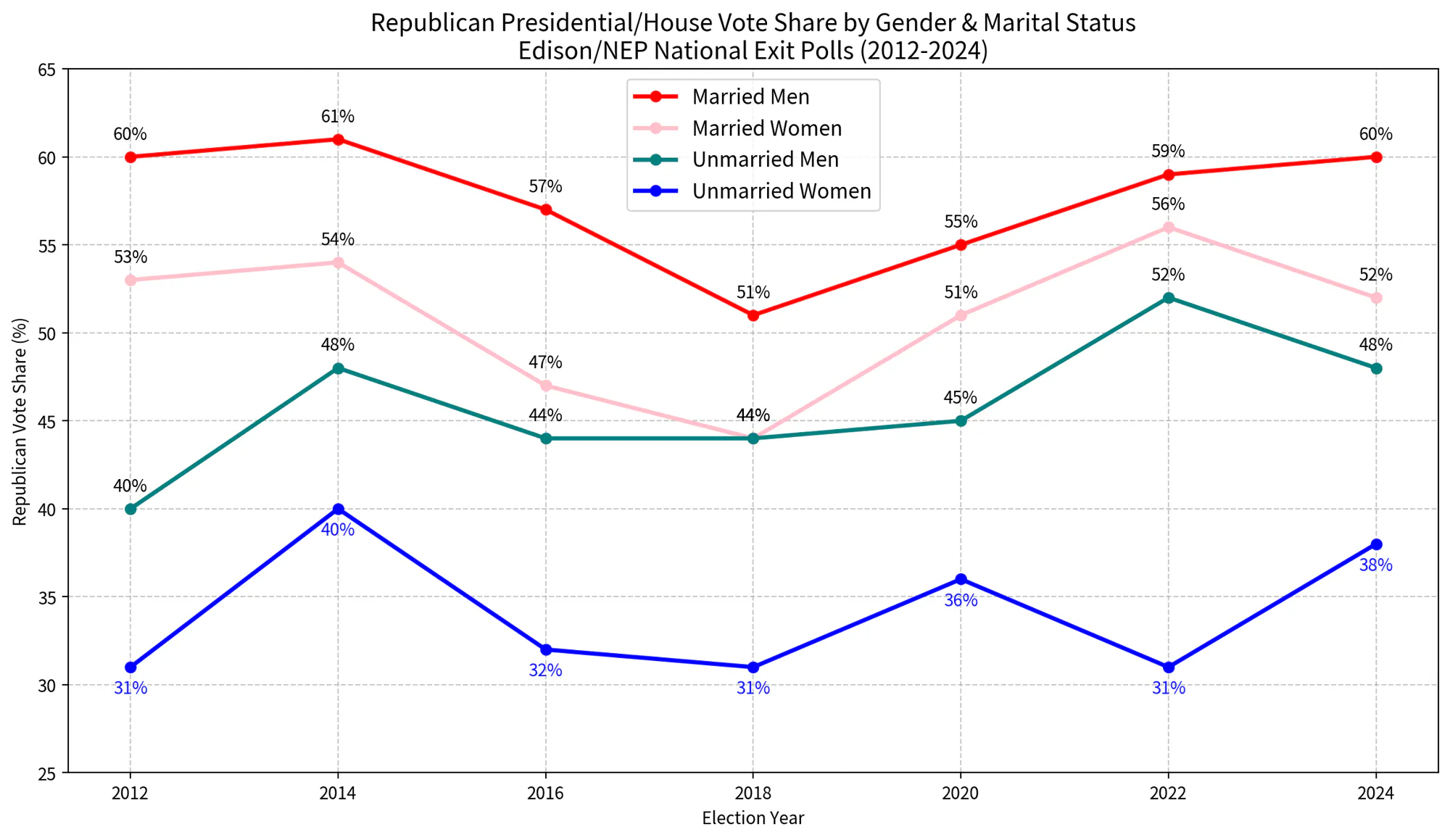
A rhetorical and policy agenda that elevates family formation and thriving would benefit Republicans. Republicans are the party of the married. Mitt Romney carried married men in 2012 by about the same percentage (60%) that Donald Trump won them in 2024. Republicans have not exceeded 40% among single women in any election since 2014. Married women and single men, however, are the swing voters, as they hover around 50% for Republicans.
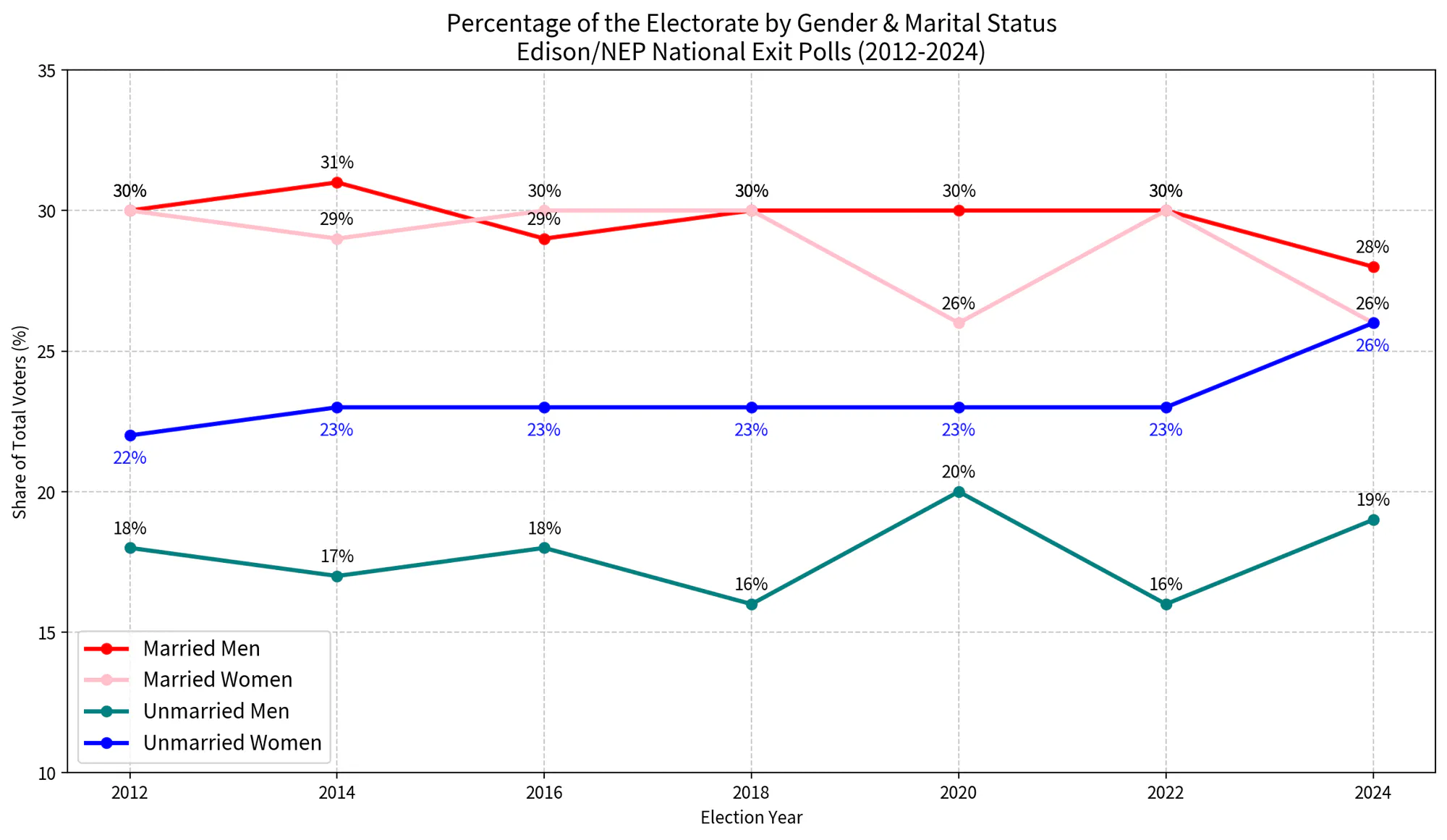
Running up the score among aligned voters, however, is complicated by the electorate’s proportions. Married men were 30% of the electorate in 2012, but only 28% in 2024. Married women resemble married men, though with more variability. In 2012, married women were 30% of the electorate, but in 2024, they were only 26% of the electorate. Single women, by contrast, increased from 23% of the electorate when 31% favored Romney to 26% in 2024, when 38% supported Trump. Single men also increased as a share of the electorate, rising from 17% in 2022 to 19% in 2024, while their Republican vote share climbed from 44% to 48%. Young men have only once broken 20% of the electorate in this era.
The opportunity is even more obvious when you look at the 2024 presidential election results. A Republican coalition that prioritizes married men, married women, and single men would have won nearly every decisive swing state without winning any unmarried women — provided turnout among married voters and unmarried men at least remained the same.
Republicans win North Carolina, Georgia, and Wisconsin when Republicans carry married men and women and avoid losses among single men. In Pennsylvania, Arizona, and Michigan, the margin of defeat under this framework is small — often one or two points. Slightly higher turnout among married voters or marginal gains among single men are enough to flip these states even if single women tilt a bit further in the Democratic direction. The task, then, is to organize and strengthen the Republican electorate.
Admittedly, single voters will generally be more important to election outcomes as marriage recedes and single women become a growing part of the electorate. Emphasizing marriage will make it more difficult to court them (politically). As a result, political strategists and the consultant class continue to think that Republicans must cater to the growing single-woman and the diversity vote. Their solution is accommodation: avoid criticizing feminism, adopt its premises while trimming its excesses, and present a softened family message consistent with “conservative girlboss” and “choice.”
This approach fails on both moral and political grounds. It abandons the project of reconstructing a nation built upon the most fundamental building block of a healthy society. It performs poorly electorally as it abets apathy among men, both married and single, who voted for Trump because of his masculine edge. Younger single women are trending progressive and Democratic and anti-family, so catering to them is a suicide pact for the traditional family. And the 70% or so who oppose Republicans represent mostly a ceiling, not a floor, for Democratic candidates.
Republicans should seek to run up the score among married voters and single men. Single men are especially an underdeveloped growth constituency. Nothing in the nature of things suggests single men must continue to vote in lower numbers if governments are willing to take their legitimate grievances seriously. Many other countries do not have turnout gaps between men and women.
Through effective appeals and policies, Republicans can move single men’s vote share from 19% in 2024 to 23% of the electorate and improve their share from 48% to 52% or higher in the short- and medium-term.
The key lies in consistently appealing to these demographics to reverse trends away from marriage among young women. Democrats understand this threat, which is why they are pouring money into male outreach. Republicans should make themselves the tribunes of legitimate grievances for men, especially single men, and adopt rhetoric and pursue policies that call men to responsibility, purpose, and character.
Republican voters already believe society has become “too feminine” and needs “masculine voices.” The party should lean into this sentiment rather than apologize for it. Elevating credible, manly politicians helps. So does acknowledging legitimate grievances: institutional hostility toward men, especially white men; educational and labor-market failures; the plagues of drugs, marijuana, porn, and gambling; policies that discourage marriage and divide the sexes.
In some cases, enforcement matters. High-profile prosecutions of universities and media companies for hiring practices hostile to white males would signal seriousness and should be undertaken. Stories of men frozen out of professions should be highlighted. Attacks on universities should intensify, as should complaints about how modern, woke public education neuters boys.
Married women are also a growth area, as they could more closely resemble their husbands if Republicans adopt concrete, family-centered kitchen-table issues like increased government support for families. Under favorable conditions, Republican support among married men could one day exceed 62% and consistently reach 55% among women.
Shifting electoral coalitions involves much more than family policy, of course. The issues that alienate progressive single women are often Republican priorities. Marrieds and single men want secure borders and remigration and an end to affirmative action. Men want purposeful jobs and attainable homes for families. Men hunger for friendship and fraternity and tend to be more passionate about national belonging and patriotism. They respond to calls to virtue. They can be shamed into leaving their parent’s basements or into better risk-taking than sports gambling. Republicans should endorse men as providers for, and leaders of, thriving families. A Republican statesman should be comfortable with messages like “No porn. No pot. No gambling. No dating apps” for men, while suggesting instead “Read Rome. Take protein. Play sport. Talk to women.”
A non-feminist, pro-marriage agenda is central to this effort. Restoring the sexual dance requires improving the quality and marriageability of men and women and removing the institutional pressures that undermine marital commitment. Changing it would address real pathologies and unmet longings for love, meaning, and purpose. Republicans might even gain some single-women voters in the process by offering a serious alternative to the ideology that is making those women feel lonelier and more miserable than ever.
In short, the demands of electoral success and the good of the country can be made to coincide if it is unashamedly pursued. A rhetoric that emphasizes marriage as part of a life well lived is essential. None of this matters if Republicans mess up foreign and broader macro-economic policy; bringing peace and prosperity is job number one. Family policy can and should be a crucial supplement while keeping first things first.
***
Scott Yenor is director of the Kenneth B. Simon Center at the Heritage Foundation.
