


One pilgrimage Catholics often overlook is visiting the chief church of their diocese — the cathedral.
“The cathedral is spiritually unique in each diocese because it is the seat of the diocese, the location of the main shepherd — the bishop — and the locus of his authority,” explains Nell Andrzejewski, director of Catholic Church Tours.
From the cathedral, each bishop conducts worship and teaches for the whole Christian community in his diocese. The church is chosen by the local bishop for the cathedral, the seat of his authority passed down directly from Jesus and the apostles. There are 193 cathedrals (including co-cathedrals) of the Latin Rite and 20 of the Eastern Rite in the United States.
“Usually, it also holds a higher place in its visual forms of art and architecture as well, so that, too, draws people to visit,” adds Andrzejewski, who also hosts EWTN’s Hidden Gems: Catholic Shrines in America. “Some cathedrals are entirely breathtaking, and all put forward something of the best that the local Church can offer for love of Jesus and neighbor.”
To prepare for the pilgrimage, Andrzejewski suggests that “some quick pre-reflection can really help you enjoy the visit and bring down some incredible graces.” Jesus is present at the cathedral and “the main draw to visit, of course, and the liberty of visiting Him is not to be underestimated.”
Prepare to come with some intentions. Start your conversation with God prior to arrival. It might be about your family and blessings for them, as an example. Then at the cathedral “you can be better prepared to better hear, while you are seeing, what He desires for you in those particularities,” she advises.
Appreciate what the cathedral has to offer — beginning outside. “Exteriors can be marvels,” notes Andrzejewski. Admire the ecclesial architecture. Look at the type of brick or stone used. Often, it comes from local quarries, like the Utah sandstone for the Cathedral of the Madeleine in Salt Lake City.
Fascinating History
And the ecclesial architecture could have a fascinating history and global connection. For example, the exterior of St. Mary’s Cathedral-Basilica of the Assumption in Covington, Kentucky, dates to 1895 and is modeled after Notre Dame Cathedral in Paris, complete with flying buttresses.
The interior is patterned after the early Gothic-style Abbey Church of St. Denis in France. Pilgrims entering the cathedral are “welcomed” by two dozen saints, among them the patrons of the diocese and some of the diocese’s parishes, portrayed in newer statues on the cathedral’s façade, along with scenes of the Annunciation and the Coronation joining The Assumption carved in 1914 to reflect the cathedral’s name.
“Inside, take your time,” Andrzejewski emphasizes about a cathedral pilgrimage. “Churches are designed for slowing down a bit, for connection, for contemplation. Whether you visit for Mass or another time, try to be a little more deliberate in seeing.”
Andrzejewski calls church buildings “a schoolhouse for the heart. They have deliberately incorporated thousands of years of history in their architecture.” And their art becomes strong visual lessons.
She encourages pilgrims to quietly sit or kneel in a pew, or slowly walk through the cathedral to take in color, texture and structure. All are sacred lessons. She advises the faithful to “ask God to show you what he wants to show you. … Talk about what you see with Him and see what He would like to say through the art or architecture.”
For instance, St. Joseph Co-Cathedral in Brooklyn, New York, began as a parish church decades ago. When the diocese’s original cathedral proved too small for this large diocese, Benedict XVI named St. Joseph’s with its large capacity and new exceptional restoration work as a co-cathedral.
At St. Joseph Co-Cathedral, pilgrims can contemplate 22 paintings of images of Our Lady, each highlighting a different title from a different country to represent the area’s immigrant parishioners, such as Mary honored as the Immaculate Conception for the United States; Our Lady of Charity for Cuba; Our Lady of Pompeii for Italy; and Our Lady of Czestochowa for Poland. These are all wonderful reminders for local pilgrims to see how they are all connected in faith by the cathedral — their “home church.”
Moving Marvels
Pilgrims to St. Mary’s Cathedral Basilica of the Assumption in Covington can marvel at something many people have rarely — maybe never — seen. The transept’s monumental window made in Germany, 67 feet by 24 feet, is considered the world’s largest handmade church stained-glass window. They can contemplate the event inspiring the cathedral’s name because the window’s two major scenes portray the Ecumenical Council of Ephesus in A.D. 431 proclaiming Mary the Theotokos, the God-Bearer, the Mother of God, and then the Coronation of the Virgin Mary after her assumption.
In other stained-glass art, pilgrims can contemplate events in the life of Jesus from his childhood to after the Resurrection. Others present Jesus’ miracles, plus reminders of the seven sacraments. The German-carved scenes in the Marian shrine present Mary’s Seven Joys and Seven Sorrows for contemplation. Pilgrims can pray at the Sacred Heart shrine. The cathedral’s Relic Shrine of St. Paul displays dozens of relics from one of the largest collections in the country. Another historic fact: Marble from the cathedral’s original altar was used for the new one — one of the ways to connect with the cathedral’s glorious past.
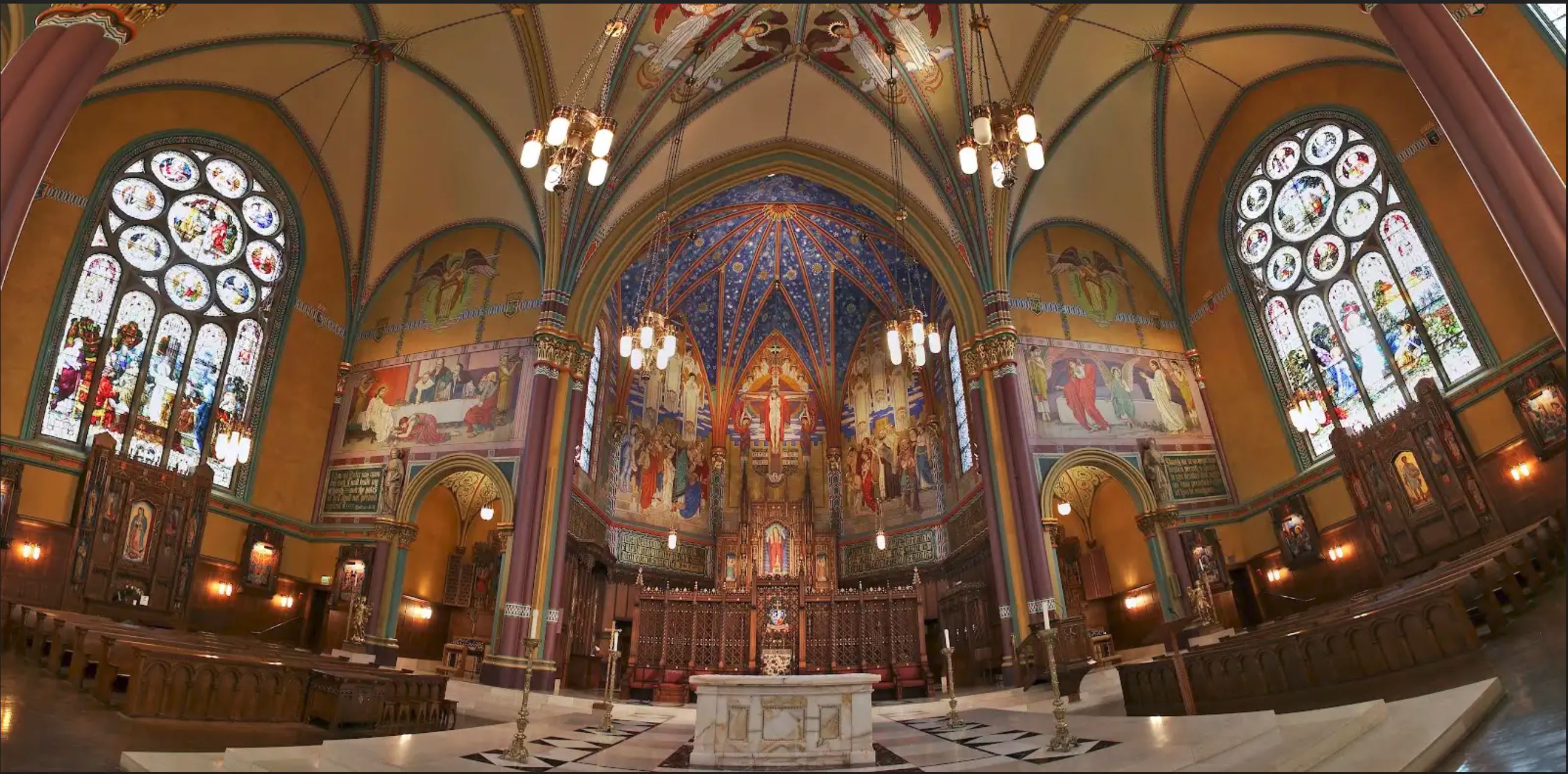
In the Cathedral of the Madeleine, pilgrims can admire and pray before many intricately carved statues like one of St. Joseph, plus scenes of the Holy Family and various saints; in addition, they can see much ornate woodwork by sculptors, including an emigrant from Oberammergau (of Bavarian woodworking acclaim) who was considered the best church woodcarver in this country.
As pilgrims would expect, murals portray scenes with the cathedral’s patroness, such as the Risen Jesus appearing to Mary Magdalen at the tomb as angels watch. The mural of Our Lady of Guadalupe reminds pilgrims of the large Latino community in the capital city.
“The histories of cathedrals are fascinating,” reflects Andrzejewski. “Learning the history of the building is learning the history of a local and universal people. It is also fortifying to learn about the longevity of our faith, through our cathedrals. Chicago’s Holy Name Cathedral for example, after having been moved, burned down in the Chicago Fire, and entirely rebuilt, has gone through about six major reconstructions.
She adds, “Each cathedral has its own story that reflects both the particular church and the diocese.”
