


When a newly ordained priest celebrates his first Mass, one of his final gestures is often not toward the congregation, but toward his mother.
In his hands is a simple strip of linen — a manutergium, used days earlier at his ordination to wipe the sacred chrism oil from his newly anointed hands. At the end of the Mass, he places it in her hands, entrusting her with a quiet but profound symbol of his vocation: one she will carry, by tradition, to the grave.
For many Catholic families, the manutergium — derived from the Latin terms of manus (“hand”) and tergium (“to wipe”) — represents something deeper than custom. It is a sign of the offering of a son given to the Church and of a mother’s hidden sacrifice in letting him go.
Tradition holds that when the mother comes before the Lord in judgment, he will ask, “I have given you life. What have you given me?” She presents the cloth and answers, “I have given you my son as a priest.” While not a guarantee of salvation, the story captures the spiritual weight the custom has come to carry.
In recent years, that meaning has drawn renewed attention, particularly among younger priests — many of whom seek handcrafted manutergia for their ordinations and first Masses.
For Kelly Miller, a Catholic convert and mother of five in Louisburg, North Carolina, that growing interest has become a quiet vocation.
A lifelong lover of crafting, Miller entered the Church at the Easter vigil in 2019. While waiting to begin Order of Christian Initiation of Adults (OCIA) classes, she began teaching herself embroidery, creating small devotional pieces featuring saints and other sacred imagery. Not long after her reception into the Church, her parish priest asked if she could make a manutergium.
She said “Yes” — and what began as a single project soon developed into a small apostolate of its own.
Since founding Thread Roses in 2020, Miller has received dozens of requests — more than she can fulfill.
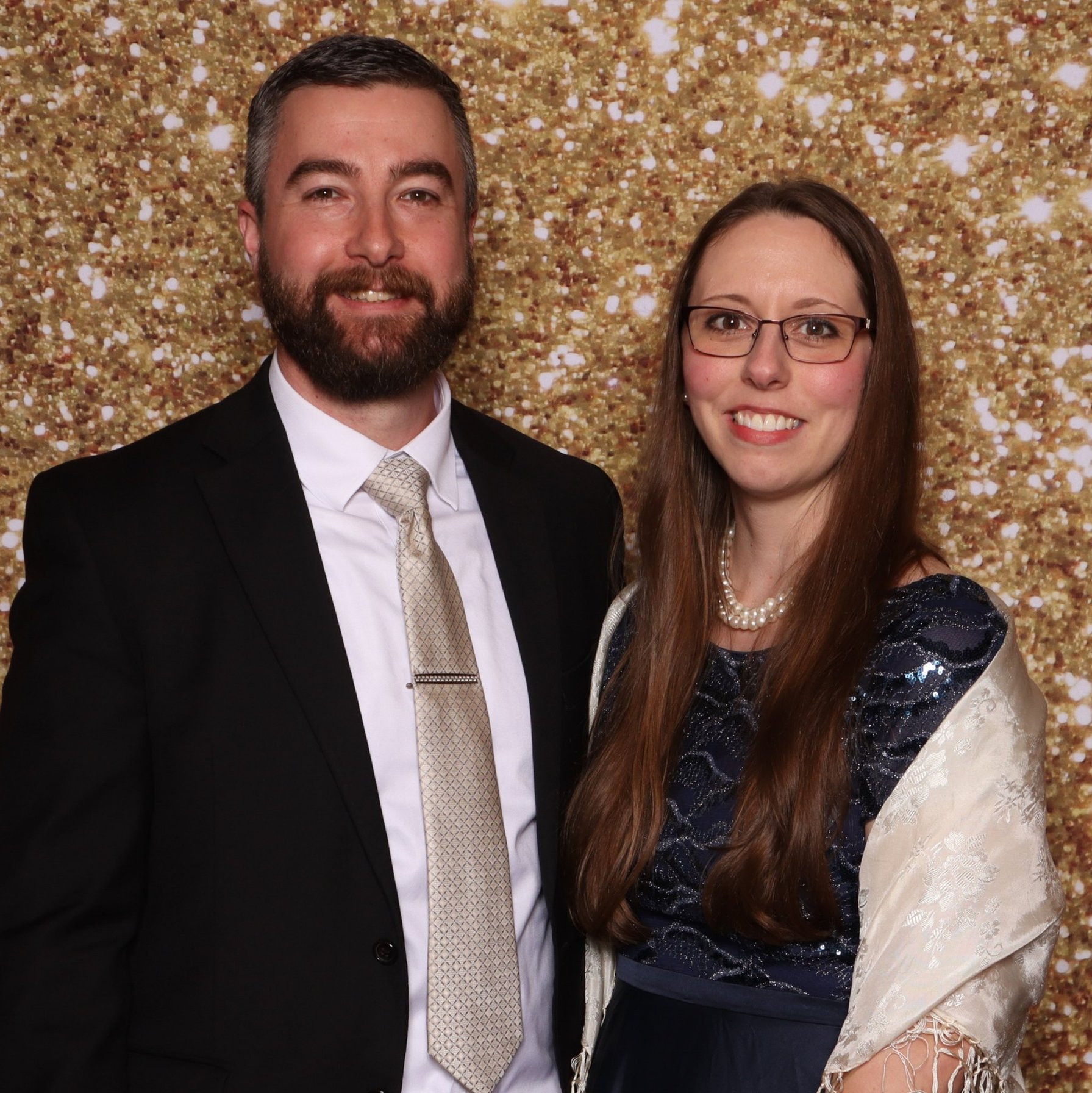
“I prefer to work on it when it’s a time that I can sit quietly and pray or reflect on things and think about who I’m making it for,” she said. “Obviously, it’s a lifelong commitment to become a priest, and it’s a big commitment on the side of the parents.”
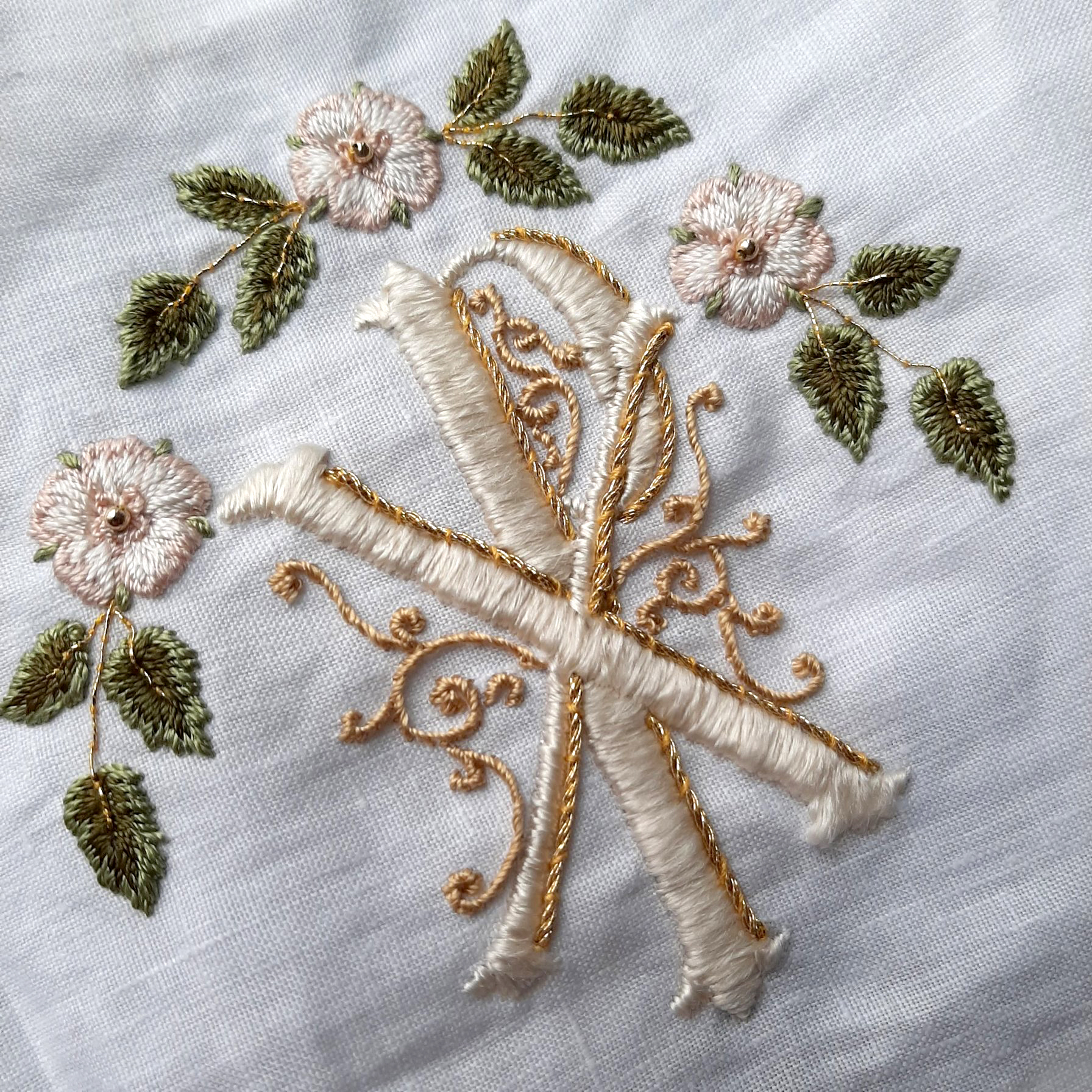
Each piece takes two to four months to complete. Working entirely by hand, she begins with a strip of linen — often repurposed from altar cloths — drawing threads to form delicate edges before hemming and embroidering the fabric with silk.
“I don’t use a [sewing] machine at all on the manutergium,” she noted. “I could, but I choose not to, just to honor the tradition of a very handmade labor of love concept. If there’s an opportunity to cut corners at various stages, I don’t do that.”
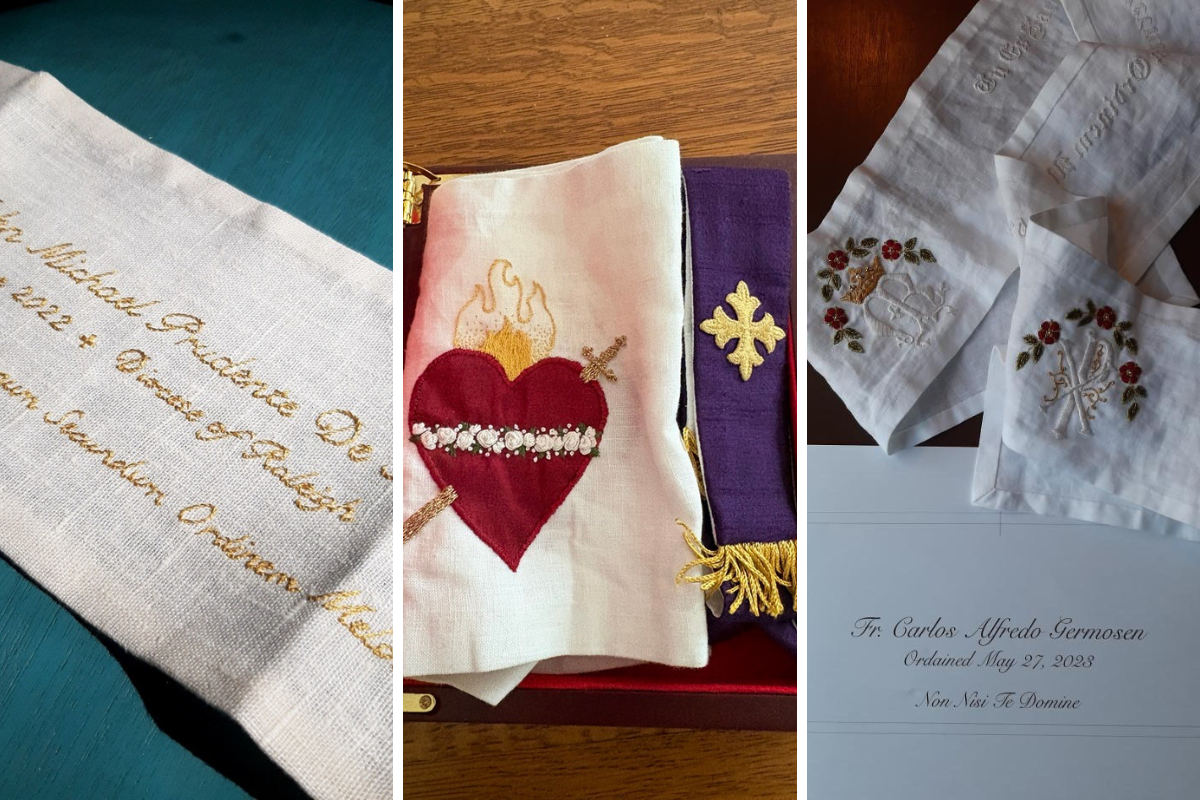
The designs vary: Marian imagery such as the Auspice Maria (intertwining ‘A’ and ‘M’ for the Latin phrase “Under the Protection of Mary”) or Maria Regina, the Chi-Rho (the X/Chi and P/Rho are the first letters for “Christ” in Greek) or the words from Hebrews 7:17 carefully traced in Latin, “You are a priest forever according to the order of Melchizedek.” Many priests request deeply personal elements, from favorite Scripture verses to roses in honor of St. Thérèse of Lisieux.
For Miller, the work is part of a larger tradition in which simple cloths become vessels of grace.
“[The manutergium] is a small cloth in the grand scheme of things,” she said, “but I think it carries a whole lot of hope and faith in it.” She pointed to the veil of Veronica and the burial cloth of Christ as reminders that ordinary fabric can become something sacred through what it bears.
That meaning comes fully into view in the moment the cloth is gifted to a priest’s mother.
An ‘Imitation of the Blessed Mother’
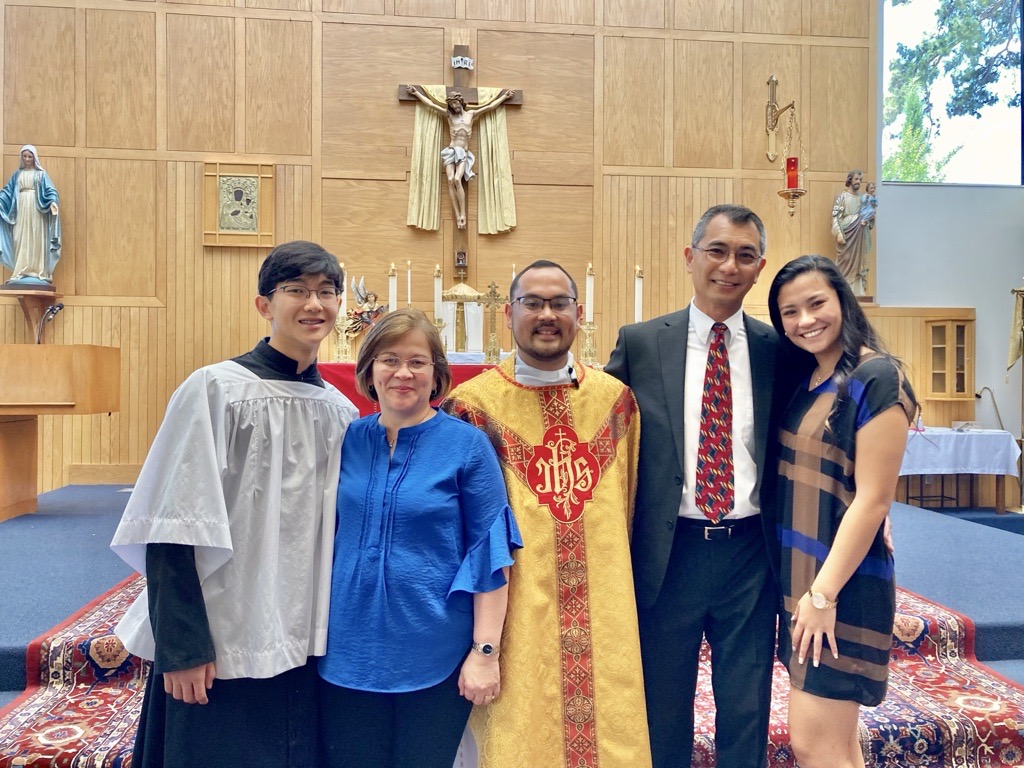
At the end of his first Mass after being ordained in the Diocese of Raleigh, North Carolina, in June 2022, Father John De Guzman invited his parents forward to receive the manutergium Miller had made. As he placed it in his mother’s hands, he broke down.
“To physically hand my mom something as a symbol of her sacrifice and the graces that come with it — I couldn’t stop crying,” he said.
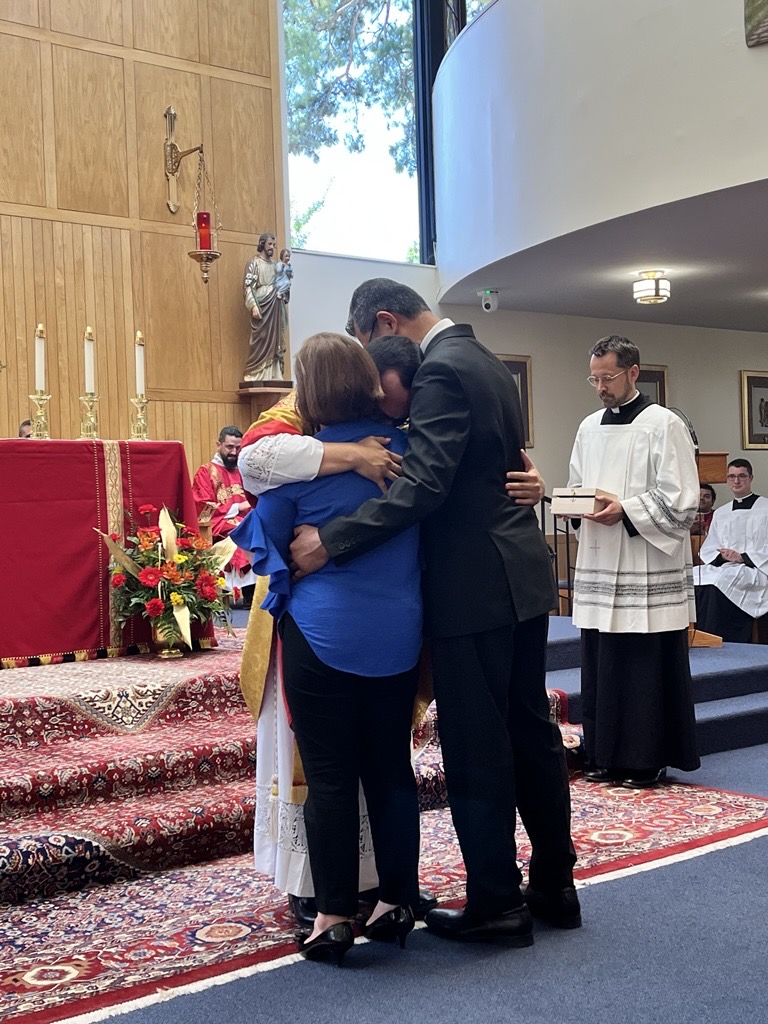
Though familiar with the tradition, he said its significance only became clear in that moment. “It gave me an image to relate more to Christ — not just in his priesthood, but in his sonship,” he said. “Mary was the foundation of his life. In a similar way, my mother helped me receive the Father’s will.”
Even years later, the manutergium remains in his parents’ home, kept alongside his first confession stole — traditionally presented to a priest’s father at the same Mass — both quiet reminders of a vocation shared within a family.
Father Carlos Germosen of the Archdiocese of New York described a similar experience during his first Mass in May 2023. Overcome with emotion even before the final moments, he recalled “sobbing uncontrollably” as he walked down the aisle.
“There were tears and this great big hug when I presented my mother with the manutergium,” he said. “I just thanked her and told her how much I loved her.”
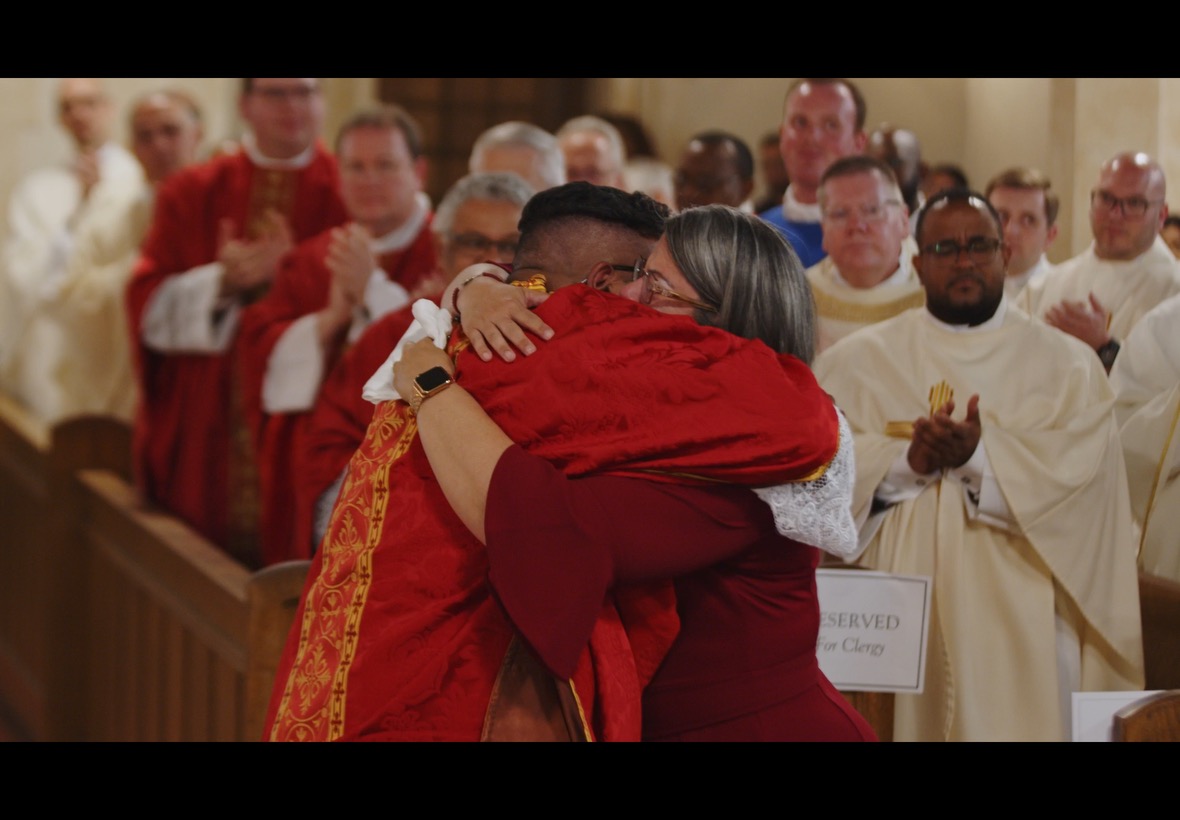
For Father Germosen, the gesture made visible something long present but often unspoken. “If it wasn’t for her prayers, I wouldn’t be here,” he said. “My mom has always been that constant, reaffirming presence of the faith for me.”
His mother, Ana Germosen, still keeps the cloth carefully stored in a box atop a home altar. It is decorated with red roses, a nod to their shared devotion of St. Thérèse, and bears the phrase Non nisi Te, Domine (“Lord, nothing except you”) from St. Thomas Aquinas. Occasionally, she opens it to catch the faint scent of chrism oil.
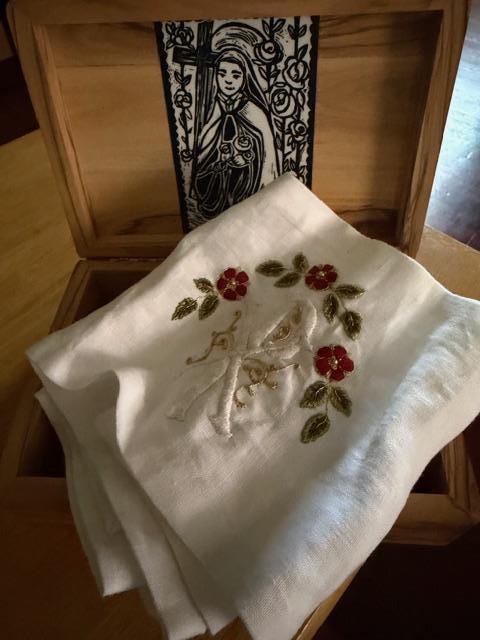
“There’s something so comforting about that scent,” she said, “and having this reminder of that moment and my son’s vocation.”
She sees in the renewed interest in manutergia among young priests a broader spiritual need. “We all need tangible reminders of the beauty of the divine,” she noted.
That same dynamic is reflected in the experience of Father Isaac Doucette, who was ordained in the Diocese of Davenport, Iowa, in June 2023. When choosing the design for his manutergium with Miller, he focused on the relationship it would represent.
“I wanted to emphasize the love between a mother and son,” he said, selecting imagery of the Sacred Heart of Jesus and the Immaculate Heart of Mary. “It was a way of saying ‘thank you’ to my mom.”
For Father Doucette, that meaning began long before ordination. “The mother is the first protector of the son,” he said, “nurturing and guiding him, in imitation of the Blessed Mother.”
The manutergium, he added, becomes a “kind of sign of a mother’s care — of what a mother has done from the very beginning.”
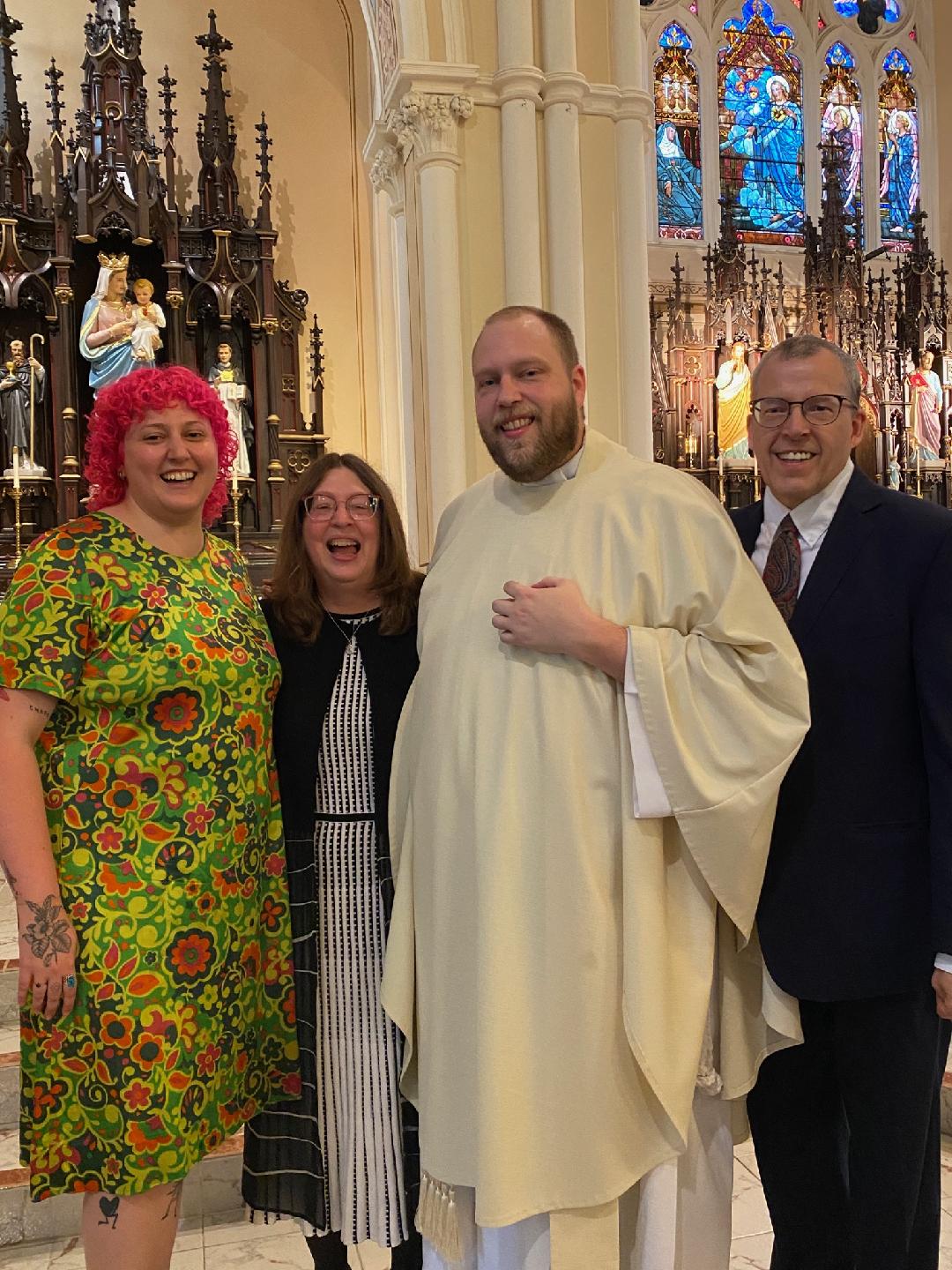
His mother, Jane Doucette, described the moment of receiving the cloth as both beautiful and enduring. “You can tell the love and the prayers that Kelly put into it,” she said. “It’s not just a piece of cloth.”
Rather than a great sacrifice or loss, she sees her son’s vocation as a gift. “It’s not, ‘I gave up my son to the priesthood,’” she said. “God gave me the blessing of having a son who is a priest.”
She described how that blessing continues outward through his ministry. “Every child my son baptizes, I have another spiritual grandchild,” she said. “And when I see other priests, I think of them as his brother. My family just keeps growing.”
For Miller, those moments — repeated in different churches, with different families — are what gives her work its deepest meaning.
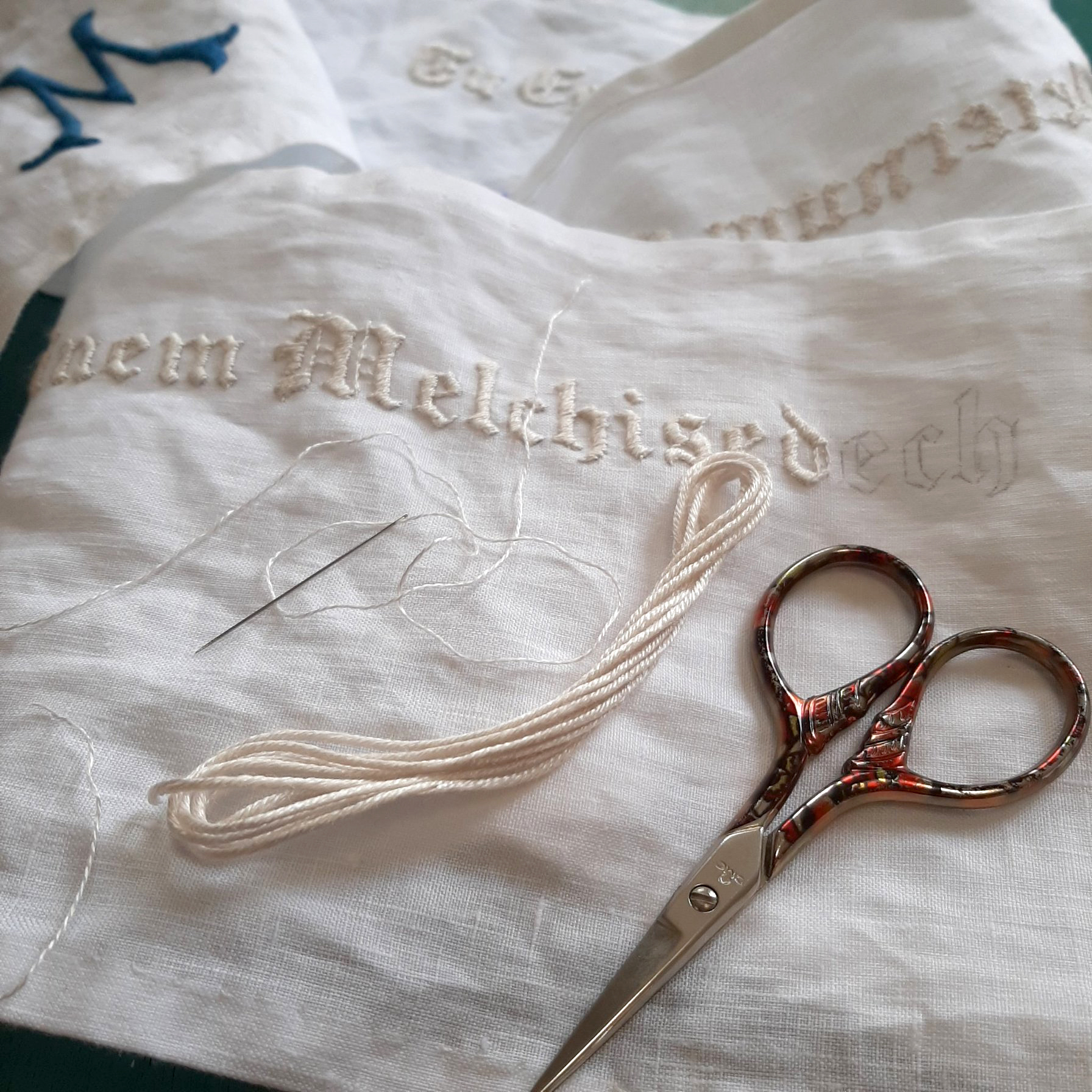
At the center of every piece, she said, is the often-unseen role of a mother.
“She is their first love, their first teacher, their first introduction to the faith,” she said.
And in a small strip of linen passed from altar to mother’s hands, that hidden role is remembered — quietly and gratefully, for all of eternity.
