


St. Mary’s Seminary in Baltimore — founded 1791 — may be the oldest seminary in the country, but its approach to helping its seminarians become the best priests they can be is very new.
When Sulpician Father Phillip Brown took leadership of the seminary as rector in 2016, he came on a mission to revamp the way it trains priests. After a period of thorough observation, seminary leadership realized that St. Mary’s had a problem. While — true to its reputation — its academic programs were strong, they concluded that an overemphasis on study was causing other important aspects of the seminarians’ training to fall by the wayside.
While courses on Scripture, moral theology, and Church history are essential to make priests effective teachers and witnesses to the Gospel, knowledge alone is not enough. Father Brown recognized that the seminary could be doing more to raise up priests who are holy, well-adjusted and able to care for their people.
Seminarians from dioceses like Buffalo, Louisville, Richmond, and even Kumbo, Cameroon, spend their final four years before ordination at St. Mary’s. The new approach has resonated with them.
“There’s a great emphasis [on the fact] that we are first and foremost to become more virtuous,” said C.J. Wild, a seminarian for the Archdiocese for the Military Services. “We’re supposed to be approachable. We’re supposed to be able to relate to others the way that Christ related to all people.”
No seminary can claim to have as much experience as St. Mary’s in training America’s priests. When it opened, George Washington was serving his first term as president and the Diocese of Baltimore covered the entire United States. The seminary was founded by the Sulpicians, an order of priests created to train seminarians.
While the Sulpicians at St. Mary’s are no longer French, as they were in the late 18th century, they are still a crucial part of the seminary community. Father Brown, originally a priest of the Diocese of Bismarck, North Dakota, is himself a Sulpician with a long history of experience in seminaries. Before being named rector at St. Mary’s, he served for 10 years at Theological College in Washington, D.C., including five years as rector. Prior to that, he spent five years on the faculty at St. Mary’s.
A New Approach
The wake-up call led to new strategies aimed at forming not just the mind, but the entire man. One of the steps was to bolster the seminary’s devotional life with the introduction of daily adoration and a Rosary.
Academic dean Matthew Dugandzic stresses the importance of prioritizing the life of prayer from the men’s very first days as seminarians.
“One of the things I always tell them is that if they ever have to make a decision about whether to pray or to study — because they have obligations to do both — they should choose prayer,” he said. “It’s okay to take a B for [the sake of] holiness.”
Under the new approach, the seminarians devote a large amount of time to hands-on ministry, spending every weekend during their four years at St. Mary’s in parish and hospital settings. In the first three years, they observe pastors, visit the sick, and teach OCIA (RCIA) and CCD classes. In their final year, after ordination as transitional deacons, they begin preaching regularly. While many seminaries have similar “teaching parish” programs, the experience is especially intensive at St. Mary’s.
While the program is challenging, said Father Brown, it takes the seminarians outside of themselves and forces them to grow in new ways. In the process, they realize the challenges that their own personality and past experience may pose.
“Whatever experiences they’ve had in life [are] going to come out. Then [we] try to bring them to awareness of how that can easily get in the way of good ministry and God’s grace.”
Some of the new programs take the seminarians out of the ordinary routine of prayer, service and study. Every seminarian, for instance, takes part in Outward Bound, a wilderness survival program aimed at building collaboration skills and discovering one’s own abilities.
“At first maybe we raise our eyebrow or question the merit to it, but then in hindsight you see it,” said newly ordained Father Tom Dzwonczyk of the Diocese of Scranton, Pennsylvania, of programs like the Etiquette Dinner, where seminarians learn the finer details of table manners.
“You could be a Scripture expert, a moral theologian; you could know the Summa like the back of your hand,” he said. “But […] if you’re invited over […] for dinner and you don’t know how to conduct yourself, that’s going to leave a very negative influence on the people of God.”
Father Brown has also looked at renovations of the seminary building as an opportunity to better prepare the seminarians. He set out to redo the old residence area — constructed in 1929 with small, shared bedrooms and bathrooms — to remove the distractions it presented to the seminarians’ growth. Today’s dormitories, completed in 2021, have more spacious rooms and include private bathrooms and common living areas.
An Emphasis on Human Formation
In his 1992 document on seminary education Pastores Dabo Vobis (I Will Give You Shepherds), Pope St. John Paul II laid out four key areas of focus — or “dimensions” — for preparing seminarians for priesthood: spiritual, intellectual, pastoral and human. Of these four, “human formation” has received the greatest attention at St. Mary’s in recent years. The first three are straightforward: Spiritual formation forms the soul; intellectual forms mind; and pastoral forms the skills needed to be a good pastor. Human formation is about forming the person. Seminary formators — or “mentors” as they’re known at St. Mary’s — meet regularly with the seminarians to help them become men of virtue, discipline and strong character.
At St. Mary’s, the human dimension is treated as foundational to the other three, encompassing the seminarian’s ability to maintain a disciplined prayer life, manage his time for coursework and be a good conversationalist in parish settings.
“We have to take [human formation] not as something that we just append on to the formation program,” said Father Dzwonczyk, who spoke to the Register while preparing for his June ordination. “[It] should be the starting point from which the other dimensions grow out of.”
As Carlos Gonzalez, a seminarian of the Diocese of Syracuse, New York, explains, the goal is not to create “cookie-cutter” priests.
“St. Mary’s is focused on forming you as who you are,” he said. “Christ called you uniquely by name with your weaknesses, with your idiosyncrasies, your strengths, your talents.”
Living in close community with men of a wide variety of personalities and opinions is an important part of the formation process, said Father Joe Ryan, a newly ordained priest of the Diocese of Syracuse. “If they weren’t in seminary together, these people wouldn’t have been friends, but somehow the Lord put them together and now they’re in a wonderful, flourishing friendship.”
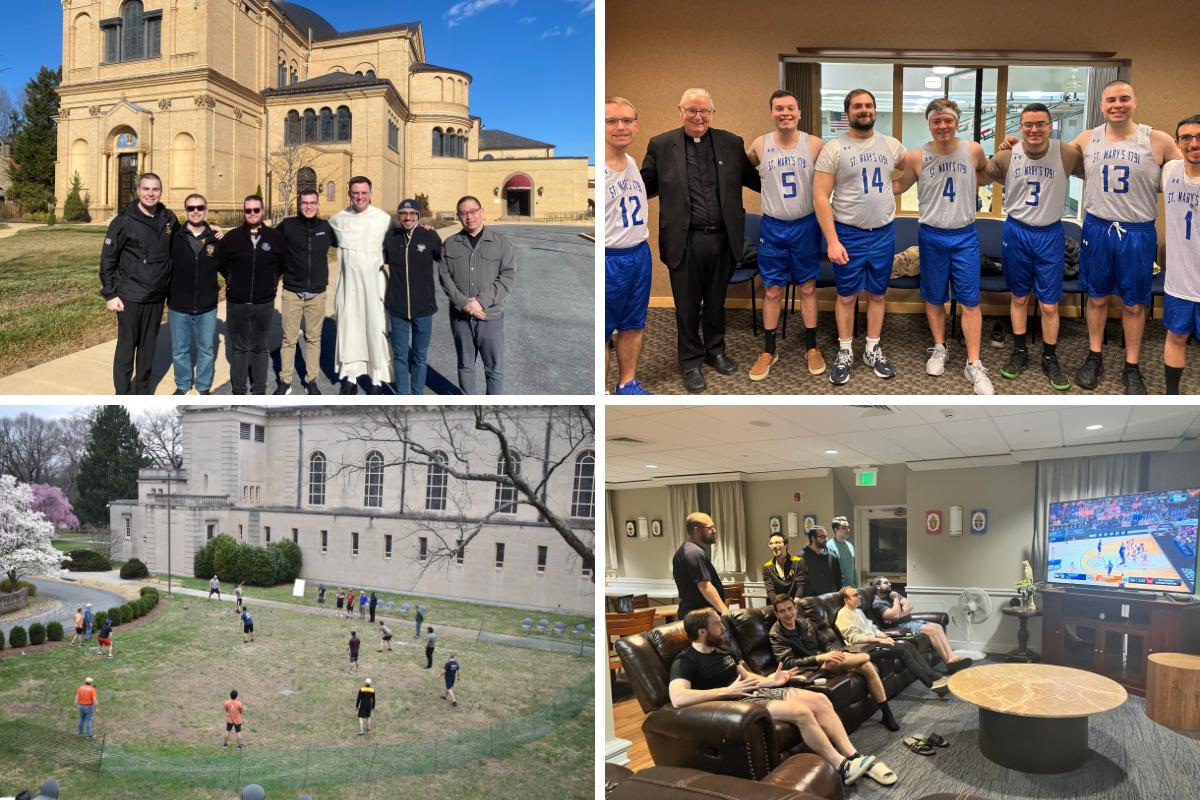
A seminarian’s human formation isn’t limited to meetings with formators or seminary formation programs. As Father Ryan noted, it is also developed in the day-to-day life of the community. “At St. Mary’s, we’re encouraged to […] be a community of friendship, a school of friendship where you can build up one another in their vocation and help them grow.”
The new approach also includes a strong emphasis on the role of psychology. Deacon Ed McCormack, St. Mary’s former director of human formation, said that helping seminarians grow requires a both-and approach: “taking psychology seriously while also appreciating the classic Catholic tradition of virtue formation.” Seminary leadership has looked to experts in psychology from the secular world and within the Church.
Deacon McCormack has been in touch, for example, with staff at the St. Paul Seminary in Minnesota, such as psychologist Paul Ruff, for guidance in emulating their efforts with small-group programs. St. Mary’s has begun implementing a similar program in which seminarians participate in groups of peers focused on discussing issues related to celibacy and emotional maturity.
Deacon McCormack’s former position itself came out of the seminary’s renewed emphasis on the human dimension. Father Brown observed that, all too often, work-related distractions pull seminary directors of formation away from the work of attending to the seminarians’ human formation. To address this, he set up an endowment for the position that stipulates that the director’s work must remain entirely dedicated to human formation. The arrangement is one of a kind in American seminaries.
St. Mary’s leadership hopes that their mission to shape priests to be not only knowledgeable but also virtuous men of prayer has a positive impact on them throughout their lives. And, more importantly, on the countless faithful that they will serve.
“You don’t shut off priesthood at 5 p.m., you know, when you punch out the clock,” said Father Dzwonczyk. “You are a priest all hours of the day, all hours of the night when you’re interacting with whoever. For many people, their encounter with the Church of Christ is through their pastor, through their priest.”
