


Just 700 miles southeast of Florida, a Catholic country has descended into chaos: Haiti.
Even before a cataclysmic earthquake hit the country 15 years ago, the population of 11 million had suffered relentless manmade disasters and the collapse of state authority.
In 2021, President Jovenel Moïse was brutally assassinated while asleep in the palace. Last year, a prime minister was forced to resign after being blocked from returning from a trip to Kenya. Now, Port-au-Prince, the capital city, is controlled by armed gangs wielding heavy weapons — gangs that burn down neighborhoods to intimidate local police.
The result is mass displacement of people and widespread food scarcity. The bishops’ Lenten message in March is a cri de coeur, referring to Haiti as a “sick country” witnessing “indescribable suffering” as the faithful are “hunted and wounded” by rampant evil.
Last year, more than 5,000 people were murdered, including a massacre targeting the elderly. Priests and religious have been targeted by kidnappers. Port-au-Prince Archbishop Max Leroy Mésidor summarized, “In Haiti, blood flows every day.”
What response has this tragedy elicited from the United States and the international community?
I talked with two experts: Miami Archbishop Thomas Wenski, who has maintained a special ministry to the Haitian community, and Msgr. Juan Antonio Cruz Serrano, the Holy See’s permanent representative to the Organization of American States based in Washington, D.C.
Archbishop’s Frustration
Archbishop Wenski is so dedicated to the Haitian community that as a young priest, he spent his summers in Haiti and learned Creole — the popular tongue, in contrast to French, the language of the elite. He spent 18 years working with Haitian Catholics in South Florida, where several hundred thousand Haitians live, even helping produce the first Creole-language newspaper, Lavwa Katolik (Catholic Voice) in the U.S.
Speaking by phone from his office, Archbishop Wenski’s frustration was obvious. “Dire” is how he described the situation several times.
“Haiti has been in a downward spiral for quite a while,” he told the Register. “About a million people have been displaced, living outside their homes or neighborhoods. There’s an increase in hunger, especially in the Port-au-Prince area, where education has been interrupted. So, the situation is dire, and it could get worse.”
Like many observers, the archbishop mentioned the role of armed gangs perpetuating chaos, but he describes a more complex picture.
“Someone is supplying the gang members with bullets and guns,” he said. “They don’t seem to run out of bullets, yet they don’t have access to passports. They don’t leave the country. Plus, they are mostly coming out of poor neighborhoods. So [the gangs] are being supplied by someone else.”
He continued, “I think there is some kind of symbiotic relationship between the gangs and political oligarchy. The politicians have very much failed their people.”
A BBC investigation in April confirmed that illegal weapons and ammunition are smuggled from the United States despite a U.N. embargo. The archbishop thinks the U.S. should do more to staunch the flow of arms.
The gangs for years fought among themselves, as they were used, paid and protected in political campaigns by opposing parties. Lately, they formed The G9 Gang Alliance under the leadership of a charismatic former policeman, Jimmy Chérizier, known as “Barbecue.” Today, they control 90% of the capital, including its seaport and airport.
Deportations
He also believes the U.S. will exacerbate Haiti’s problems if it rushes to send people back.
“To help, the U.S. government could decide not to return half a million Haitians to Haiti at this particular time, through deportation,” he explained. “We have hundreds of thousands of Haitians who are in the United States with temporary protective status, which the administration wants to end. And then you have another couple hundred thousand Haitians, allowed into the country under a humanitarian visa, that the administration also wants to end.”
Archbishop Wenski continued, “So over half a million Haitians are living and working in the United States, which gives them money to help their relatives. And if you take away their temporary protective status and their work permits, that ends. The United States should not make the humanitarian crisis even worse than it is right now.”
(On July 18, the U.S. deported 96 Haitians on a plane that landed in the city of Cap-Haïtien, on the country’s north coast.)
Regarding humanitarian aid, the archbishop confirmed the logistical difficulty of sending food, medicine and other necessities to the country, mainly because its international airport and the Port-au-Prince port are controlled by gangs.
“One port opened up on the southern coast, so we try to do what we can by sending a container here and there, but it’s a drop in the bucket,” he said.
The archdiocese also helps pay teachers’ salaries and supports Catholic Relief Services, which did not respond to an interview request for this article.
Asked what he thought of Secretary of State Marco Rubio’s suggestion in May that the Organization of American States (OAS) should take a stronger role in addressing Haiti’s needs, Archbishop Wenski noted that the OAS “does not have much of a track record” for providing security assistance to a troubled country.
“The U.N. was there for a dozen years or so, but that didn’t solve any political problems,” he added.
But Archbishop Wenski does not blame the secretary of state for looking to the OAS: “It just shows that he has no idea what to do, but that’s no reflection on him, because if you ask most Haitians how to solve the problem, they have no idea what to do either.”
What’s most important to the archbishop is the Church’s unblinking presence on the ground.
He reported, “The Church is still active in Haiti. In the areas outside of Port-au-Prince, people go to Church. And the Church is still very involved in various activities such as education, health care and assisting the people. In spite of all the problems, the Church is still with the people.”
Organization of American States’ Role
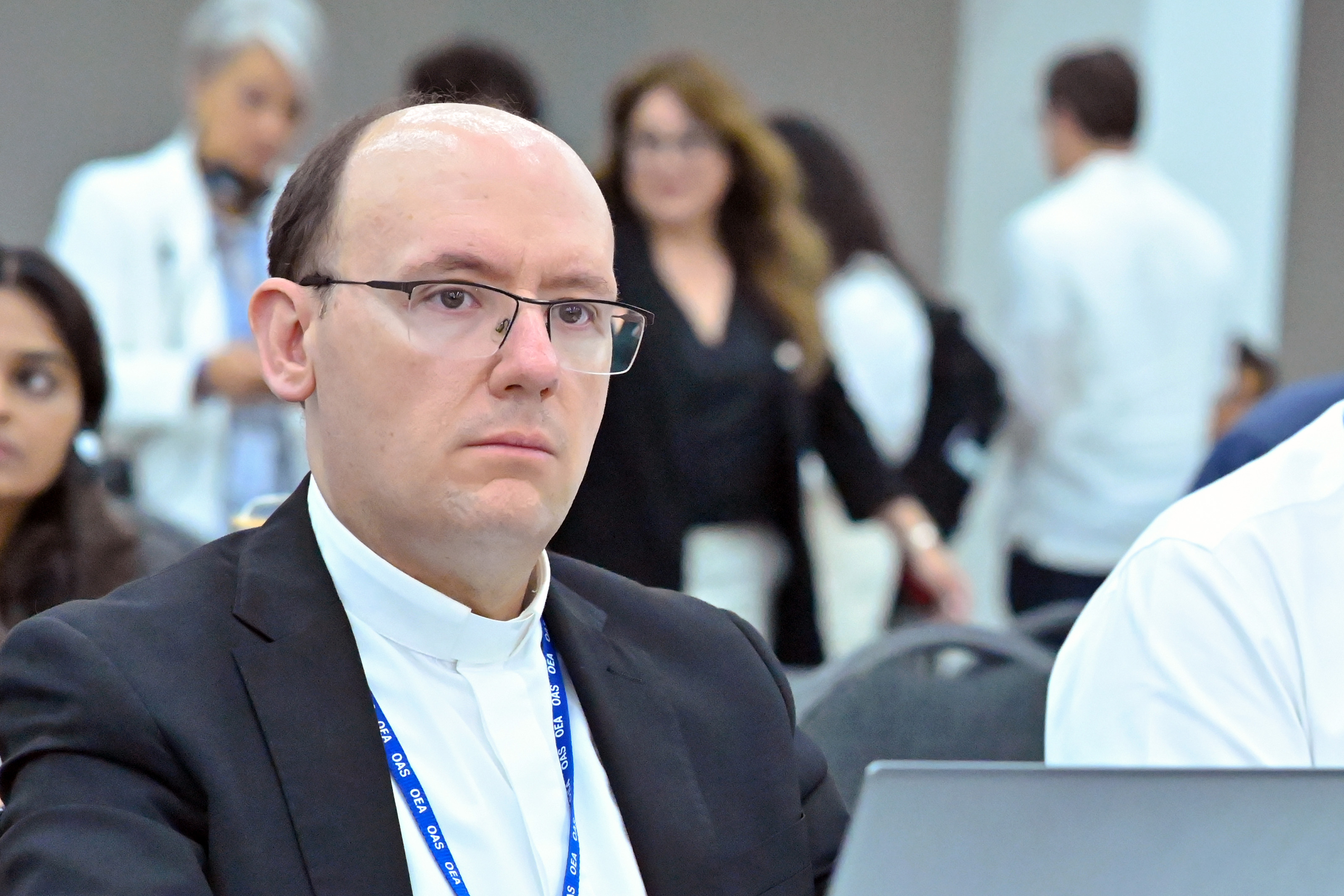
Seasoned Vatican diplomats, trained at the world’s oldest diplomatic school — the Pontifical Ecclesiastical Academy (the Accademia) — are typically calm and thoughtful, with a broad, comparative understanding of global affairs. Msgr. Juan Antonio Cruz Serrano, the Holy See’s permanent representative to the Organization of American States, is no exception. He served in Zimbabwe, Ireland and Chile as well as Rome before being assigned by Pope Francis to the OAS, a regional forum for 37 countries in Latin America, North America and the Caribbean. (Pope Francis made this position a diplomatic post in 2019.)
We met at the Holy See’s nunciature in Washington, D.C., where Msgr. Serrano lives. It is directly across the street from Vice President JD Vance’s residence.
Msgr. Serrano described the current situation in Haiti as “a great crisis.” He says many countries in the region want to help, but the No. 1 problem is national security and the physical safety of regular people.
“Without security, it is impossible to have democracy or for people to develop their capacities,” he said.
Unfortunately, a highly-touted U.N.-supported mission of Kenyan law enforcement officers, deployed in June 2024 to bolster and train Haitian national police, has not proven effective.
Close behind security is the need for humanitarian aid because “more than 2 million Haitian people are existing at the level of famine,” according to the priest. To avoid the choke-hold gangs have on Port-au-Prince, Msgr. Serrano said humanitarian efforts focus on helping people outside the capital, then moving goods and food into the city from other parts of the country.
Noting that Secretary of State Rubio pointed specifically to the OAS as the best locus for action, the Spanish diplomat said he has witnessed an intense level of concern for Haiti in organizational proceedings and from a new secretary general, Albert Ramdin, from Suriname.
For example, at its June general assembly meeting in Antigua and Barbuda, OAS delegates approved the resolution, “Calling for concrete solutions to be brought to bear as a matter of urgency to resolve the grave security and institutional crisis in Haiti.” It requires the OAS secretary general to produce an action plan within 45 days, which should be Aug. 11.
“All the OAS member states spoke about Haiti during the general assembly. Everyone was Haiti in that moment, wanting to help,” recalled Msgr. Serrano. “This is Fratelli Tutti in action, because they see a big family with the same problems, the same history, a great fraternity, and they need to help each other.” (Msgr. Serrano was on the team of translators for Fratelli Tutti, so the encyclical is close to his heart.)
The challenge, he told the Register, is that the OAS has no mandate to send a military force, a decision only the United Nations can unlock. Yet the U.N. has so far rejected the idea of sending peacekeepers — despite a written request last October from Haiti’s Transitional Presidential Council.
Reading U.N. Secretary General António Guterres’ Feb. 24 report on Haiti, it seems his argument against peacekeepers is that the country is too dangerous: “At this stage, transitioning to a United Nations peacekeeping operation is not assessed as a feasible option. Such a transition could be considered once significant progress has been made in substantially reducing gang territorial control.”
Colombia Analogy
What seems missing from the picture is dialogue with combatants, the armed groups controlling Port-au-Prince. The Catholic Church, and Pope Francis personally, were engaged in finding a resolution to an intractable war in Colombia, the longest-running conflict in the hemisphere. The breakthrough required dialogue between enemies and resulted in a peace treaty in 2016. The Pope visited Colombia a year later.
Interestingly, Colombia’s president, himself a former rebel, visited Haiti on July 18 for the second time this year. Perhaps Colombia provides some keys to Haiti’s violent stalemate.
Said Msgr. Serrano, “Dialogue is very difficult at this moment, especially with the capital overtaken by gangs, but not everything is lost. We need to continue to press the message of salvation. Some of them could hear this message, change, and the nation would have a window of hope.”
