


COMMENTARY: Notre Dame’s gargoyles, flying buttresses and open spire reveal how the great cathedrals united engineering, artistry and theology into a single vision reaching toward heaven.
When the Cathedral of Notre Dame in Paris went up in flames on April 15, 2019, the Catholic world was shocked and heartbroken — as were the artists and architects who for hundreds of years have considered Notre Dame one of the greatest cathedrals in the world.
Part of the reason Notre Dame is such a stunning structure is that it was built by the hands of artisans, masons, craftsmen, millwrights and architects back in the 12th century. Of the many examples of form meeting function in this magnificent cathedral, the three most obvious are the gargoyles, flying buttresses and open spire. Let’s look at these one at a time.
Gargoyles
We all know — or think we know — what gargoyles are: they are devilish-looking ghouls, monsters and goblins who spew fetid water out of their mouths and away from the church. This is true as far as it goes. However, gargoyles also serve a theological purpose: they show that evil is cast out and away from a consecrated place — like a church or cathedral or a basilica — and they are never represented inside a church (save in statuary or stained glass windows where Satan is trod underfoot by the likes of St. Michael or St. George). This “outside and away” motif is a type of physical representation of an exorcism: devils may never enter the House of God and must always be thrust far away.
Janetta Rebold Benton puts it succinctly: “Gargoyles are elaborate waterspouts. Usually taking the form of an elongated fantastical animal [or demon], these decorated gutters are architectural necessities turned into ornament.” She’s right, of course: anyone who has had a broken, missing or clogged gutter on their house knows how quickly and insidiously rainwater works its way into the wood of the roof and house.
However, gargoyles did not originate with Christian churches: according to architect Thomas Gordon Smith, the former chairman of the architecture school at the University of Notre Dame, gargoyles can be traced to military engineer Marcus Vitruvius Pollio around 40 B.C., who was renowned as the Roman Empire’s “water-mover,” from aqueducts to early systems of irrigation.
It is believed Vitruvius came up with gargoyles to keep water off the roofs of ancient Roman pagan temples. Catholic architects after him kept these in place. A great example of this is Rome’s magnificent Pantheon, rededicated by Pope Boniface IV as “Santa Maria ad Martyres.”
Flying Buttresses
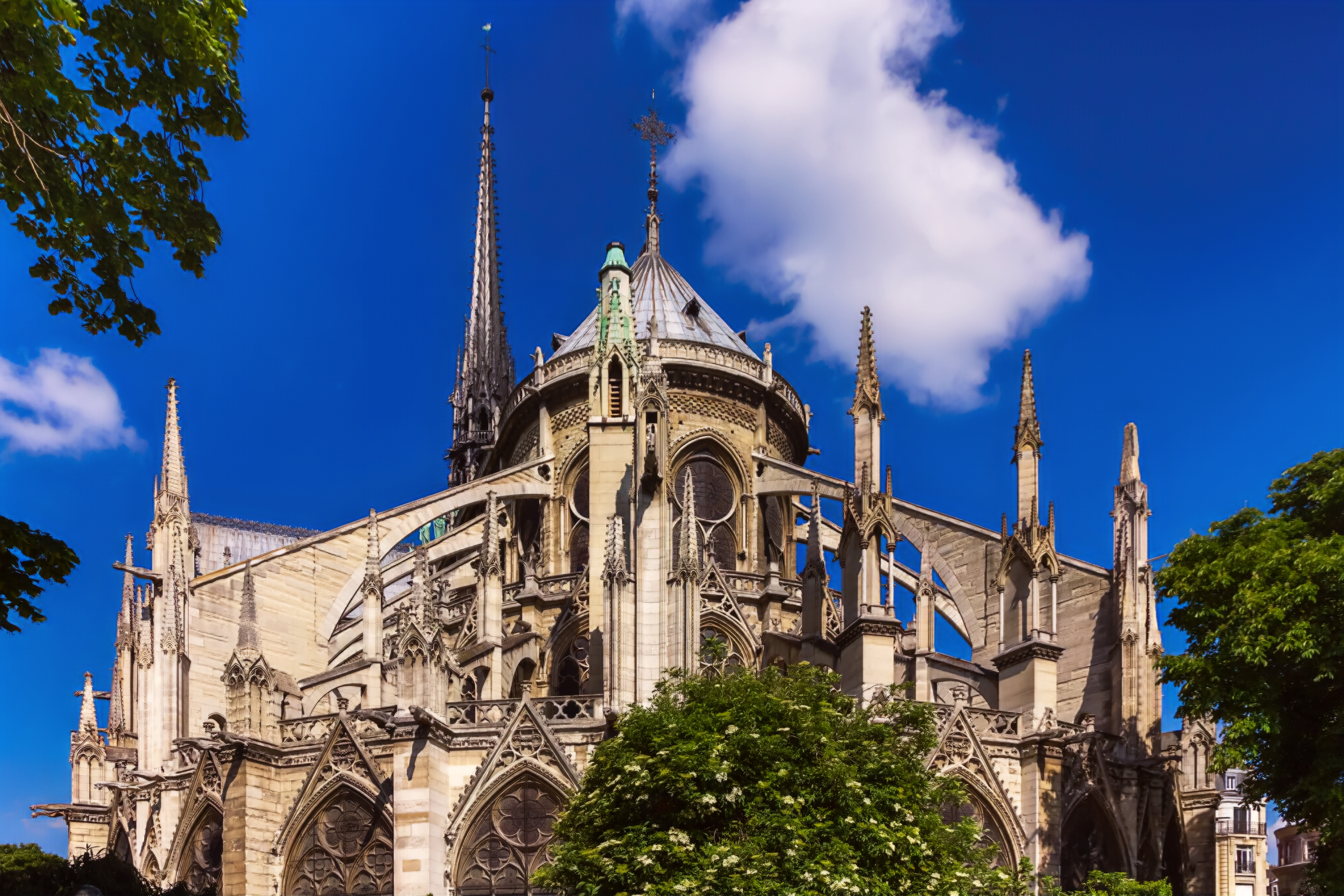
A much bigger deal in church art and architecture is the flying buttress. Before their invention, the walls of a church had to get thicker and thicker the higher and higher the church rose while requiring innumerable columns throughout the inside of the church to help support the roof. Walls could be made only so thick before it became impossible to raise them further without worrying about them falling.
Thus arose the necessity of the buttress (the “flying” adjective came later). Sir Kenneth Clarke, in his groundbreaking and timeless miniseries, Civilisation — along with its accompanying book — rightly calls them “one of those happy strokes where necessity has led to an architectural invention of marvelous and fantastic beauty. Inside [the church] there is no trace of difficulty or calculation: the whole harmonious space seems to have grown up out of the earth according to some natural law of harmony.”
This is due to the fact that the flying buttress, as beautiful as it may be, is doing all the hard work of holding the structure in place and dispersing the weight of the walls to the outside of the church.
This led to yet another benefit of artistry: Since church walls no longer had to be low and thick, but high and thin and free from interior columns crowding all around them, stained-glass windows, which had existed on a much smaller scale, now exploded into almost unimaginable beauty.
One need only look once at the rose window at Notre Dame. According to Judith Dupré, author of Churches, this rose window — which resembles a gigantic kaleidoscope — “occupies a whole storey — the Cathedral’s rose window … is said to have spawned more imitators than any other Gothic façade.” This window, which words truly cannot describe, would not be possible were it not for the load-bearing done by the flying buttresses. Clarke remarks that the flying buttress resembles “a living cage of ribs” and the church itself seems, on the exterior, to breathe.
Spire
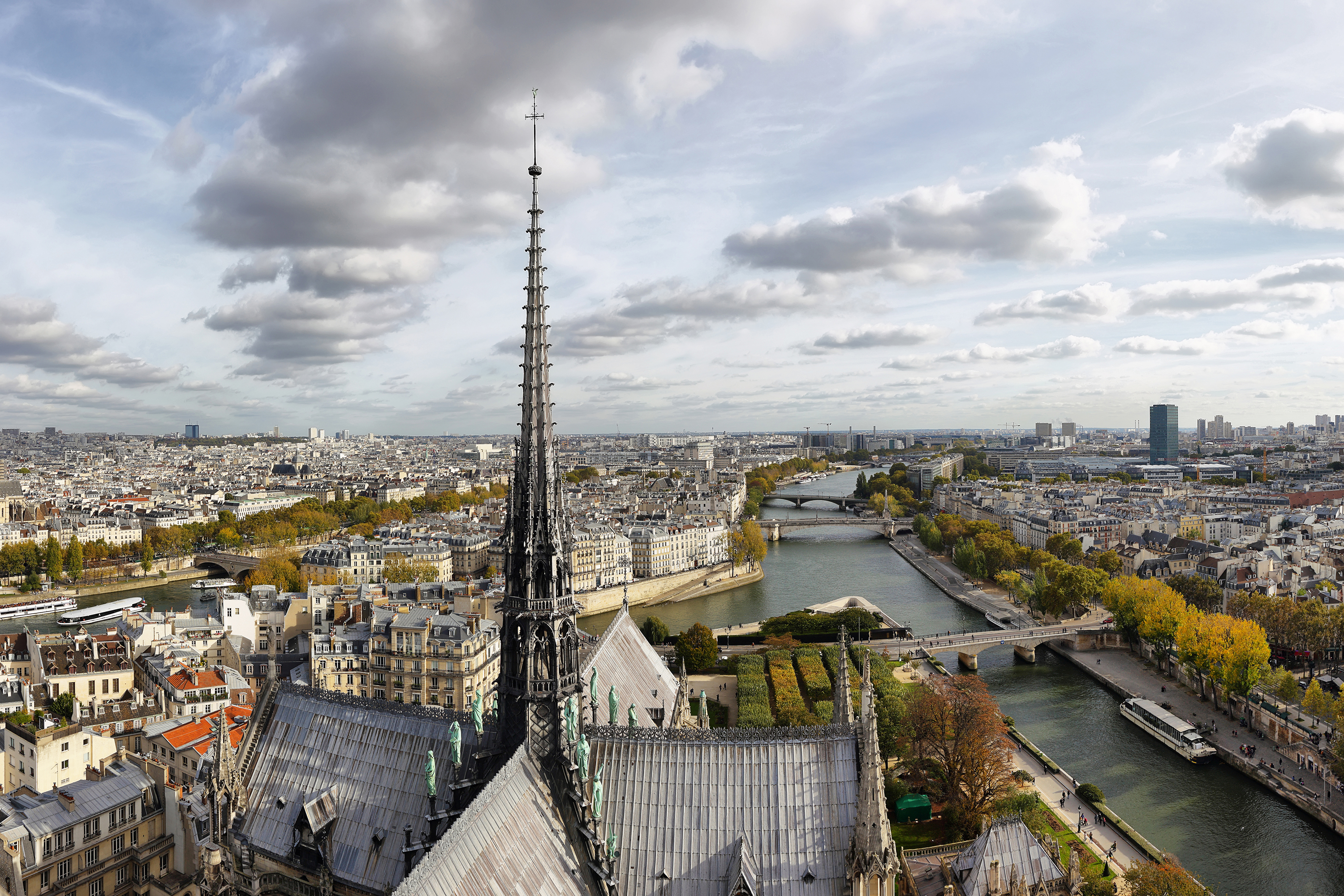
Perhaps the moment when the world collectively gasped in horror during the Notre Dame Cathedral conflagration came when the church’s central spire fell. It was eerily reminiscent of when the second tower of the World Trade Center collapsed, the last part being the giant transmitter tower going down into the smoke.
Notre Dame’s central spire was special because it was an “open spire” — that is, you could see through the bottom of it. Why build a spire in this way? In terms of function, it allows for a hollow spire to reach higher and put less pressure on the roof that is supporting it. In terms of aesthetics, an “open spire” is one of those architectural optical illusions: it looks higher than it actually is, since you can see the sky right through it.
Unlike the flying buttresses, which have the serious business of keeping the church in place, and the gargoyles, which seem an artistic flourish to the necessity of keeping water off the roof and away from the church, the open spire is a clarion call (not literally, as that’s left to the bell-towers). It shows the mixing of the heavens (the sky) and the artist (in the open stonework) into a whole: God is reaching into the church and the church is reaching to touch the heavens.
There aren’t many open-spire churches in the world, and in America only a handful exist — the tallest being St. Louis Church in Buffalo, New York. This makes them even more remarkable: their rarity. And while not many churches have this trifecta — an open spire, flying buttresses and gargoyles — the Cathedral of Notre Dame is one of the very few.
