

Legendary Teachers Continue to Inspire the Next Generation of Catholic Academics| National Catholic Register

Editor’s Note: This story kicks off the Register’s special report on “Legendary Professors.”
When Chad Engelland originally decided to enroll in graduate school, the thought of becoming a professor was far from his mind.
But in his first semester at The Catholic University of America (CUA), Engelland took a course with Father (now Msgr.) Robert Sokolowski, a philosopher who has taught at CUA since 1963. He recalls being blown away by his legendary professor’s presence in the classroom, especially his masterful ability to explain the connection between faith and reason.
“What he laid out there was exactly what I was looking for,” Engelland told the Register.
But the experience didn’t just give Engelland intellectual clarity. It also made it clear to him the vocational path he wanted to pursue.
“Within a matter of weeks of being there and seeing the truth open up for me, I couldn’t imagine doing anything else,” said Engelland, now a University of Dallas philosophy professor who has taught for more than 20 years. “And that is largely due to the example of Father Sokolowski.”
A Legacy of Mentorship
Father Sokowloski’s impact on Engelland is part of a long legacy of legendary Christian scholars mentoring their students and inspiring them to follow in their footsteps. Examples from history include St. Albert the Great’s mentorship of St. Thomas Aquinas, or St. Ambrose’s of St. Augustine.
The age-old pattern highlights the profound impact of personal influence in the academic vocation, and it continues to play out today, shaping the next generation of Catholic professors.
Notre Dame law professor Sherif Girgis, for instance, recalls being “mesmerized” by the example set by political philosopher Robert George, McCormick Professor of Jurisprudence and director of the James Madison Program in American Ideals and Institutions at Princeton University.
Girgis had been inspired to apply to Princeton after reading an article about George in Crisis Magazine, so he was already aware of the professor’s reputation when he stepped foot on campus. But in person, Girgis said that the iconic Catholic scholar made a life in academia seem like a courageous and exciting endeavor. George’s witness was especially compelling to Girgis as a recent convert, who was well aware of how unpopular many Catholic views are in secular society — and especially at Ivy League schools.
“It’s not just that he happened to hold these views privately; it’s not even that he defended publicly the idea that you can be reasonable and hold them,” Girgis explained. “He was saying, ‘My view is rationally superior to my opponent’s, and I can prove it on their own grounds.’”
“He was in the valley of the beast, and he was a cheerful, joyful, happy warrior, totally out in the open, taking on all comers, and I thought that was incredible,” he added.
Sometimes, the inspiration to pursue an academic vocation is even more direct. Alex Taylor, a research fellow at the Russell Kirk Center for Cultural Renewal in Mecosta, Michigan, chose to go into academia in large part due to some direct encouragement from Susan Hanssen, his history professor at the University of Dallas. While he was an undergrad, Hanssen suggested he bring his academic work into the public sphere and begin presenting at conferences.
“I started having an experience of what the academic life [is] outside of being a student very early on, and it was largely because of her encouragement,” said Taylor, who has taught English at Christendom College and the University of Dallas.
Imitating the Masters
Just as children take after their parents, Taylor notes, students take after their professors, adopting many of their intellectual traits and mental habits. The result is something like a “family tree” of academics.
“It’s like any family. When you only know one member of the family, you might not realize or know all the connections, but the more acquainted you become, you start to see these great likenesses,” said Taylor. “I think [it’s] lovely because I think academia is supposed to be like any other community in the sense that, fundamentally, what we do is built off of friendship.”
When students follow their mentors into academia, they take with them not just their ideas but their teaching styles, too.
Girgis has picked up a variety of George’s habits in the classroom: playing devil’s advocate, encouraging lively debate among students, framing issues passionately and dramatically, and speaking without notes, to name a few.
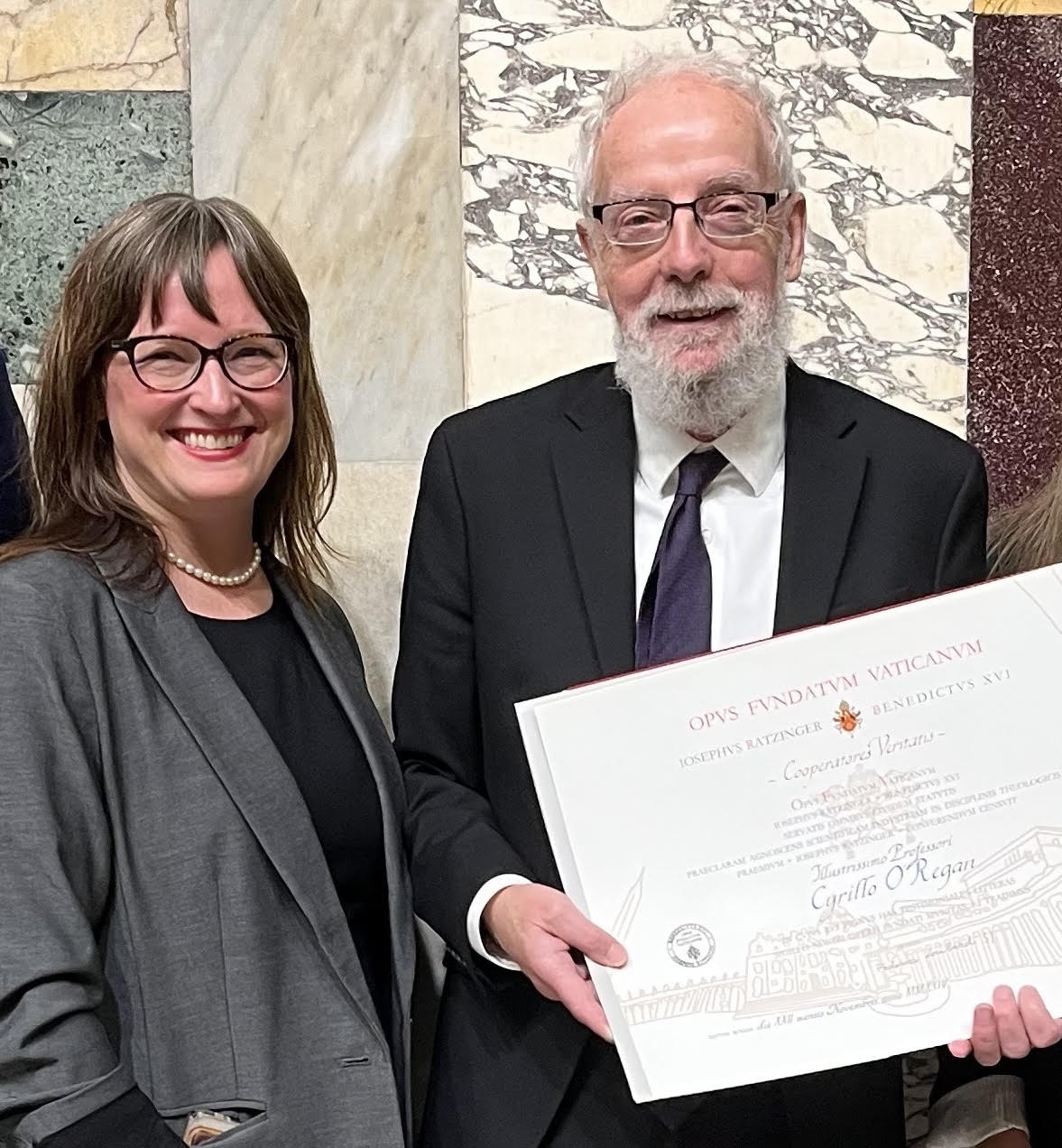
Notre Dame theology professor Jennifer Newsome Martin, who was mentored by the renowned Notre Dame theologian Cyril O’Regan, said she has especially tried to emulate his great care for students. She observed in O’Regan a great respect for the dignity of each student and an ability to see students both as they are and as they could be.
“Someone would ask a terrible question in a seminar, and somehow he would rephrase it just enough to make it a brilliant question,” recalled Martin, who heads the de Nicola Center for Ethics and Culture at Notre Dame. “He would be able to really dignify the student — he was able to see what was really the issue, to see to the heart of things.”
Sometimes the imitation comes down to the very particular. Engelland notes that he still uses variations of the same stick-figure diagrams on the board that he remembers Father Sokolowski drawing to illustrate philosophical concepts.
That so many of today’s professors take on the likeness of their mentors is unsurprising, says Girgis. As he puts it, we learn best by imitation.
“There’s an abstract ideal of truth-seeking and of intellectual rigor and of generosity in teaching, but it’s nothing compared to the lived examples of the people who are truly great in those respects,” said the scholar.
More Than a Job
Beyond teaching styles and big ideas, legendary professors have also handed on a vocational understanding of academic work to the next generation.
For Martin, O’Regan helped her to see being a professor not just as a job, but as a way of life. She noted that he reads widely and voraciously, including subjects outside of his field.
“[His] way of thinking that everything in the world is interesting and has something to disclose — to me, that felt big enough to be a vocation,” she said of O’Regan, who received the prestigious Ratzinger Prize in 2024 for his theological contributions.
O’Regan also helped Martin see the importance of “rolling up your sleeves” and leaning into the day-to-day responsibilities of life on a university faculty, including committee work and serving on dissertation boards.
“Cyril thinks about the academic vocation [as] not just high-minded or speculative,” she said. “You have to serve the department, you have to serve the Church, and you can’t be a diva.”
As with the other professors and mentors, the inspiration Martin receives from O’Regan continues to the present day. The two have maintained a close friendship, and O’Regan is even the godfather to Martin’s daughter. “It just feels like an ongoing conversation that we’ve been having for 20 years.”
Inspiring the Next Generation
Naturally, Catholic professors who have been inspired by others to pursue an academic vocation will themselves go on to inspire some of their students to embark on the same path.
Martin takes into consideration — admittedly with some “fear and trembling — the influence she may be having on her students.
“You never know the sort of impact you might have in education,” she said. “In my heart of hearts, I always think of that verse from Paul in 1 Corinthians, where he says, ‘I planted the seed, Apollos watered it, but God has been making it grow.’”
Nicolas McAfee, a young political science and economics professor at Christendom College, hopes to inspire his students to pursue the intellectual life just as his University of Dallas professor Gerard Wegemer, a renowned scholar of St. Thomas More, did for him.
He is cautious not to focus on it too much or push students into academia. Inspiration is an important factor, but the decision should come from within. For the students who will find joy in it, it will be contagious.
“I think it’s only natural [to inspire others] if we genuinely show excitement and love for the things we’re sharing,” McAfee said.
Engelland argues that the best way to inspire the next generation of Catholic professors is to be receptive to the “hidden dimension, the subtle workings of divine Providence” and to live out the vocation well. And for Catholic professors, that means imitating Christ.
“Ultimately, I think what is going to be attractive about our teachers is the sense in which we glimpse Christ the Teacher in them in some way,” he said. “Insofar as you’re an effective teacher, insofar as you enable your students to glimpse the truth … they’re going to get excited and they’re going to want to share that with others.”
