


In 1987, 9-year-old John O’Leary was a suburban kid from St. Louis, growing up in a Catholic family, making the same kinds of mistakes most kids make — including one that would have truly explosive consequences.
An experiment with matches and gasoline in the family garage blew up in his face — literally — burning down his family home and leaving O’Leary with third-degree burns on 85% of his body and a projected chance of survival in the single digits.
O’Leary’s remarkable recovery, and the many twists and turns that his life took next, are vividly depicted in the new film Soul on Fire (rated PG, AFFIRM Films), which releases nationwide on Oct. 10.
The movie is based on O’Leary’s bestselling 2016 book On Fire: 7 Choices to Ignite a Radically Inspired Life. In the director’s chair is Sean McNamara, best known for the 2011 film Soul Surfer as well as Reagan, released last year.
In the decades since his accident, O’Leary has built a successful life as an author and public speaker, addressing tens of thousands of people every year as he encourages them to live a life marked by gratitude and the embrace of their God-given potential. But his path from juvenile burn victim to quasi-celebrity was far from a sure thing.
For many years after he left the hospital, O’Leary buried his past and his feelings — and drowned them in alcohol — wanting nothing more than to blend in. He kept his scars under wraps as best he could, even from his close friends. He cultivated a party-boy persona in college and chose to go into the contracting business after graduation — despite having lost his fingers.
O’Leary, 48, told the Register that viewers expecting to watch a film about a little boy swathed in bandages and defying the medical odds will quickly realize that the film, while certainly depicting that struggle, also explores an even deeper journey: O’Leary’s later wrestling with feeling unworthy of love and tethered and tied to past mistakes — and the freedom he found by surrendering to God’s plan for his life.
In addition, the film highlights how profoundly blessed O’Leary was to have family, neighbors, friends, caregivers and a loving wife who recognized his God-given dignity and potential — even when, in his most broken state and for years afterward, he himself had lost sight of that potential.
“Out of all these things I’ve ever done, the film is by far the most vulnerable,” O’Leary said.
“It’s weird to talk about myself in the third person, but I, or in the movie, John, begins to recognize the beauty in the broken and how God has redeemed the situation. He’s just the last one to recognize it.”
The film opens with an adult O’Leary (portrayed with verve by Joel Courtney) being invited in 2008 to address a Girl Scout troop at a Catholic school and inspire them with the tale of his miraculous recovery. Through the jitters and nerves, O’Leary fields a question from one of the children: If he could go back in time and stop the accident from ever happening, would he?
Flashback to the ’80s, and viewers get the scoop on how a younger O’Leary (James McCracken) was enticed, through the bad example of some pyromaniacal peers, into the idea of setting gasoline on fire.
The film briskly proceeds to the moment every audience member knows is coming: After the gasoline can explodes, the fiery aftermath is shown from O’Leary’s point of view, as he runs through the house (the one in the movie is the O’Leary’s actual former home), screaming in agony, and his siblings frantically attempt to douse the flames consuming their brother.
“I want to die. Please kill me,” the burned O’Leary, supine on the front lawn, whispers as emergency services screech to a halt. But no one is giving up on him that easily.
As he’s wheeled into the operating room — the doctor already having delivered a grim prognosis — O’Leary’s mother, Susan (Stephanie Szostak), tearfully tells her son to “take God’s hand and walk with him.”
With that, O’Leary takes his first true step into faith as he places his young life in God’s hands.
Throughout his five-month hospitalization, O’Leary received an outpouring of support from the St. Louis community, led by the legendary St. Louis Cardinals sportscaster Jack Buck (William H. Macy). After serendipitously hearing about O’Leary’s ordeal, Buck appears by O’Leary’s hospital bed, telling the then-immobile and mute boy, in a stout pep talk, that he will recover.
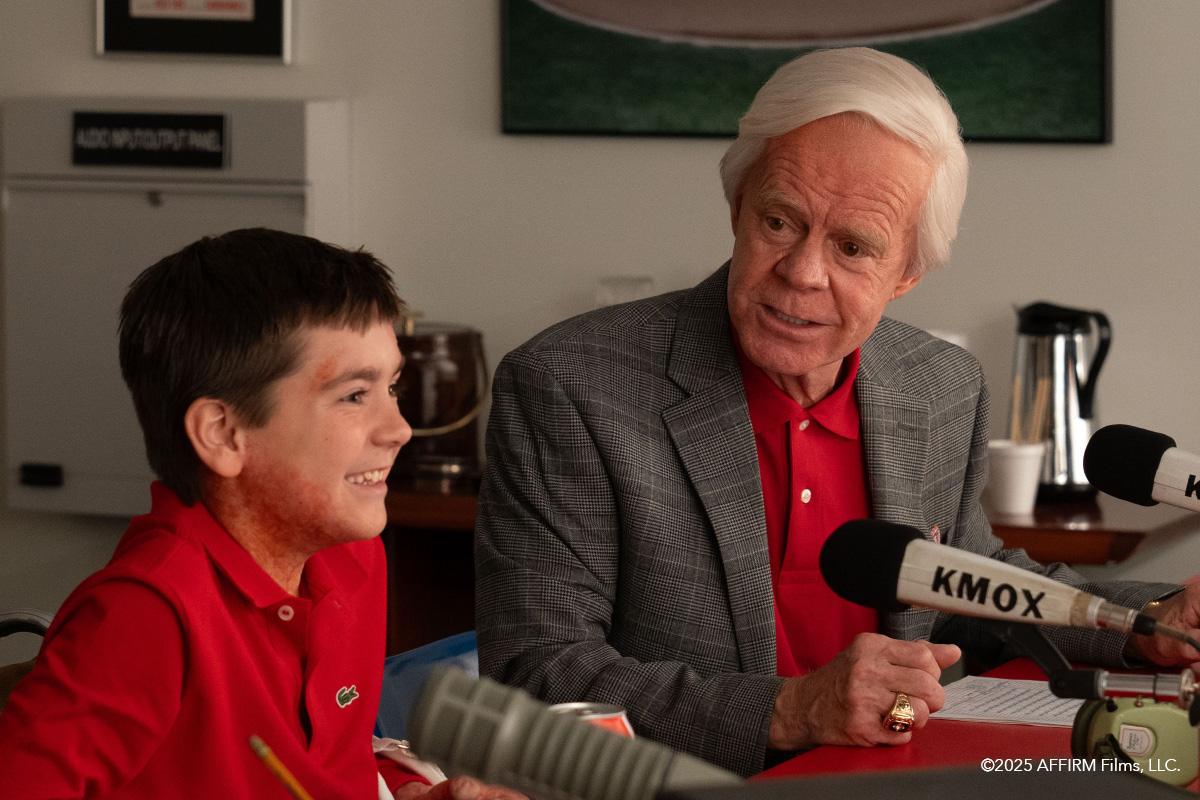
Recover he does, but not without a lifetime’s worth of pain, constant prayers from his mother and innumerable others, and the tireless care of his doctor, Vatche Ayvazian (Iyad Hajjaj) and his nurse, Roy Whitehorn (DeVon Franklin).
O’Leary’s triumphant exit from the hospital isn’t even close to the story’s end. He continued to be celebrated in his hometown, even getting to “run the bases” (pushed by his dad in a wheelchair) and share the broadcasting booth with Buck at a Cardinals game played in his honor.
But as the celebrations die down, O’Leary must adapt to the way his scarred body now looks, as well as to a fingerless existence — they had to be removed during one of his many surgeries — not to mention wrestling constantly with the guilt of what he put his family through.
O’Leary, both on-screen and in real life, expected his father to be furious. But instead, Denny O’Leary (John Corbett) emphatically tells his son:
“I love you, buddy, and there’s nothing you can do about it.”
St. Louis — almost a character in itself — is a place steeped in a long history of Catholicism, so it’s no surprise that the film lingers prominently on the city’s many Catholic institutions; to name just a few, the Catholic hospital where O’Leary spent his recovery, St. John’s Mercy; Saint Louis University, the Jesuit-run college O’Leary attended; as well as the striking Shrine of St. Joseph in downtown St. Louis, site of O’Leary’s wedding. (The actress portraying his wife Beth, Masey McLain, wears Beth’s real-life wedding dress in the film.)
Soul on Fire, as O’Leary himself acknowledges, may well be dismissed in the secular press as just another faith-based film — and to be fair, the film is unquestionably “faith-based,” even if explicit references to God and to prayer are relatively sparing and tend to be a little more subtle than your average “Christian” movie.
But the film, taken as a whole, contains a host of positive depictions of love that Catholics can relate to: the unconditional love of O’Leary’s father (naturally evocative, of course, of the unconditional love of another Father); the tough love of the many people, mostly medical, who had to put O’Leary through pain — such as the necessary hours-long bandage changes daily, or the excruciating stretching of his burned tendons and skin as he learned to walk again; the tender love of his friend, girlfriend and eventual wife Beth; and the self-sacrificial love of the many people who went out of their way to lift O’Leary up, most prominently Jack Buck. (In the words of O’Leary in the film, “Everybody mattered.”)
“Everything you did … why me?” the cinematic O’Leary asks incredulously, Buck having just given him his priceless, crystal Hall of Fame baseball as a graduation gift.
“Seemed like you needed it,” Buck replies simply.
Later on, the film explores O’Leary’s feelings of unworthiness and shame at never having the chance to truly thank or repay Buck for his kindness. Buck died in 2002 at age 77.
“I’ll never fully understand why you were so good to me,” the on-screen O’Leary chokes out, addressing Buck’s headstone. “I love you.”
The real-life John O’Leary lives a life today of innumerable blessings that emerged, quite literally, out of “ashes,” as Denny tearfully tells his son in a moving scene. (Denny, who suffered with Parkinson’s disease for decades, died in May — but lived to see a screening of the film.)
Ultimately, O’Leary’s is a faith defined by a consistent return to core Catholic tenets: an embrace of redemptive suffering, a firm belief in the power of the sacraments and prayer, and a life oriented around the simple, yet profound, call to say “Yes” to God.
And with that, the film’s goal, O’Leary said, is to serve as an “invitation to join us in the faith walk” and to remind audiences that “God is still God, that prayer still matters, and the best is yet to come.”
“My hope as people leave this film, ultimately, is that they’ll have that same response…to recognize ultimately that God is working still in their lives; in their faith, in the brokenness, and in the good,” he told the Register.
“That was our hope: that people would recognize that God works through all things and all people in all ways, but you gotta be open to it.”
Viewer Caveat
Rated PG for thematic content, including burn injuries, some peril and suggestive material.
