


About an hour and a half north of Budapest by car, there’s a little yellow church — the Basilica of Our Lady of the Assumption — that stands, baroque and bright, at the bottom of the valley of Mátraverebély. The shrine is called Szentkút, and our journey to the shrine began on a chilly May morning.
We met the other pilgrims at 7 a.m. and took the bus north. At the Church of St. Elizabeth in the village of Mátraszőlős, the bus stopped and our trek began. For 7.5 miles, we walked through Hungary’s beautiful hills, past silent cows, barking dogs and waving villagers. We picnicked in the shade by a dried-out riverbed, then kept walking. Wide meadows turned into hilly forest, and the group fell silent as we climbed. On the downgrade, Hungarian hymns echoed softly through the trees. We had reached the valley of Mátraverebély.
About 200,000 people visit Mary’s Shrine at Szentkút annually. Some come alone. Others come with groups from across Central Europe: Hungary, Austria, Slovakia, Romania, and Serbia. Visitors come for spiritual consolation, for peace of heart, for healing, and for prayer. Others come for the sake of the scenery, since Mátraverebély is a place of great natural beauty. Still others make their way to Szentkút on foot as pilgrims following Mary’s Way.
The Shrine’s Origins
In the days of roaming warlords and rising kingdoms, King St. Ladislaus of Hungary was fleeing from Cuman warriors astride his warhorse, Szög, through the Mátraverebély valley. Hard-pressed by his pursuers, the king urged his horse to jump across a gorge. The animal made the jump and in the horse’s brave footfalls, a spring appeared. Because of this miracle, Hungarians venerate St. Ladislaus as a Mosaic figure, and he is often depicted, spear in hand, drawing water out of a rock.
Some years later, farther down the same valley, Our Lady appeared to a mute shepherd boy holding the Child Jesus. She directed the little shepherd to dig in the ground and to wash himself in the water that appeared. The boy obeyed, and he was cured. This miracle was the first documented healing, and to this day, healings continue. The still-flowing spring gives the shrine its name: Szentkút or Holy Well.
Early History
Pilgrims have traveled to Mátraverebély for almost a millennium. St. Ladislaus’ miracle took place in 1091 — four years before the king’s death. Our Lady appeared some years later. By 1258, the shrine had received a pilgrimage charter from Pope Alexander IV in far-off Rome. A church was built. Cistercian monks built a monastery beside the shrine in the valley, and hermits moved into caves high up in the hills.
By the 14th century, a savvy landlord was running a three-day market festival on the Solemnity of the Assumption to capitalize on the crowds of pilgrims coming to the valley. A pious man, he also commissioned a Gothic-style church for the shrine, and on Nov. 9, 1400 — a jubilee year — Pope Boniface IX granted the new church an indulgence. Pilgrims to Szentkút could receive the same indulgence that they could receive from visiting the Portiuncula in Assisi or the Imperial Cathedral in Aachen, Germany.
The Turks Invade
Of course, the shrine’s course wasn’t always smooth. In 1544, Turks invaded the Carpathian Basin and destroyed the shrine. The monks fled or were killed. Monasteries throughout Central Europe were falling to the Turkish invaders. The Cistercian monastery of Heiligenkreuz outside Vienna was overrun. Those monks accidentally left one of their brothers behind, and he was found and killed by the Turks. To this day, Cistercians of Heiligenkreuz venerate him as a martyr.
Eventually, with the help of Christian Europe, the Hapsburgs drove the Turks back and incorporated Hungary into the Austro-Hungarian Empire. Franciscans had been caring for the shrine even under Turkish occupation, but by 1700, religious life returned in earnest. Pope Clement XI investigated some of the healings that had taken place at Szentkút and approved them.
A stone church was built in 1705 — likely to replace what the Turks had destroyed—and it became a pilgrimage site. In the mid-1700s, a Szentkút hermit built the current church in the baroque style: ornate façade, intricate domes, and painted ceiling. And the devotion was spreading. The first book about Szentkút was written by a priest who was cured of a back ailment on the Feast of the Assumption.
Religious Suppression
But trouble was brewing in Vienna — the seat of Hapsburg power. In 1780, much beloved Empress Maria Theresa died, and her son took control. Unlike his mother, Joseph II was a man of the Enlightenment. To decouple from papal influence, he forcibly closed contemplative monasteries and convents, sold monastic lands, banned religious orders, and required bishops to swear fidelity to the empire. During his 10-year solo reign, more than 700 monasteries closed and the number of religious in the empire shrank from 65,000 to 27,000.
Sources available to me, an English speaker, don’t say precisely what happened to Szentkút during that time. They simply note that it was a period of hardship. Maybe the emperor sold monastic land or confiscated revenue? Perhaps the monks were expelled from their monastery? And more suffering was on Hungary’s horizon: continued clashes with the Hapsburgs, back-to-back world wars, devastating territorial losses via the Treaty of Trianon, and, finally, 45 years of Soviet occupation.
In 1950, the Soviet state expelled the Franciscans from the Szentkút monastery, which was nationalized and turned into a nursing home. The forcible eviction of monks and nuns was happening everywhere — across then Czechoslovakia and throughout Hungary. Pilgrimages were risky and religious practice was frowned upon, something Cardinal József Mindszenty attests to in his memoirs and Cardinal Péter Erdő, presently the primate of Hungary, described in a recent interview.
Hope Despite Suffering
But Soviet occupation could not crush the Hungarians. Many brave priests and bishops suffered for the faith. Cardinal Mindszenty persistently reminded the world about the plight of the Hungarians, especially Hungarian Catholics. And in 1970, Pope Paul VI named the church in Szentkút a minor basilica.
In 1989, the Soviet Union collapsed, and the long and complicated process of restitution began — a process that’s still ongoing in parts of Central Europe. That same year, the Franciscans returned to Szentkút. And on the Solemnity of the Assumption in 2006, Cardinal Erdő celebrated Mass at the site and announced that the Hungarian Bishops’ Conference had made Mátraverebély a national shrine.
Franciscans continue to care for the shrine and to welcome pilgrims with a newly expanded pilgrimage center. In 2016, the shrine was affiliated with the Basilica of St. Mary Major in Rome. Affiliation is a unique privilege available to “shrines, churches, and chapels dedicated to the Blessed Virgin Mary” upon an in-depth application process. Once affiliation is granted and certain conditions are met, pilgrims can receive a special plenary indulgence “every time the faithful gather as a group for devotion in the affiliated church.” Even in a secular capacity, the shrine is gaining regional significance.
Mary’s Way
Unlike the Camino de Santiago, which brings pilgrims from various starting points to a centralized finish at the Basilica of St. James in Santiago de Compostela, Mary’s Way is a network of routes that connect the major Marian shrines of Central Europe. The route is shaped roughly like a cross. The vertical beam begins in Poland at the Shrine of Our Lady of Czestochowa, runs south through Hungary, through Esztergom and Budapest, then ends in Bosnia-Herzegovina at the shrine of Our Lady of Medjugorje. The horizontal beam of the cross connects Mariazell in Austria with Budapest and Máriapócs, another Hungarian shrine, then ends at a Franciscan church in Șumuleu Ciuc in modern-day Romania.
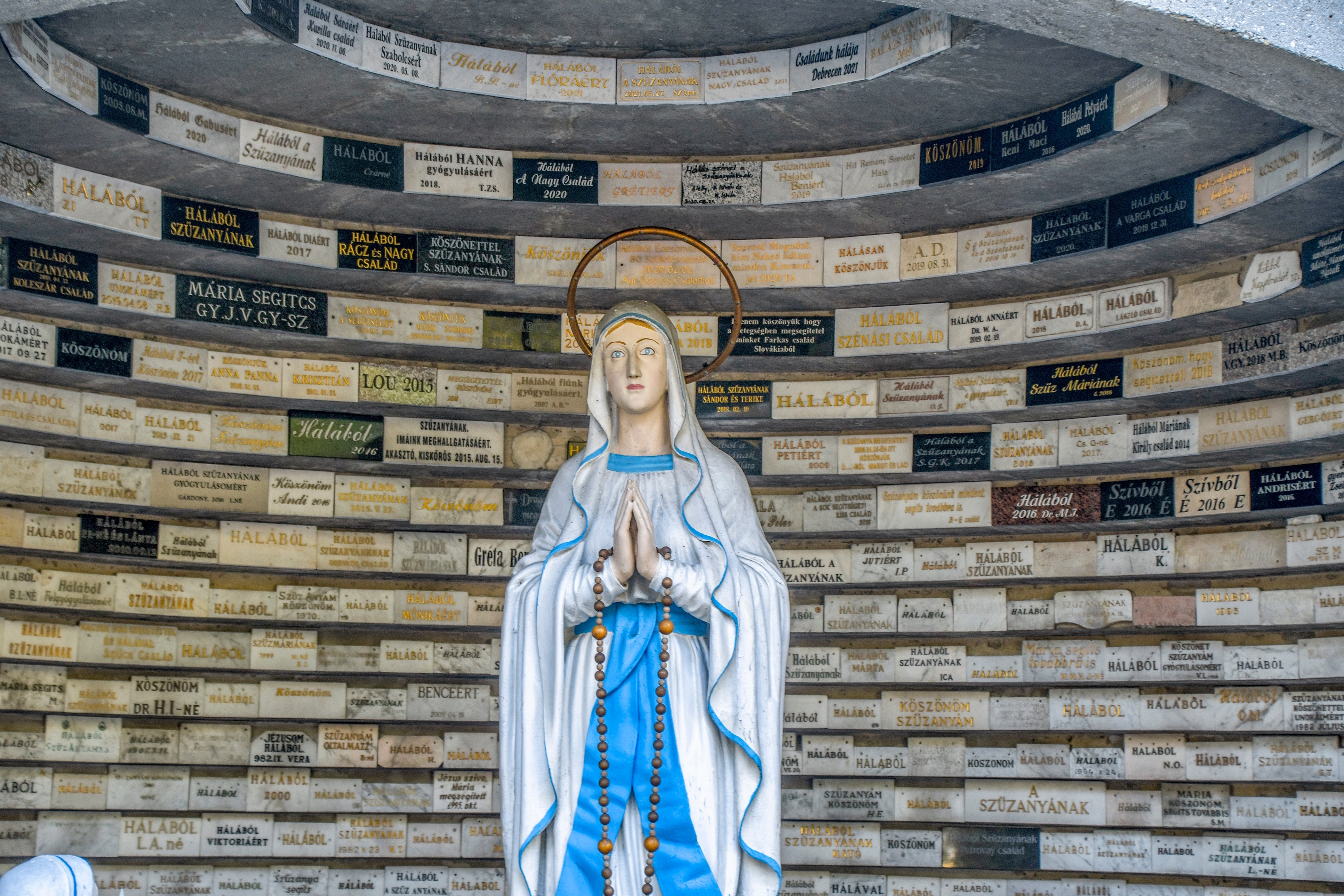
Szentkút is at the heart of both routes — north of Budapest, east of Esztergom, south of Czestochowa — at the heart of the cross. That placement encapsulates the whole of Mary’s Way. Our Lady pondered life with Christ silently in her heart. Mary’s Way is an invitation into that same hidden life. Pilgrims who arrive at the shrine of Szentkút write their messages for Mary in a book at the back of the shrine. Many messages begin with draga edesanyam — in Hungarian, “my precious sweet mother.”
Lourdes and Fatima are well-known pilgrimage sites. Szentkút is a well-kept secret because of the Iron Curtain and Hungary’s long-suffering. But suffering notwithstanding, deep gentleness pervades the place. As my husband and I walked out from under the trees and entered the clearing, hungry and tired, a Franciscan friar smiled at us and welcomed us to Mary’s shrine. We drank from the Holy Well and prayed before Our Lady’s image. We saw the shrine’s painted ceiling depicting Ladislaus on horseback and Our Lady with the shepherd boy. We ate gulyás (goulash)and almás rétes (traditional Hungarian apple pastry) together in the sunlight. We went home peacefully.
In years to come, may Mary draw many more pilgrims to her heart along Mary’s Way and to the little baroque church in the bright valley of Mátraverebély.
Evelyn Whitehead, a graduate of Franciscan University of Steubenville and Ave Maria Law School, is currently a fellow in the Budapest Fellowship Program. Her research areas are culture, the human person, and life and family policy. You can read her reflections on her substack, “With Love From Hungary,” here.
