


While the Pope’s September visit to France turns global attention to Notre Dame Cathedral and Lourdes, a lesser-known basilica — with ties to Sts. Thérèse of Lisieux and John Henry Newman, the Augustinians, and even Mozart — keeps one of France’s most enduring Marian devotions alive.
The Marian dimension of Pope Leo XIV’s Sept. 25-28 apostolic trip to France is already evident in the detailed itinerary released by the Vatican, including solemn vespers at the newly restored Notre-Dame de Paris Cathedral (named for Our Lady), followed by a weekend in Lourdes, where the Blessed Virgin appeared 18 times to a young peasant girl in 1858.
This spiritual focus also offers an opportunity to draw attention to other major sites of Marian devotion scattered throughout the country, even if they are not on the agenda for upcoming papal visit. For instance, many Catholics know of the famous Chapel of Our Lady of the Miraculous Medal on Rue du Bac, where Mary is said to have appeared to St. Catherine Labouré. However, there is another site — less well-known but no less iconic — located just a few steps from the Paris Stock Exchange: the Basilica of Our Lady of Victories.
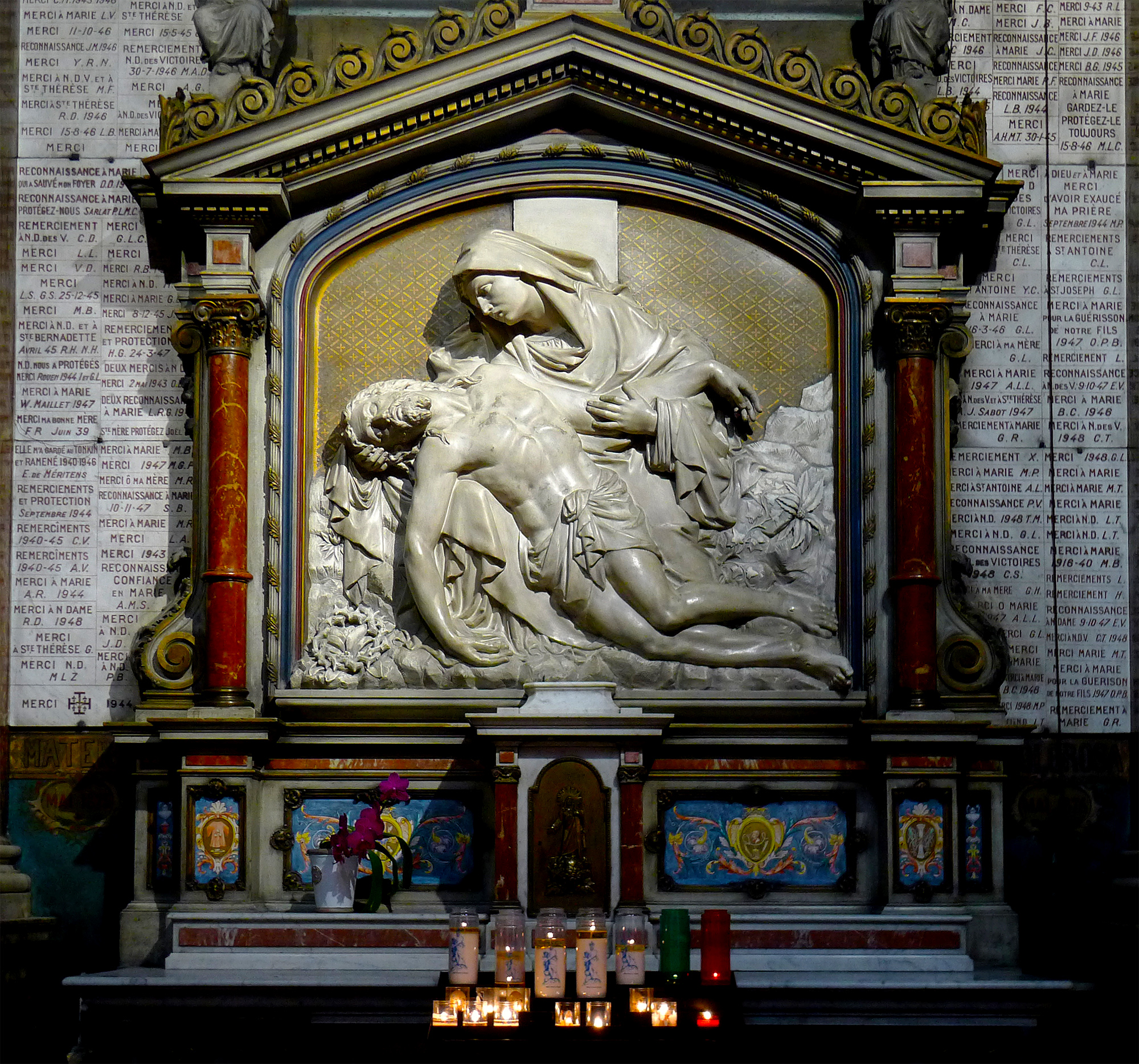
Covering its walls from floor to ceiling are more than 37,000 marble votive plaques, each giving thanks for a prayer answered — a devotion that remains vibrant to this day, with the most recent plaque having been added in 2021.
Named in thanksgiving for a military triumph in the 1600s, saints, cardinals and a whole host of writers and musicians have left their discreet mark on the shrine over the centuries.
A Trail of Victories
The sober Baroque façade of Our Lady of Victories, inspired by Rome’s Chiesa del Gesù, is deliberately unadorned in keeping with the vow of poverty of the Discalced Augustinians, known as the petits pères, who had been the church’s original custodians. However, once inside, austerity gives way to the grandeur of the Counter-Reformation. Eight stained-glass windows illuminate the single nave, maintaining a subdued atmosphere even in broad daylight. Only the choir glows with vivid colors and gilding, dominated by seven monumental paintings, six of which depict the life of St. Augustine.
How this monument has survived from its groundbreaking in 1629 to the present day is, quite rightly, a story of victories won against all odds. The first is the event that gave the church its name: a vow made by King Louis XIII, which was fulfilled following a military victory over the Protestant stronghold of La Rochelle in 1628. Carle Van Loo, a painter at the court of Louis XV, dedicated the seventh monumental painting to Louis XIII, depicting him presenting the Virgin Mary with a drawing of the very church he had promised to build for her. But it took more than a century, and the patronage of three other monarchs, before the building was finally completed in 1740.
Then came the French Revolution and its devastating anticlerical fervor. The Augustinian friars who had built the church were expelled, their library of 40,000 volumes seized, and the building itself stripped of its religious purpose — first requisitioned to serve as the headquarters of the national lottery, then as an annex to the nearby stock exchange.
When it was returned to Catholic worship in 1809, its survival was far from assured, as its parish had been stripped of its substance by decades of de-Christianization.
In the winter of 1836, the parish priest, Father Charles Éléonore Dufriche-Desgenettes, began to consider resigning from his post after four years of ministry that seemed to bear no fruit. While celebrating Mass before a handful of the faithful on Dec. 3 of that year, he heard, twice, a voice urging him to consecrate his parish to the Immaculate Heart of Mary. He acted swiftly. Within a few days, he had drafted the bylaws for a prayer association dedicated to the conversion of sinners. A week later, nearly 500 people — 10 times his usual Sunday congregation — attended its first meeting. The archconfraternity of the Most Holy and Immaculate Heart of Mary, founded that winter, would eventually grow to include millions of members worldwide, and the stream of pilgrims it drew to that once-deserted parish has continued to grow ever since.
A Wall of Answered Prayers
That trickle is now measured in the tens of thousands. Every available surface inside the basilica — walls, pillars, even the staircases — is covered with marble ex-voto plaques, more than 37,000 of them, each recording a favor Catholics believe they obtained through Our Lady’s intercession.
However, the devotion long predates 1836 and has drawn an unlikely range of visitors over the centuries. Jean-Baptiste Lully (1632-1687), the great composer of Louis XIV’s court, is buried in a side chapel near the nave. A century later, a 22-year-old Wolfgang Amadeus Mozart made a habit of stopping by whenever he was in the city; in a July 1778 letter to his father, he wrote that he never failed, “to say [his] rosary, to go to Notre-Dame des Victoires.”
St. John Henry Newman himself visited the church to give thanks after his conversion, as did Alphonse Ratisbonne, who had experienced his own sudden conversion in Rome in 1842. Colette Willy, Georges Bernanos and Édith Piaf are also counted among those who prayed within its walls.
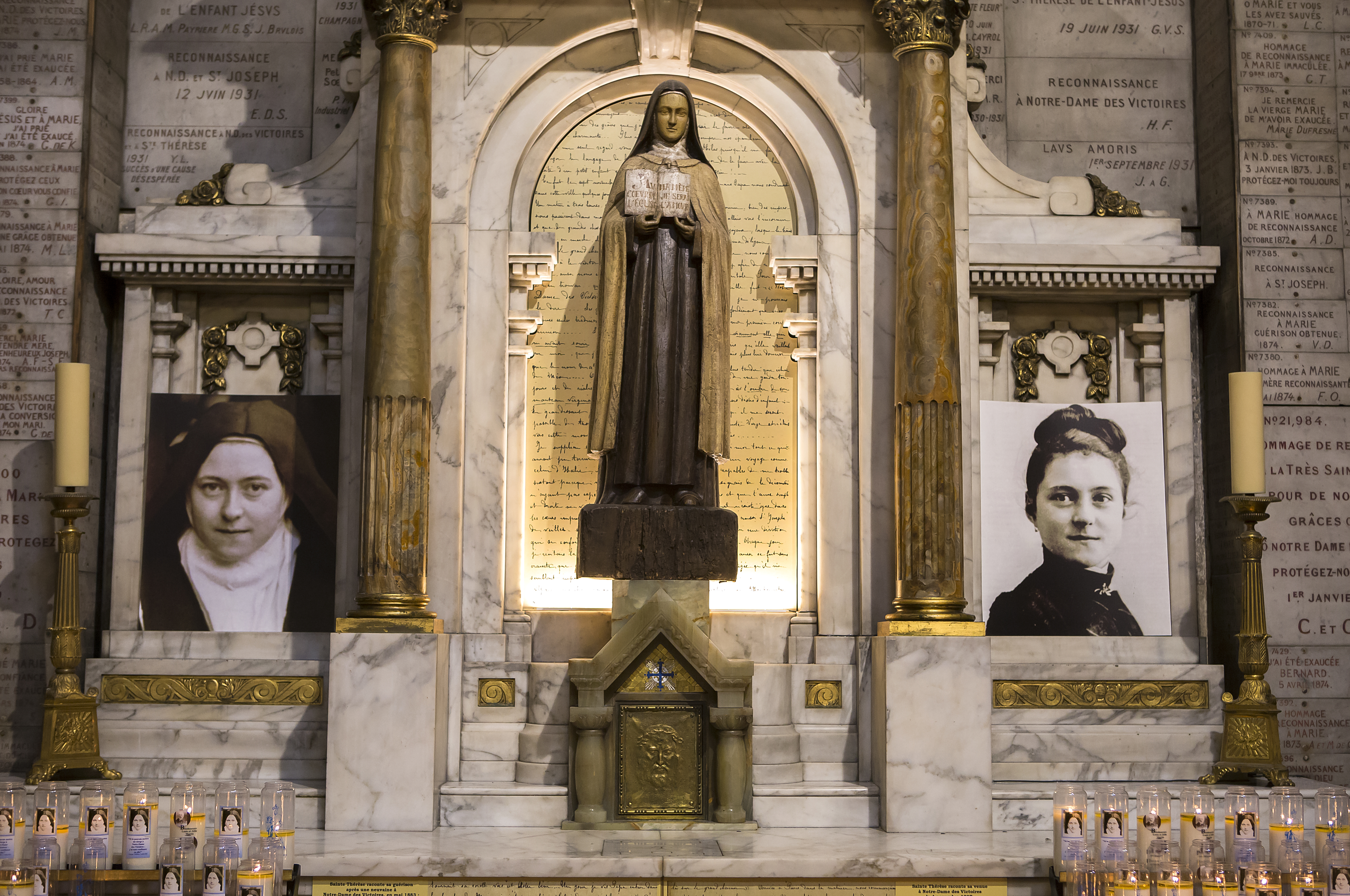
But the church’s most emblematic association with sanctity belongs to St. Thérèse of Lisieux. In 1883, when Thérèse was gravely ill at age 10, her father sent to Paris for a novena of Masses to be said at Notre-Dame des Victoires for her cure — and she recovered, attributing her healing to a smile from a statue of the Virgin at her bedside. Four years later, passing through Paris on her way to petition Pope Leo XIII in Rome for permission to enter Carmel as a teenager, she stopped at the shrine in person. Whatever doubts had lingered about the grace she had received as a child, she wrote, were resolved there: “Our Lady was very beautiful, and I saw her smile at me.”
Today, the sanctuary is animated by a small community of Benedictine Sisters of the Sacred Heart of Montmartre, working alongside the parish’s current rector, Father Antoine d’Augustin.
With Marian shrines like Our Lady of Victory standing as symbols of enduring faith in France — a country once named the eldest daughter of the Church — it remains to be seen what spiritual fruits will come from the visit to the French capital by the first Augustinian pope in history, against the backdrop of a Catholic revival that is as unexpected as it is profound.
