


“Compound interest is the Eighth Wonder of the World. He who understands it, earns it; he who doesn’t, pays it.”
Albert Einstein supposedly said that. Lots of quotes get attributed to him that he didn’t actually say, and this may be one of them; I personally don’t see the guy who imagined riding a light beam to figure out the Theory of Relativity waxing poetic about compound interest.
But even if Einstein really didn’t say compound interest was the Eighth Wonder of the World, it’s still a good point. Compound interest is pretty dang awesome. It’s a powerful concept — one that can massively strengthen, or weaken, your finances. It can either work against you (when it comes to debt) or for you (when it comes to savings and investments). The man who understands it will have a tool to increase his net worth; the man who doesn’t will go through life stuck in a paycheck mentality.
Unfortunately, not every young adult has someone sit them down and explain compound interest to them. Which is a shame, because its power is greatly amplified the earlier you put it to work. If you want to set a young man up for financial security and wealth, then pass this accessible and inspiring primer on to them. If you’re older and never really got an education in compound interest, or you could use a refresher on it, this guide is for you, too. Even if you’re getting a late start with leveraging compound interest, the second best time to plant a tree is now, as they say.
What Is Compound Interest?
To understand compound interest, it’s useful to understand simple interest first.
Simple interest is calculated on the principal or the original amount of a deposit or loan. It’s really, well, simple to figure out.
Let’s say you take out a loan for $10,000 at a simple interest rate of 5%. The duration of the loan is four years.
To calculate the interest that’ll accumulate on the loan, you’d use the following formula:
Principal x interest rate x term of the loan
Plugging in our numbers, it would be:
$10,000 x .05 x 4 = $2,000
So that $10,000 loan will cost you $2,000 in simple interest.
Car loans and student loans use simple interest. A loan you take from a family member or friend will likely use simple interest (if they charge you interest at all).
Now that you understand simple interest, we can move to compound interest.
Compound interest is calculated on the principal amount and — this is key — also on the accumulated interest of previous periods. It’s interest on interest.
Here’s what the compound interest formula looks like:
P(1 + r/n)^(nt) − P
[P = Principal; r = annual interest rate in percentage terms; n = number of compounding periods for a year; t = number of years money is invested or borrowed]
Yeah, it looks confusing, but let’s plug in our numbers from the simple interest example to see what we’d pay if the interest was compounded.
So we got a $10,000 loan that compounds annually at 5%. The duration of the loan is 4 years. What would we pay in interest? Let’s look at the progression of the math:
$10,000 (1 + .05/1)^(1×4) − $10,000 →
$10,000 (1.05)^4 − $10,000 →
$10,000 (1.21550625) − $10,000 →
$12,155.0625 – $10,000 = $2,155.06
So on a four-year loan that’s compounded annually, we’d pay $2,155.06 in compound interest. That’s $155.06 more than a loan issued on simple interest. Calculating interest on the interest already accrued on a principal can really add up. And add up fast as we’ll see in an example below.
If you’d rather not do the math yourself, there are plenty of compound interest calculators online.
Credit cards charge compound interest, and unlike our example above, they typically compound it daily rather than annually. The high interest rates of credit cards coupled with their daily compounding is why pretty much every single personal finance guru out there says “Don’t carry a balance on your credit cards!” You end up paying a lot for that extended credit. For example, a credit card balance of $10,000 carried at an interest rate of 20% (compounded daily) would result in total compound interest of $2,213.36 over one year, or about $184 per month.
Compound interest can work in your favor, though. Big time. When you sock your money into a savings account, banks typically pay compound interest daily on the money you keep with them. The national average savings interest rate is 0.61%, and some top high-yield accounts are at roughly 4%. Keep $10,000 in an account paying 4% interest compounded daily, and you’ll earn $408.08 over a year without lifting a finger. It adds up.
If you invest in an index fund, you can leverage the power of compound interest by reinvesting your earnings into buying more of the index fund which will allow you to earn even more, which you then reinvest, and so on and so forth.
Compounding Periods Have a Big Effect on Earnings
Looking at the compound interest formula, you’ll likely notice that the frequency of compounding periods can have a big effect on your earnings or how much you have to pay in interest. The more compounding periods, the more interest that is accrued. You’ll earn more in interest from a bank that compounds daily compared to a bank that only compounds monthly; you’ll pay more in interest on a loan that compounds monthly compared to one that compounds annually.
So when looking at interest rates for a savings account or loan, make sure to pay attention to how often interest is compounded.
Time Is Your Friend
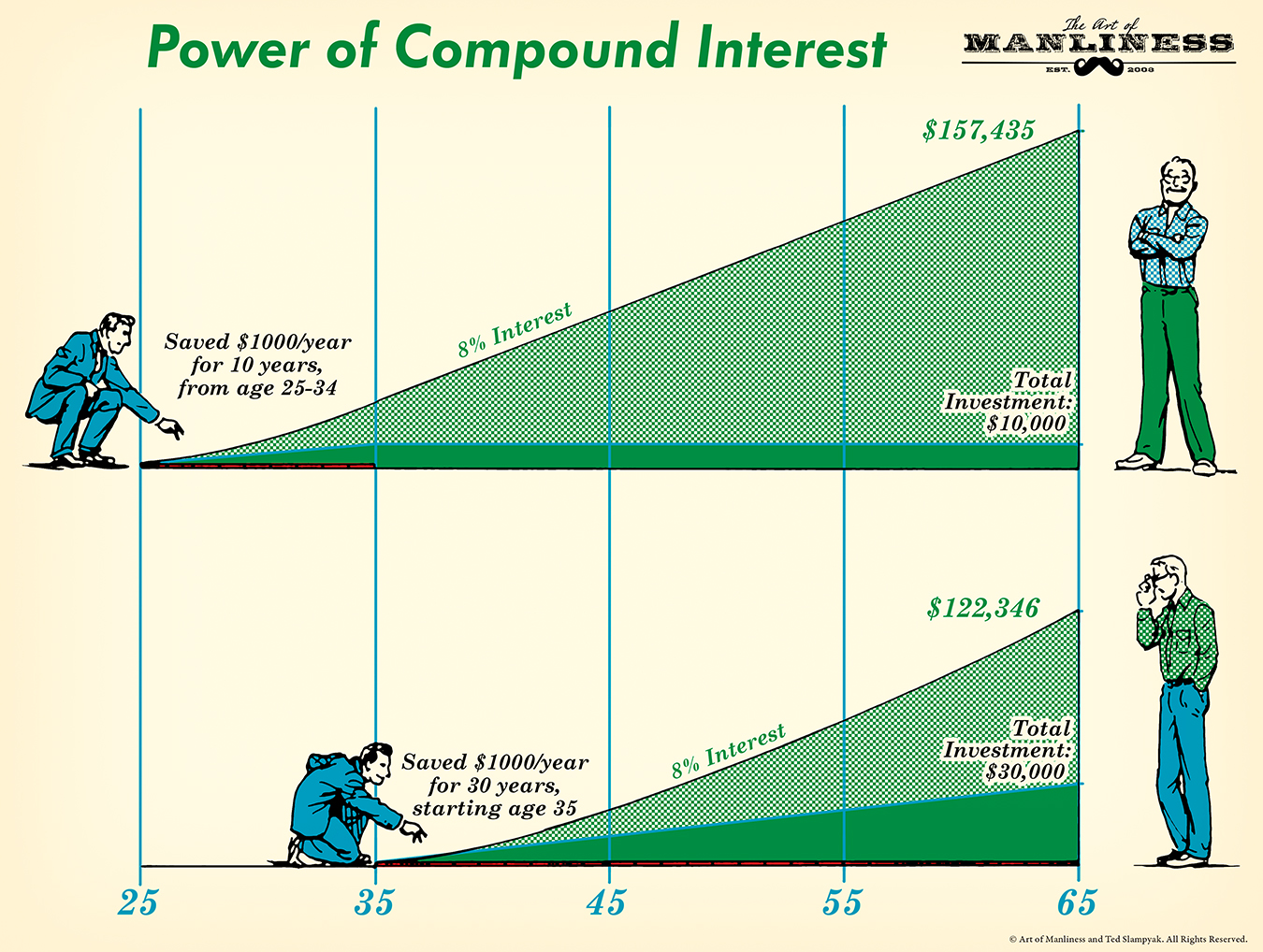
The real magic of compounding reveals itself over long periods of time. The longer you let your money sit in an account and compound itself, the more money you make.
This example from personal finance expert Beth Kobliner illustrates the point:
If you were to save $1,000 a year from age 25 to 34 in a retirement account earning 8% a year, and never invest a penny more, your $10,000 investment would grow to $157,435 by age 65. But if you don’t start saving until you’re 35 years old and then invest $1,000 a year for the next 30 years (that’s a total investment of $30,000), you’ll have only $122,346 by age 65. The bottom line: Start early, so your money has enough time to pile up.
The way that investments snowball over time means that how you decide to make big purchases can have a far bigger effect on your finances than you even realize. For example, let’s say you choose to buy a $600,000 house instead of a million dollar house, and you only need to put down a $100,000 down payment instead of a $200,000 down payment. Then you invest that $100k saved and earn an average 10% annual return on it. In 30 years, that $100k will turn into almost $2 million dollars. In 35 years, it could net you around $3 million. So in choosing the more affordable house, it’s like you just made yourself $3 million dollars. (And that’s not even counting the money you saved on your monthly mortgage payments and the interest you paid on that loan.)
But the snowball effect has a profound impact when it comes to investing small savings, too. If you can find a way to save $10 a day, by, say, brown bagging your lunch instead of eating out, and you invest that money in the market, in 30 years, it’ll turn into $700k. In 40 years, you’ll have almost $2 million. Notice both how small savings can mushroom, and the difference a decade makes!
Bottom line: the earlier you invest, the better. Get your kids started now! Even if you’re older, investing today as opposed to even five years from now will make a significant difference.
Use the Power of Compound Interest to Your Advantage
Understanding compound interest can really help you move ahead with your finances. Knowing that credit card companies compound the interest on your balance on a daily basis should act as an incentive to pay off credit card debt as quickly as possible. Knowing that you can make money from your money should act as an incentive to sock away as much dough as you can and to not touch it for as long as you can.
The key is to get started today. If you’ve got credit card debt, start paying it off now so compound interest doesn’t devour you. If you don’t have a savings or retirement account, start one today so you can leverage the power of this Eighth Wonder of the World.
Be sure to listen to my podcast with David Bach about how compound interest can make you a millionaire:
With our archives now 4,000+ articles deep, we’ve decided to republish a classic piece each Sunday to help our newer readers discover some of the best, evergreen gems from the past. This article was originally published in July 2018.
