


One year after the 2024 presidential election returned him to the White House, President Donald Trump remains popular among Catholic voters, whose support proved pivotal to his re-election, a new EWTN News RealClear Opinion Research Poll shows.
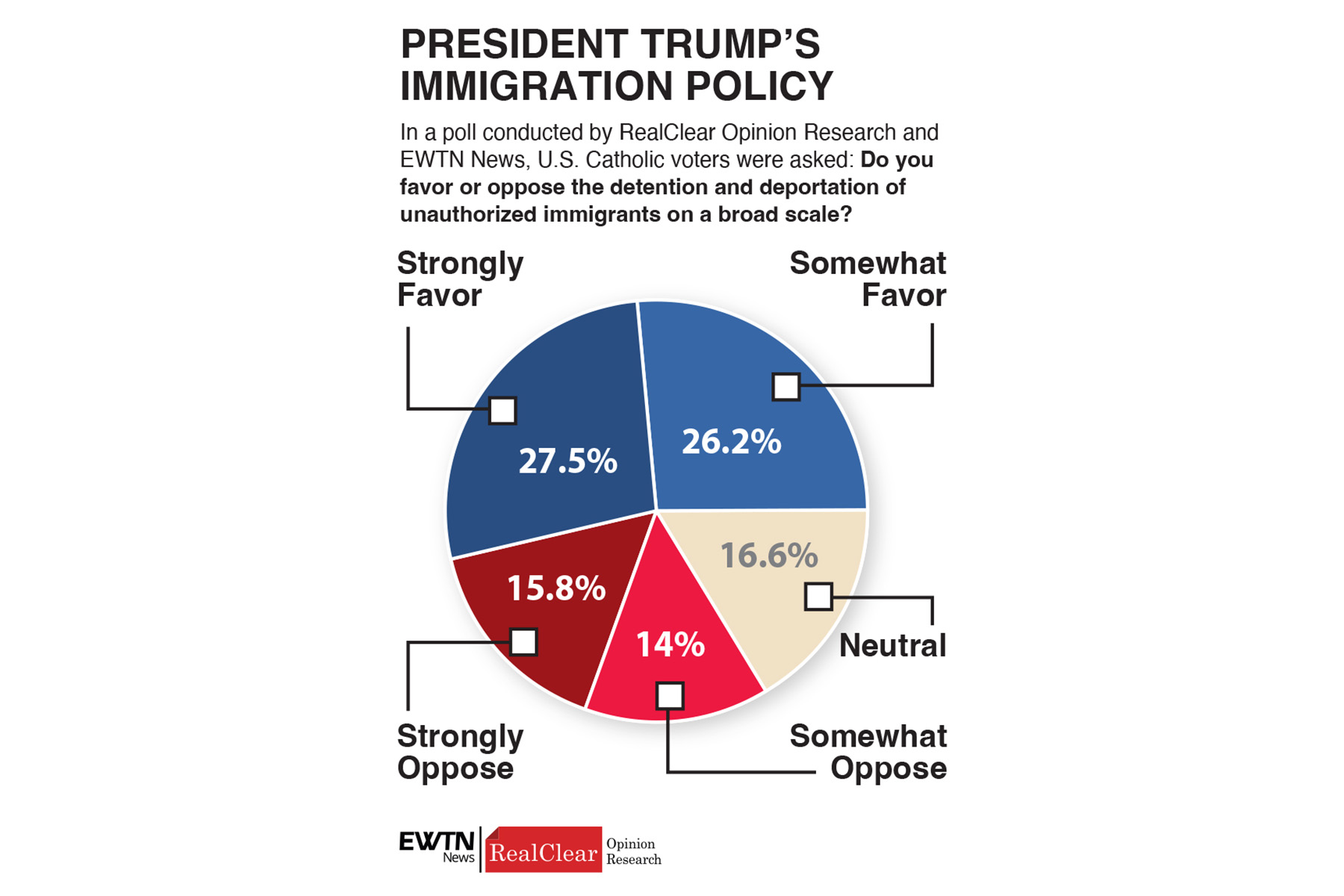
That backing extends to the chief flashpoint of Trump’s first year since regaining the presidency: the ongoing mass deportation of hundreds of thousands of illegal or undocumented immigrants.
That policy has sparked national protests, widespread media coverage, and strong statements of concern and condemnation from the U.S. Conference of Catholic Bishops and individual bishops. Even Pope Leo XIV has criticized it on multiple occasions, as did his predecessor, Pope Francis.
Yet a majority of Catholic voters (54%) say they support Trump’s policies calling for the detention and deportation of unauthorized immigrants on a broad scale; 30% are opposed, and 17% neither favor nor oppose.
The broadest source of support comes from the 60% of white Catholic voters who favor detentions and deportations on a broad scale, while 26% oppose. Notably, Latinos — who, as a group, are bearing the brunt of the Trump administration’s aggressive enforcement strategy — are split on the issue: 41% say they support it, while 39% are opposed.
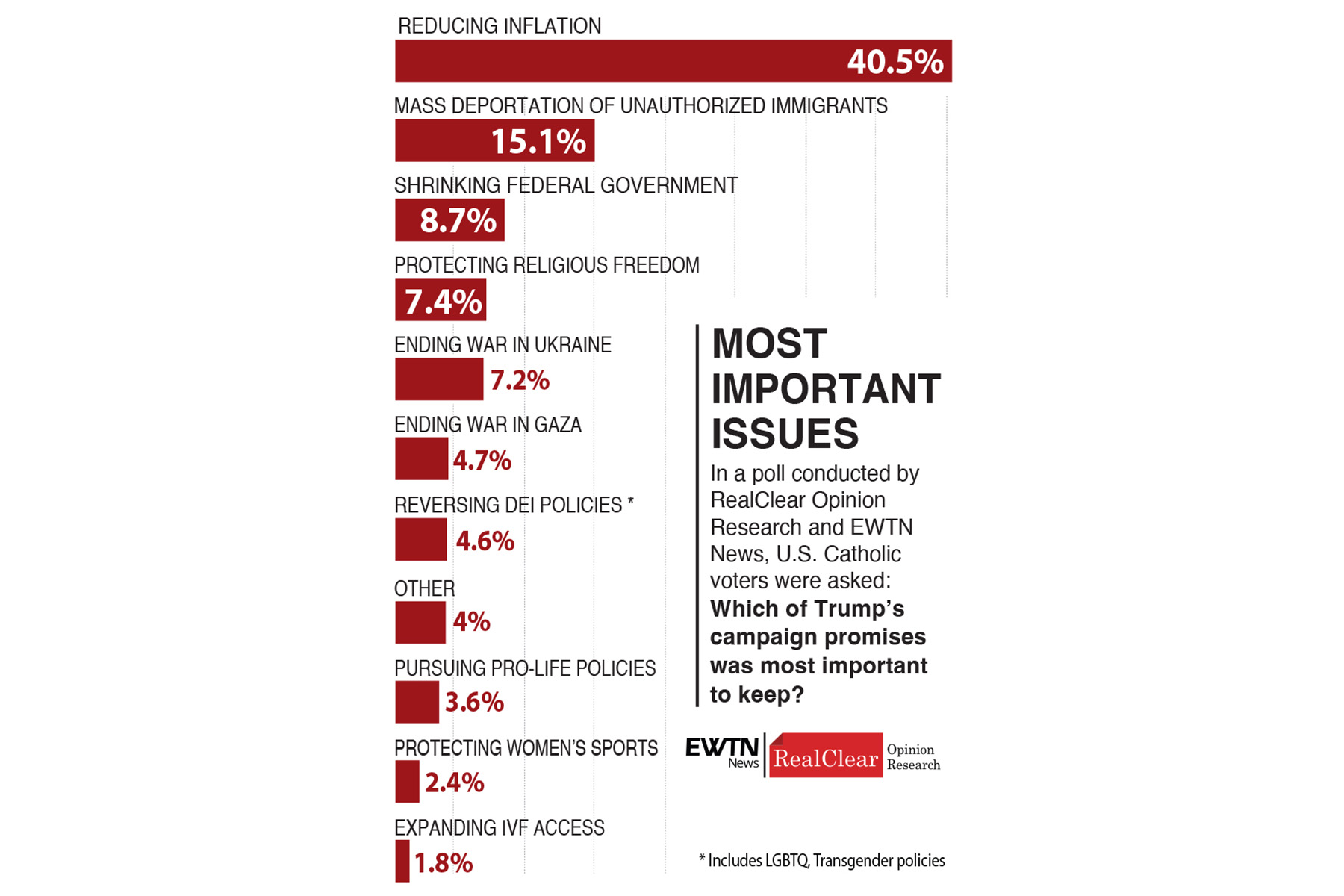
At the same time, however, Catholic voters in the poll were clear that immigration is not their chief concern. Just 15% ranked it as their highest priority, compared to 40% who said reducing inflation is the Trump campaign promise they care most about — far and away the top choice.
Overall, President Trump is viewed favorably by 52% of all Catholics, with 37% viewing him unfavorably and 11% neutral. That number is consistent with the overall Catholic vote for him in the 2024 election.
In fact, among Catholic voters, Trump is more popular than two prominent Catholics in his administration: Vice President JD Vance (50% favorable, 31% unfavorable, 19% neutral or never heard of) and Secretary of State Marco Rubio (42% favorable, 25% unfavorable, 33% neutral or never heard of).
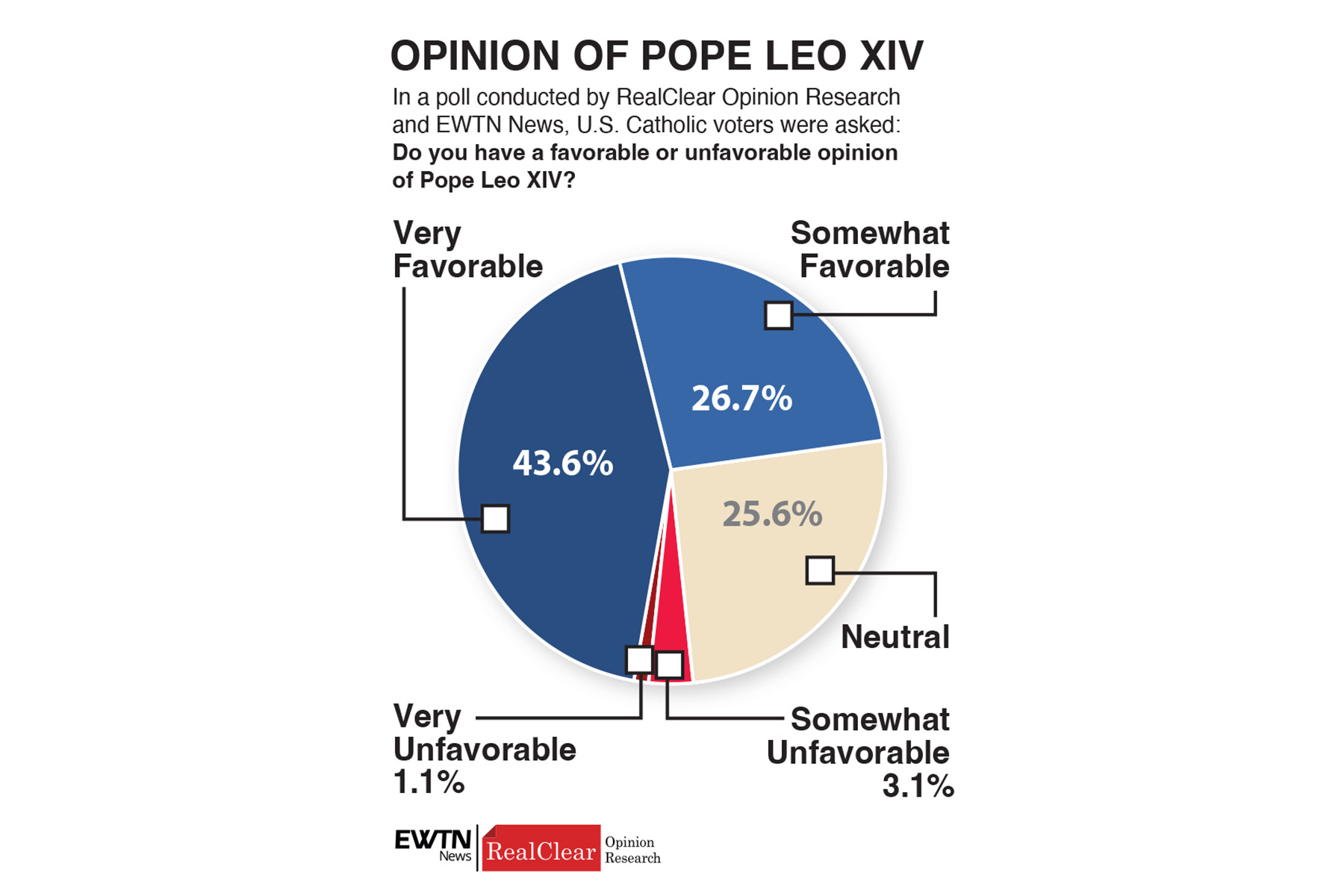
Pope Leo XIV, meanwhile, has a 70% favorability rating among all Catholic voters, with 4% viewing him unfavorably, the poll shows.
Looming Mid-Term Elections
The latest EWTN News/RealClear Opinion Research poll, conducted from Nov. 9-11, asked 1,000 Catholic voters for their views on a variety of issues in addition to President Trump and his immigration policy, including the death penalty, in-vitro fertilization, and the rise of political violence in the country. The poll has a credibility interval, similar to a poll’s margin of error, of +/- 3%, and the sample consists of voters who are self-identified Catholics, including practicing Catholics, those who consider themselves Catholic but do not regularly practice, and those who were raised Catholic and identify with it culturally, not religiously.
It comes as the Trump administration enters its second full year and the nation gears up for the 2026 midterm elections in November.
The Catholic vote is certainly not monolithic; there are differences among Catholic voters according to gender, ethnicity and political affiliation. However, sacramental practice — above all, Mass attendance and the frequency of confession — remains the most decisive predictor of Catholic views on the president and the most pressing issues of the day.
Trump’s favorability among Mass-attending Catholics — those who attend Mass daily or once a week — stands at 67% viewing him very or somewhat favorably. Among Catholic voters who attend Mass a few times a year or once a year, the number is 43.5% for very or somewhat favorable.
He is also buoyed in the polling by a gender gap: 62% of male Catholic voters view him favorably, compared with 45% of female Catholic voters. Catholic women voters also gave the president the strongest unfavorable rating at 33%, compared with 23% for males.
Likewise, Trump is viewed very or somewhat favorably by 58% of white Catholic voters, compared with a still significantly large 41.5% favorability among Latino voters. White and Latino Catholic voters are also nearly identical in viewing Trump very unfavorably, at 27.8% and 28.6%, respectively.
When asked which campaign promises are the most important for Trump to keep, Catholic voters listed one clear issue: inflation. At a time when Democrats are beginning to use affordability as a possible campaign theme heading into the 2026 midterm elections, Catholic voters ranked inflation ahead of every other issue by a wide margin. Some 40% of Catholic voters think reducing inflation is the most important campaign promise President Trump must keep, far eclipsing other major issues such as mass deportations (15%), shrinking the federal government (9%), protecting religious freedom (7%), and ending the war in Ukraine (7%).
There are, however, divides among Catholic voters on these issues, including party affiliation, gender, ethnicity, and especially sacramental practice. Independents (47%) and Democrats (45%) were more likely than Republicans (34%) to view reducing inflation as the most important promise, and Republicans (24%) were more likely to list mass deportations than independents (10%) or Democrats (6%).
Male Catholic voters were more likely than female voters, 21% to 10%, to list mass deportations as the most important campaign promise. However, both male and female Catholic voters still view inflation as the top campaign promise (at almost 40% and 41%, respectively). And while both white and Latino Catholic voters rank inflation as most important, more whites than Latinos see mass deportations as their top issue, 18% to 7.6%.
Finally, among daily and more-than-weekly Mass-attending Catholics, about 30% see inflation as the primary concern, while Catholics who attend less regularly are far more likely to see it as the priority, including weekly attendees (42%) and those who attend once or twice a month (44.5%).
As with the gender divide over the question of the most important campaign promise, his deportation policy has also sparked a split between the sexes, as 62% of men strongly or somewhat favor the policy, while 46% of women strongly or somewhat favor it.
Looking at the political gap, Catholic Democratic voters are unsurprisingly less supportive of the policy, with only 27% strongly or somewhat in favor, compared with Republicans (76%) and even independents (almost 50%).
Trump’s deportation policy is also cutting along the sacramental divide among self-identified Catholics. Among daily and more-than-weekly Mass attendees, about 75% strongly or somewhat favor mass deportations. This is in sharp contrast to Catholics who attend Mass weekly (49%) and those who attend once or twice a month (45%).
Support For School Vouchers, Death Penalty
When asked about other pressing topics, Catholic voters expressed a clear consensus (65%) in favor of states giving parents tax-funded vouchers they can use to help pay for tuition for their children to attend private or religious schools of their choice, while only 14% oppose, and 21% neither favor nor oppose.
In the area of gender ideology, Catholic voters were asked which option best describes their view on medical interventions for minors who identify as “transgender” and wish to alter their body’s development. A majority, 52%, do not support either puberty blockers, cross-sex hormones or surgical procedures, while 11% support surgical procedures, 10% support the use of puberty blockers or cross-sex hormones, 9% support both, and 19% are unsure. This is consistent with other national surveys of the general American population.
Catholic voters are also very concerned about political violence in the U.S. today, especially in the aftermath of several attempts on the life of President Trump, other assassinations of political leaders, and the murder of conservative leader Charlie Kirk. Overall, 84% of Catholic voters consider political violence either a very serious or somewhat serious problem. Likewise, most Catholic voters, 80%, do not think political violence is ever justified, while 13% think it can be justified.
When asked whether they are concerned about the safety of places of worship — once again, in the aftermath of recent violent attacks on churches — 80% of Catholic voters said they were very or somewhat concerned, while 10% were concerned and 10% were not concerned. Catholics who attend Mass frequently were especially worried, with 80% of daily Mass attendees and 86% of more-than-weekly attendees being either very or somewhat concerned.
Catholic voters are also in favor of some forms of restrictive gun policies, including preventing people with mental illnesses from purchasing guns (85% in favor) and increasing the minimum age for buying firearms to 21 years old (83% in favor). They are more divided on allowing teachers and school officials to carry guns in K-12 schools (43% favor, 37% oppose, 20% neither).
Three other significant issues for Catholic voters are the death penalty, defunding Planned Parenthood, and in-vitro fertilization. A majority of Catholic voters, 55%, are in favor of the death penalty for a person convicted of murder, while 20% are opposed and 25% are unsure. This places them at odds with Church leaders, including recent popes, who have been outspoken regarding the prudential judgment in opposing the death penalty.
While 45% of Catholic voters favor permanently eliminating federal funding for Planned Parenthood, 34% oppose, and 21% neither favor nor oppose. A small plurality of female Catholic voters (40%) oppose permanently eliminating federal funding for Planned Parenthood, while 37% favor it. In contrast, most male Catholic voters (54%) favor eliminating federal funding, while 26% oppose.
And a majority, 54%, favor access to in-vitro fertilization (IVF), while 19% oppose it. Notably, when respondents were subsequently informed that “the Catholic Church opposes in-vitro fertilization (IVF), citing the separation of the creation of human life from the natural union of husband and wife (or ‘marital act’) and the loss of unused embryos,” support dropped nine points to 45%, while opposition increased five points to 24%.
This is a clear indication that catechesis and clarity in Church teaching can shape opinion, especially among Catholic voters who are often misinformed or poorly catechized in the faith. It also raises anew the important question of the characteristics of the Catholic voter — and the so-called Catholic vote — in the 21st century.
