


Dave Stotts of Drive Thru History is now bringing his signature style — hitting the road to explore history — to EWTN, complete with Catholic highlights, puns and, fittingly for the “Catholic Indiana Jones,” a movie reference or two.
The Road Less Traveled: Türkiye premieres Sept. 17 on EWTN+ and EWTN.com, showing across six episodes how Christianity came of age in this ancient land.
“It was here, for the first time, Jesus’ followers were called Christians,” Stotts explains of ancient Antioch (now known as Antakya). See Acts 11:26.
Viewers accompany the intrepid traveler, seeing sweeping views of ancient ruins and Mediterranean sunsets, Roman mosaics and seaports.
Acts came to life here through the missionary efforts of saints like Peter, Paul and Barnabas.
Stotts also offers a crash course in “Turkish Coffee 101.”
Then come early Church explainers. After all, tradition holds that Peter served as the first bishop of Antioch. Stotts takes viewers inside the cave Church of St. Peter — it’s easy to imagine what it was like to worship here so long ago, praying at Mass with an eye on the tunnel escape route, just in case, during an era when being a Christian was truly dangerous.
Learn how St. Ignatius of Antioch’s letters offer a profound defense of the Eucharist, before the show heads to Edessa. “Buckle up — things are about to get a little X-Files,” according to Stotts.
First, he detours to Göbekli Tepe, an 11,500-year-old archaeological site believed to contain some of the world’s oldest religious monuments.
Then he arrives in ancient Edessa, near the traditional site associated with Abraham’s birthplace — rather than Ur in modern-day Iraq, as another tradition holds — Stotts explains, along with an aside about holy fish.
It was here, according to ancient Christian legend, that King Abgar corresponded with Jesus, asking Christ to come and heal him of leprosy. Jesus is said to have promised to send a disciple. Thaddeus (possibly St. Jude Thaddeus/St. Jude the Apostle) is then said to have come to Edessa, healed the king and preached the Gospel. To bring home the tradition, Stotts outlines how St. Jude imagery sometimes depicts the saint carrying an image of Jesus.
And don’t miss the portion on the lost-and-found Edessa cloth, complete with the theory linking it to the Shroud of Turin.
Moved by the Mass
Episode 2 about Cappadocia is more than Turkish Star Wars (watch to find out about that cinematic link), Stotts promises viewers — and he doesn’t disappoint, descending into underground cities and cave churches filled with incredible frescoes.
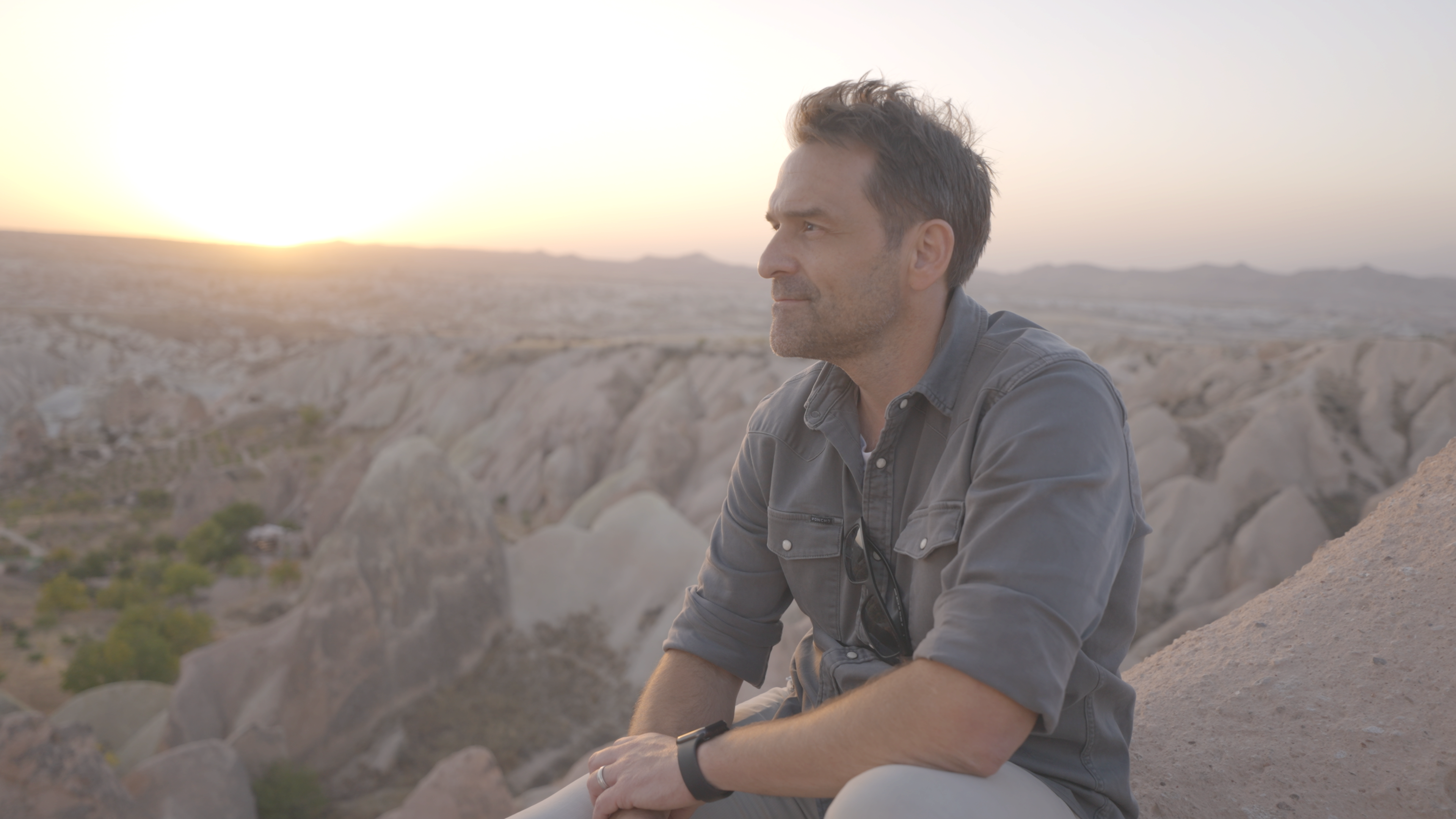
Peter addresses Christians here in 1 Peter 1:1.
In this segment, Stotts discusses the birthday of the Church and the nine-day novena tradition in relation to the time frame between the Ascension and Pentecost and how people from Cappadocia were among those present at Pentecost.
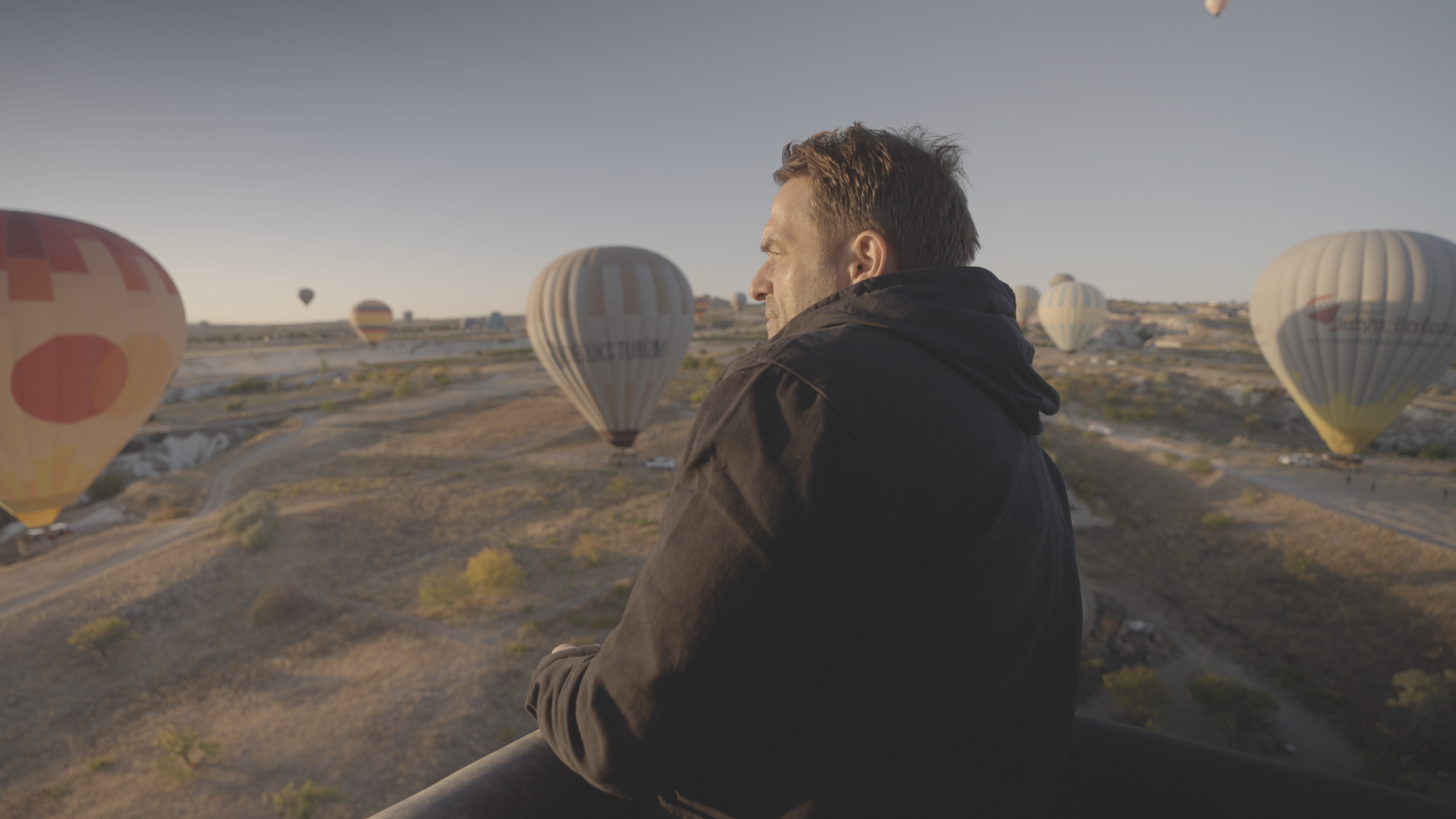
And then the view transitions: Modern-day hot-air balloons float above the mysterious terrain, with Stotts in a balloon himself, surveying the sweeping vistas marked by “bizarre beauty.”
Most moving is the episode’s segment highlighting how Christians used underground settlements as places of refuge and worship during periods of persecution.
The underground city of Derinkuyu was discovered during a home renovation in the 1960s.
A deep well offered fresh water for inhabitants; between the various levels and rooms, historians estimate that about 20,000 people and their livestock could shelter in the elaborate subterranean system. An impressive network of ventilation provided fresh air.
Stables, chapels, a convent and numerous other spaces were part of this remarkable underground complex.
Nearly 200 feet underground, a cruciform church showcases crosses carved into the walls and a baptismal font, offering a “sacred place of divine worship.”
Stotts beautifully sets the stage for the clandestine liturgies that would have taken place: “The Mass here would have been simple, solemn … just bread, wine — and the Lord made flesh.”
He notes that the Christians gathered underground worshipped “knowing that Christ would meet them in the Mass.”
“Early Christians risked everything to celebrate the Holy Sacrifice of the Mass,” he emphasizes, adding that “the altar of God is never out of reach.”
Then it’s on to an open-air museum that once served as a monastic center, with chapels adorned with 10th- and 11th-century frescoes — vibrant blue pigments frame Marian art, alongside depictions of saints (note the Apple quip) and the Last Supper and other hallmarks of Christ’s life.
The fish-symbol explainer should not be missed — and wait for the aforementioned Indiana Jones reference.
Stotts also considers: Could St. George have been born here?
The camera’s sweep upward to the colorful Christ Pantocrator in a dome of what is known as the dark church is breathtaking — “the eternal king watching over history itself,” as Stotts puts it.
The history lesson moves to Christianity’s legalization in the Roman Empire in the early 300s, complete with a segue for thesaurus aficionados (flapdoodle, anyone?).
Stotts continues to delve into the “Battlefield of Creeds” regarding Arianism and how “theological titans” — two of them brothers — confronted the heresy head-on with “doctrinal warfare” (with a training-montage aside, complete with Rocky reference) — and insights on the Trinity, leading to discussion of the Second Ecumenical Council and the Nicene Creed Catholics profess at Mass.
On to Ephesus
Episode 3 focuses on Ephesus, the capital of Roman Asia, where Paul encountered a culture steeped in sorcery and entrenched paganism — see Acts once again.
Stotts offers a trivia-night assist on the Seven Wonders of the Ancient World, including the Temple of Artemis, which has seen better days — “let’s see your property in 1,600 years,” he jests.
These archaeological segments include a look at public bathrooms and the local museum’s Artemis statue, which was prominent in the city when Paul arrived.
Stotts highlights Paul’s third visit to Ephesus at length, detailing how he baptized converts and taught publicly — and squared off against pagan would-be exorcists, followed by a mass act of repentance before a riot, as explained in Acts 19, sparked by craftsmen’s complaints over lost business (since Artemis wasn’t as much in vogue thanks to Paul’s efforts).
Overall, Paul “left behind a strong, well-established church,” Stotts says, ensuring continuity with Timothy as bishop and thus offering a lesson on apostolic succession.
Stotts also recalls Paul’s Letter to the Ephesians before explaining the tradition that John arrived with Mary and expounding on Mariology and the early understanding of Our Lady as the mother of all Christians. He even visits the stone house traditionally believed to be Mary’s home, where he lights candles and prays in the chapel.
Then it’s on to the traditional site of John’s tomb in Ephesus, where Stotts wanders through the ruins of the Basilica of St. John and elaborates upon baptism and John’s encouragement to the Ephesians: “Little children, love one another.”
The Church of Mary is the last sacred site in the program, with the host explaining its distinction as possibly the first church ever dedicated to Our Lady. The church, with little remaining today, serves as a venue to discuss the Council of Ephesus in 431, where the title Theotokos — “Mother of God” — was affirmed.
As Stotts ends his time in Ephesus, he notes that statues of the Gospel writers were once placed on columns along the Arcadian Way — only the columns have endured — leaving a decidedly Christian mark on the grand thoroughfare of the ancient city.
Other episodes cover Myra, including the story of St. Nicholas; Nicaea, site of the First Ecumenical Council and the original Nicene Creed; and then Constantinople.
Don’t miss this Catholic travelogue imbued with the richness of early Church history.
It is evident that this is not just a travel show for the host — but a true pilgrimage, as he is seen kneeling in prayer and making the Sign of the Cross several times and is clearly taken with the subject matter.
Travel along The Road Less Traveled to learn and be inspired.
Viewer Caveat: Some subject matter may not be appropriate for the youngest viewers.
