


A church named after a devotion mentioned by Pope Leo XIV in his first address has drawn visitors and immigrants for decades.
On May 8, the day Pope Leo XIV was elected as our new Holy Father, he told the faithful, “Today is the day of the Prayer of Supplication to Our Lady of Pompeii. Our Mother Mary always wants to walk at our side, to remain close to us, to help us with her intercession and her love.”
Of course, Our Lady in that title is venerated in Pompeii, Italy, the site of the Pontifical Shrine of the Blessed Virgin of the Rosary of Pompeii and its miraculous image.
But there is also Our Lady of the Rosary of Pompeii Church in New York City, where first-time visitors usually have a jaw-dropping response, maybe even a whispered, “Wow!”
That natural response is certainly what scores of immigrants said and felt in their own fashion when they arrived at their new parish in America. While the feast of Our Lady of the Rosary is celebrated every Oct. 7, the date is doubly memorable for this church. This edifice with its Old World beauty was dedicated on the Oct. 7 feast in 1928 at a Mass celebrated by Cardinal Patrick Hayes. Located between 6th and 7th Avenues in the Greenwich Village historic district, it became the first real edifice for the parish. Until then, people had worshipped in several other chapels.
From its founding in 1892, this parish has played a major role in serving immigrants and being a constant reminder of the importance of devotion to the Rosary and to our Blessed Mother. It was founded by a missionary from the Scalabrini Fathers, who still administer the parish today. For decades it was the anchor for Italian immigrants who settled in this section of the city, and then for their descendants, too.
These new arrivals from Ellis Island were greeted with a touch of home by the church’s Romanesque architecture and its campanile, or bell tower. It was modeled after the campanile at the Shrine of Our Lady of the Rosary in Pompeii.
From the late 19th century, emigrants sailing from the major port of Naples would first go to that shrine in nearby Pompeii to ask Our Lady for a safe trip. Once in New York, the new arrivals would first come to this church, in order to thank our Blessed Mother for their safe voyage.
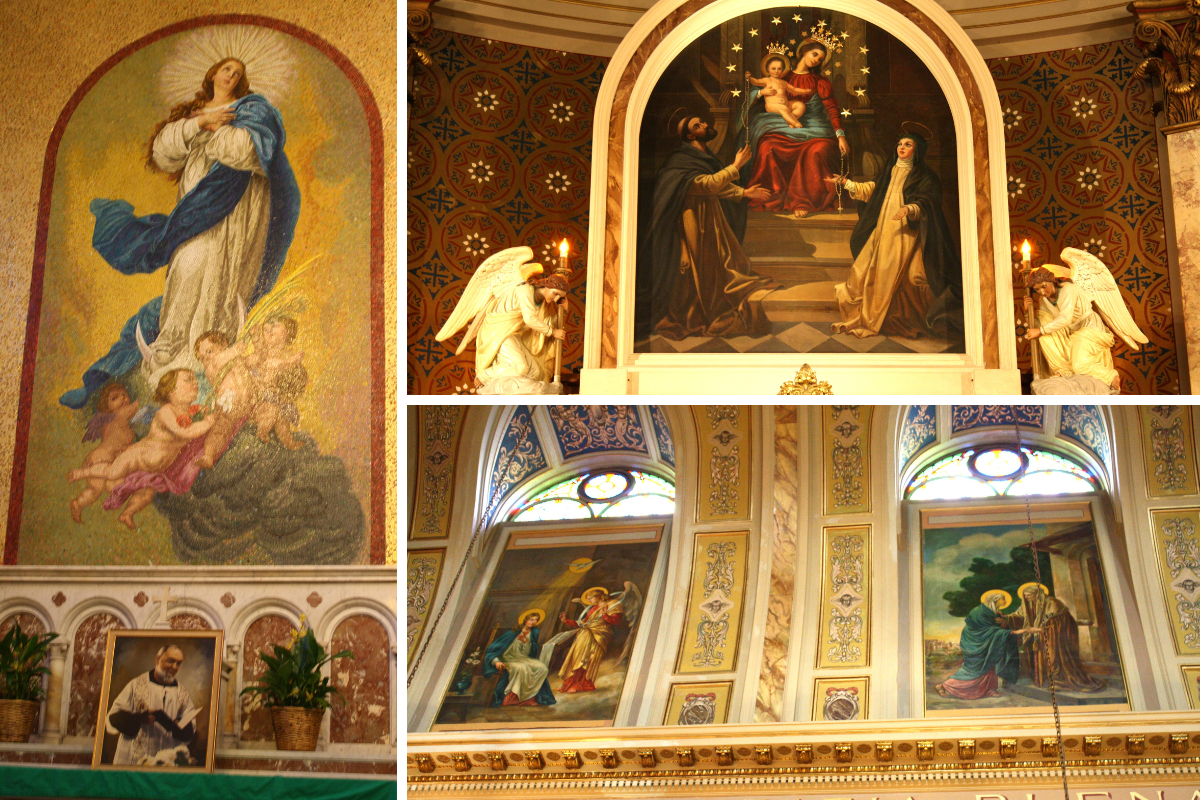
They prayed before a painting of Our Lady of the Rosary that resembled the image enshrined in Italy. In both depictions, the Child Jesus sits on Mary’s lap, handing a rosary to St. Dominic, while Our Lady offers a rosary to St. Catherine of Siena.
Today, the image remains resplendent in a Romanesque arch high above the main altar’s marble reredos — one part of the awe-inspiring beauty of the interior. The image prompts the faithful to feel enfolded in Our Lady’s arms and mantle. On the frieze around the entire nave, tall, bright gold letters encircle the congregation with the “Hail Mary” in Latin. It becomes a beautiful reminder of how the Blessed Mother wrapped countless immigrants in her arms for a safe trip to America and now continues to enfold each person entering this church — seeking a safe voyage to a heavenly port.
The Mysteries of the Rosary also surround everyone. High above the frieze, where the barrel-vaulted ceiling begins its arch, paintings of the Joyful Mysteries line one side of the nave and Sorrowful Mysteries line the other. The Glorious Mysteries shown in round medallions raise our sights higher still as they line the center of the ceiling. Since these mysteries were completed before the mid-20th century, these paintings pre-date the Luminous Mysteries added by St. John Paul II.
Remarkable decorations surround these masterful depictions of the Rosary and also highlight the ornate architectural details. Not only do the faces of cherubs distinctly appear, but high in the vaults, a close inspection reveals angelic figures woven among the fanciful florals, leaves and scrolling that appear nearly everywhere.
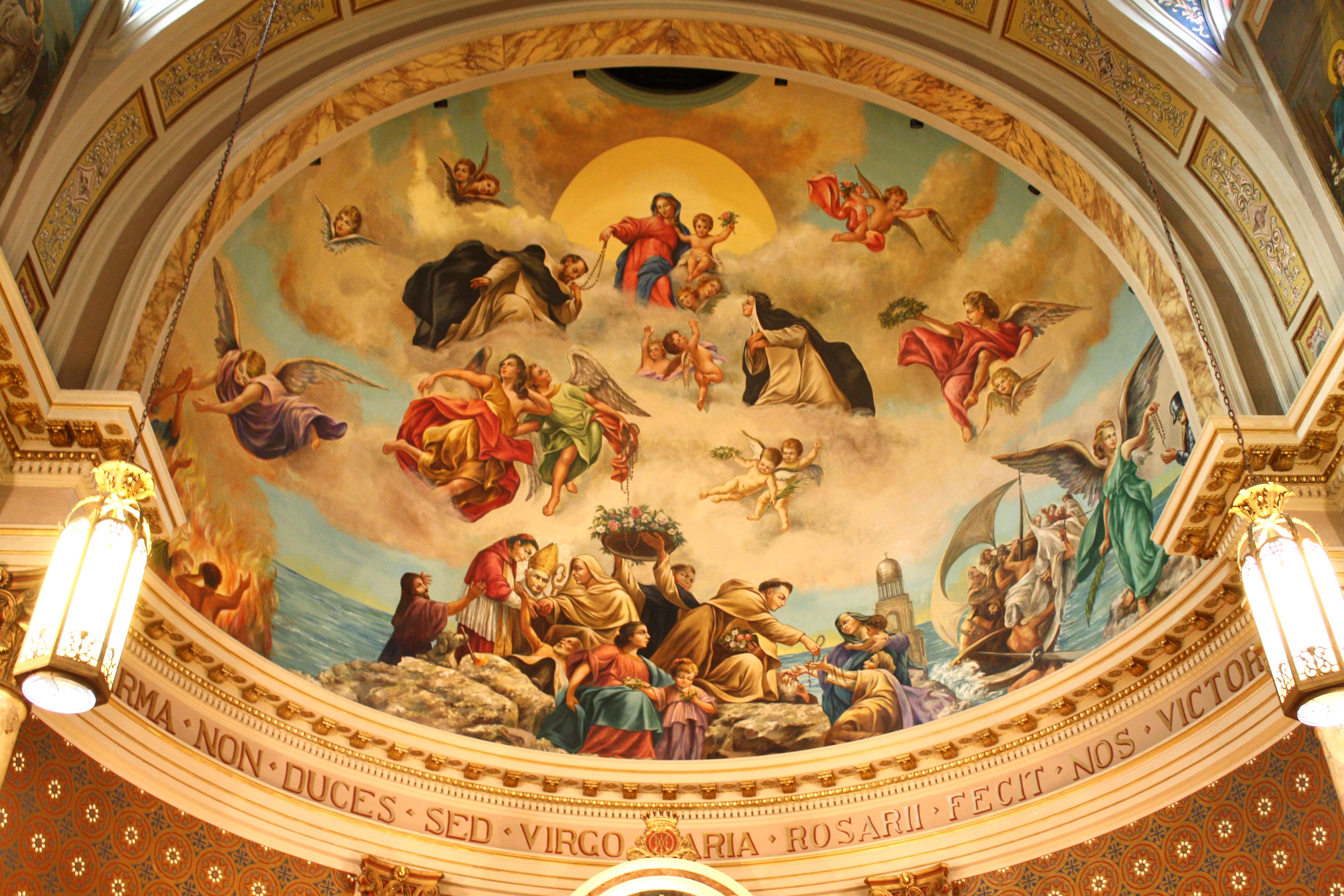
High in the sanctuary above the altar, one colossal mural fills the apse’s half-dome to tell several stories at once. It begins with Our Lady of the Rosary. In this slightly different artistic presentation, our Blessed Mother and the Child Jesus are depicted in front of a sun and stand on clouds. Our Lady is shown presenting St. Dominic with a rosary. He is pictured holding and contemplating the crucifix, while St. Catherine of Siena appears to gaze in awe.
One lower corner of the panoramic mural recalls the Oct. 7, 1571, Battle of Lepanto, the miraculous naval victory attributed to the Rosary: Pope St. Pius V asked Europeans to pray for Our Lady’s intercession for a favorable outcome. One angel among the many in the mural is depicted handing a military man the major “weapon” — a rosary.
The frieze around the apse right below the mural proclaims the reason St. Pius V instituted this feast: Non Arma, Non Duces, Sed Virgo Maria Rosarii Fecit Nos Victories (“Neither arms nor leaders but the Virgin Mary of the Rosary Made Us Victors”).
More enlightening stories appear on this extraordinary mural. In one part, against a background of sea and sky, there are the campanile from Pompeii in Italy, religious tending poor immigrants, and a friar giving a rosary to a woman who gladly reaches for it.
Among those depicted are St. Charles Borromeo, patron of the Scalabrinians (also known as the Missionaries of St. Charles), and next to him, Blessed John Baptist Scalabrini, bishop and founder of this congregation of priests and sisters. In 1998, Pope John Paul II beatified him, calling him the “Father of Migrants.”
Renderings of Blessed Scalabrini, who visited this parish at the turn of the 20th century, and St. Martin de Porres were added to the scene in 1985.
The original mural dates to 1937, along with other paintings including Jesus bringing devotion to his Sacred Heart to St. Margaret Mary, plus decoration, by Italian immigrant Antonio D’Ambrosio who founded D’Ambrosio Ecclesiastical Art Studios. It was removed in the 1970s, but recreated in 1985 by his son Anthony who used his father’s original drawings.
As part of the marble altar, the painting of Our Lady of the Rosary placed within it is an exact replica of the picture at Our Lady of the Rosary at the shrine in Pompeii, Italy. After this painting was placed in the altar, Blessed Bartolomeo Longo (soon to be canonized), the founder of the shrine in Pompeii, permitted the church to promote itself as the American shrine.
The church also radiates with stained-glass windows installed in the early 1940s and glow with Old World beauty. They present catechism and Gospel lessons and become a mini-list of saints.
Brilliant blues, greens, roses, reds and other colors shape scenes portraying each sacrament. Then the beatitudes are illustrated using saints. For example, St. Stephen is included in “the meek shall inherit the earth,” St. Catherine of Siena’s mystical marriage is highlighted for “the pure in heart,” and John the Baptist represents “those persecuted for righteousness sake.”
Windows honor Peter, Paul and the Four Evangelists. One depicts Leo XIII directing Mother Frances Cabrini to go to America to remind us she was a migrant, the first U.S. citizen canonized, and visitor to this parish, but not this particular edifice. In fact, for a time, her sisters taught religious education here.
Not only does this magnificent church have several small shrines within it, but the stained-glass windows added in 1986 over the main doors illustrate the Flight Into Egypt, Christopher Columbus coming to America, and immigrants in New York.
The pastor, Scalabrinian Father Jefferson Orlando Bariviera, told the Register that many Italian tourists come to this church during their time in New York because they know Mass is celebrated in Italian.
Masses are not only in English and Italian, but also Portuguese, as today’s emigrants from Italy and Brazil find a welcome and a home here.
In so many ways, this parish continues to care for new immigrants as it highlights and promotes devotion to Our Lady and her Rosary — a devotion that we now know is dear to Pope Leo’s heart.
