

What Does ChatGPT Have to Do With Slavery? ‘Magnifica Humanitas’ Highlights AI’s Hidden Exploitation| National Catholic Register

When most people type a question into an artificial intelligence (AI) chatbot like ChatGPT, Claude, or Gemini, it may not occur to them that the speedy and friendly responses they receive could have any connection with sweatshop-style dehumanizing labor. Pope Leo XIV is hoping to make this connection clearer. In Magnifica Humanitas, the new papal encyclical on safeguarding human dignity amid the rise of AI, the Pope vividly highlights “new forms of slavery” that AI is already facilitating, writing that that the benefits of enhanced efficiency and other innovations are not to be celebrated if they are “built on a chain of exploitation that remains deliberately hidden.”
Some experts on the topic welcome the papal intervention, noting that AI-driven exploitation is not only difficult to track, but also hard to get people to care about, given that it typically takes place far away from the places where AI products are most in demand.
In her home country of the Democratic Republic of the Congo, Catholic theologian Léocadie Lushombo has witnessed children and women emerging from cobalt and nickel mines, bathed in toxic dust and doing the backbreaking but largely invisible labor needed to supply the elements necessary for the chips that make countless modern technologies possible, including AI systems.
“It’s an image you can never forget — it breaks your heart,” Lushombo told the Register.
Child miners are an arresting image, but there’s another kind of exploited AI worker that most everyday chatbot users are likely less aware of: the thousands of human data labelers who work to “train” the AI, many of whom toil for low wages in developing countries and are subjected to violent or sexually explicit imagery for hours on end. “I looked at people being slaughtered,” Naftali Wambalo, a Kenyan father of two with a college degree in mathematics who took a low-paying job as a data labeler, told 60 Minutes in late 2024. Wambalo said he was also required to watch images of child sex abuse, bestiality, and suicide, and he later sued his employer for creating “unreasonable working conditions.”
Like Wambalo, many of the workers in these “digital sweatshops” are relatively well-educated and tech-savvy but are pushed into data labeling due to limited alternative forms of employment. According to the 60 Minutes report, these workers are often paid between $1.50 and $2 an hour, work 20-hour shifts, and receive little to no mental health support despite watching hours of disturbing footage each day. This diffuse and hidden high-tech work — often referred to in the AI community as “data enrichment” — constitutes a nearly $4-billion industry.
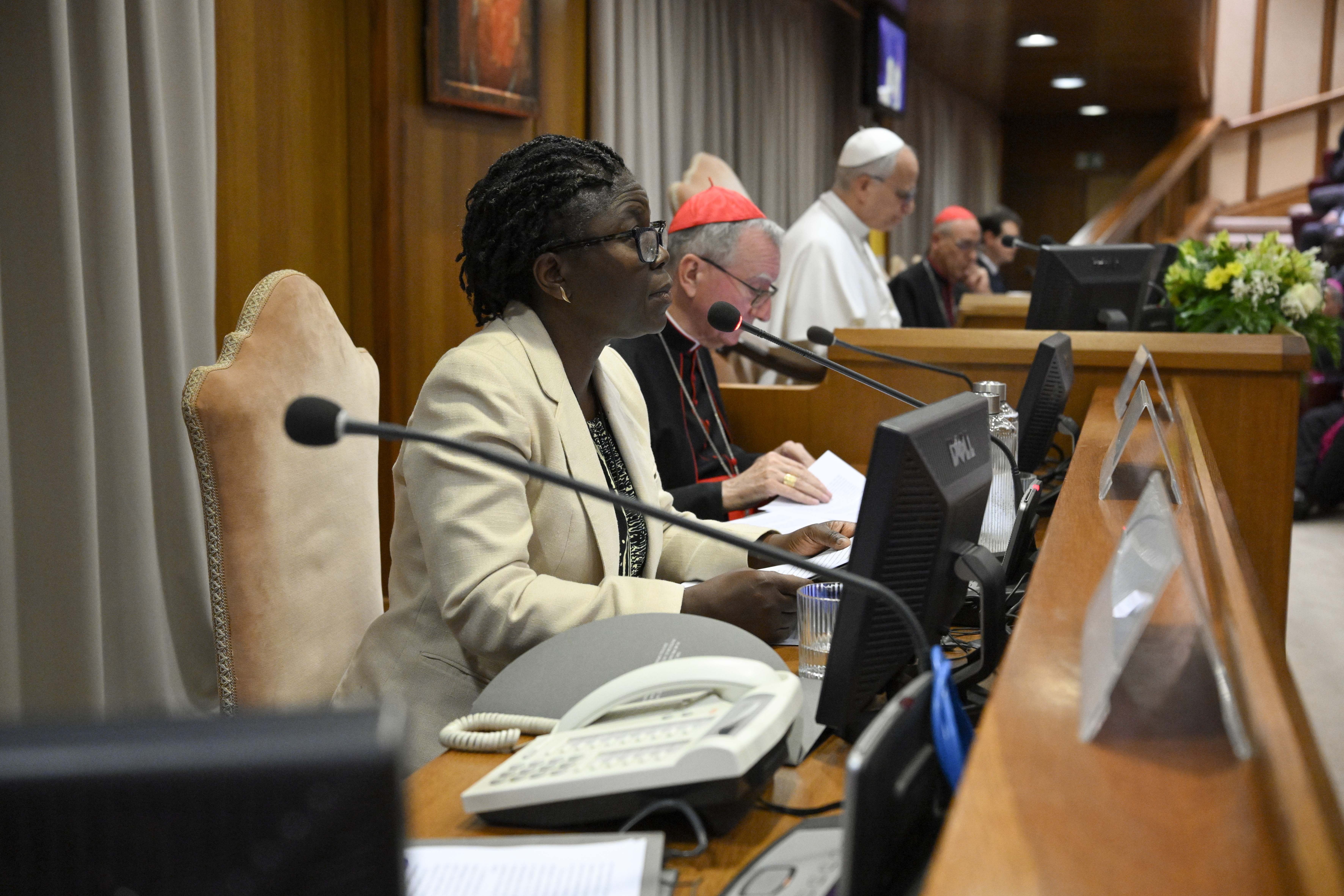
Lushombo, who teaches at Santa Clara Jesuit School of Theology in California, was invited to give a speech at the Vatican launch of Magnifica Humanitas, in which she praised the Pope for shedding light on the ways that the world’s appetite for AI is hurting many of the world’s poor, pushing many into a new kind of servitude.
“Nothing in the world of AI is immaterial or magical,” Pope Leo wrote. “Every seemingly immediate and flawless response is the result of a long chain of mediation, involving vast networks of natural resources, energy infrastructure and, above all, people. … If technology promises emancipation, yet produces new forms of global subordination, it stands in contradiction to the fundamental principle of human dignity.”
Lushombo said that spreading the word about these new forms of exploitation — as the Pope has now done — is the vital first step to affecting any kind of change.
“When I saw that section in the encyclical, I was so happy,” said Lushombo, whose work has focused on building more humane supply chains. “[Pope Leo] expresses it so clearly: We have to consider the perspective of the victim.”
Underreported Victims
There is already a degree of public awareness around the problem of exploitative labor in manufacturing and mining, in part because they involve physical labor and physical items that can be more easily seen and documented, said Hiruy Gebreegziabher, a lecturer at the University of Notre Dame Australia who has extensively studied modern slavery and exploitation by the tech industry.
But the still-emerging forms of exploitation at the stage of data handling and training AI models have not yet been “properly looked into,” in part because the remote and diffused nature of the work makes it harder to track who is doing what and where.
“So far as I know, I don’t really know of any big tech company [that] clearly takes responsibility for what’s happening out there,” Gebreegziabher said.
Gebreegziabher told the Register that the level of exploitation of these workers in the AI pipeline varies widely; many are deceptively recruited and work under harsh conditions, but the work is technically consensual and the conditions are not necessarily serious enough for the workers to be considered “slaves” in the strict sense of the term.
There are, however, numerous documented cases of workers being trafficked to other countries and forced to work while being held against their will. Gebreegziabher studied a “quite classic case of modern slavery” whereby African tech workers were trafficked to Asia and forced to do digital work under very dehumanizing conditions, not even knowing exactly what they were doing or who they were working for.
The underdiscussed work of data labeling, highlighted by the Pope, is increasingly outsourced to “data farms,” many of which operate under exploitative conditions in less-developed countries with high unemployment rates, such as Kenya, the Philippines, Myanmar or Thailand. Many workers have developed significant mental health challenges after being subjected to such large volumes of inhumane content.
Tech giants in the U.S. often hire intermediaries — Scale AI, for example, is a major one — to handle the vital work of data enrichment for them. It remains unclear how long AI companies — many of which are chasing the concept of artificial general intelligence (AGI), AIs that can purportedly perform any task a human mind can — will need to continue employing human data labelers and content moderators.
The Register queried U.S. tech giants Microsoft, Meta, Google, OpenAI, Scale AI, and Anthropic for comment on what steps each company has taken to mitigate exploitation specifically within their AI supply chains and whether each company is planning any further measures in response to the Pope’s raising awareness of the issue. Microsoft declined to provide any comment, while the other companies did not respond.
‘Care About Knowing’
Presenting possible paths forward in Magnifica Humanitas, Pope Leo called for transparency regarding the supply chains that drive the technological industry and digital economy, “so that no competitive advantage is built upon hidden exploitation.” He also called for companies and investors to adopt clear criteria for due diligence, prioritizing the protection of workers, the fight against forced labor, responsible cooperation with authorities, and the assessment of the social impact of data-driven business models.
Jordan Wales, an associate professor of theology at Hillsdale College and a member of the Vatican’s AI Research Group, said Pope Leo’s mention of those exploited by the AI industry serves as an important examination of conscience — a reminder that the common good, and not simply efficiency, is the measure of any successful project. As Pope Leo goes on to highlight in his encyclical, the relative “inefficiency” of humans is not a flaw in our value, but rather an invitation to lean on God’s grace, Wales noted.
“Any goal we might seek, if it’s not rooted in the flourishing of all in Christ, will tend to shave off the necessary goods of human life in the name of efficiency,” Wales told the Register.
Lushombo, while recognizing that the issues with the AI supply chain will not be easily or quickly solved, praised Pope Leo’s “prophetic” inclusion of care for digital workers and encouraged people to “care about knowing” how their use of AI products affects other people.
“If you don’t care about knowing, it’s very difficult to raise awareness about the situation,” she said. “We just need to figure out how to work for the common good. … It doesn’t have to be this way.”
Gebreegziabher expressed a similar sentiment, noting that simply knowing that issues like data labeling are a problem is a first step to advocating for change through words and behavior.
“The more we rely on AI, the more we rely on technology, it basically feeds the problem,” Gebreegziabher said. “I’m not saying we should avoid AI, or we should not rely on technology, but at least we have to be aware of some of the nameless victims who could possibly be victimized because we are relying too much on something, even when we don’t necessarily need to.”
